
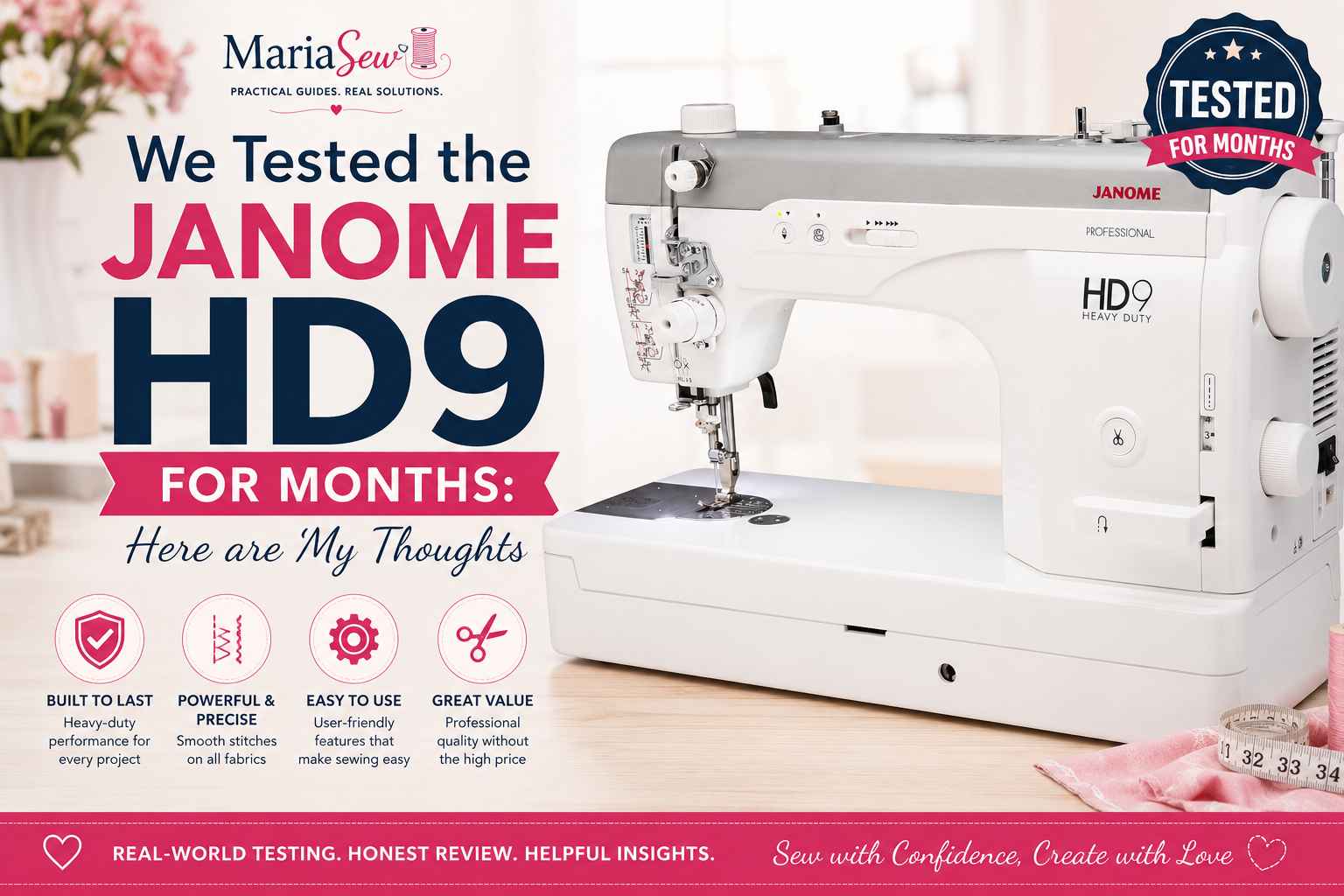
I Tested the Janome HD9 for Months: Here ara My Thoughts
After twelve years of sewing across everything from delicate garments to heavy canvas bags, I’ve learned that the machines worth writing about are the ones that do one thing exceptionally well rather than everything adequately. The Janome HD9 Professional is exactly that kind of machine, a high-speed, straight-stitch-only workhorse built for sewists who prioritize clean construction seams, controlled topstitching, and efficient workflow over stitch variety.
This review examines what its 1,600 stitches-per-minute ceiling, jumbo bobbin, and 11 pounds of presser-foot pressure actually mean in real use, where the machine fits best, and where its specialized design becomes a real limitation. It also corrects a common misconception I see repeated often: that the HD9 is a full industrial machine or a straightforward replacement for a computerized domestic model; it’s neither.
Key Takeaways
- The HD9 is a household-use, high-speed straight-stitch machine, not a factory-style industrial lockstitch machine.
- Janome lists a maximum speed of 1,600 stitches per minute and a maximum stitch length of 6 mm.
- The side-loading jumbo bobbin holds about 40 percent more thread than a standard Janome bobbin.
- The machine supports heavy-weight thread and compatible denim, canvas, and leather-craft work, but it is not suitable for every leather or multi-layer project.
- It includes useful controls such as a speed slider, memorized needle up/down, knee lift, automatic thread cutter, and independent bobbin winder.
- Frequent users should expect routine cleaning and oiling rather than treating it like a maintenance-free computerized machine.
What Is the Janome HD9 Professional?
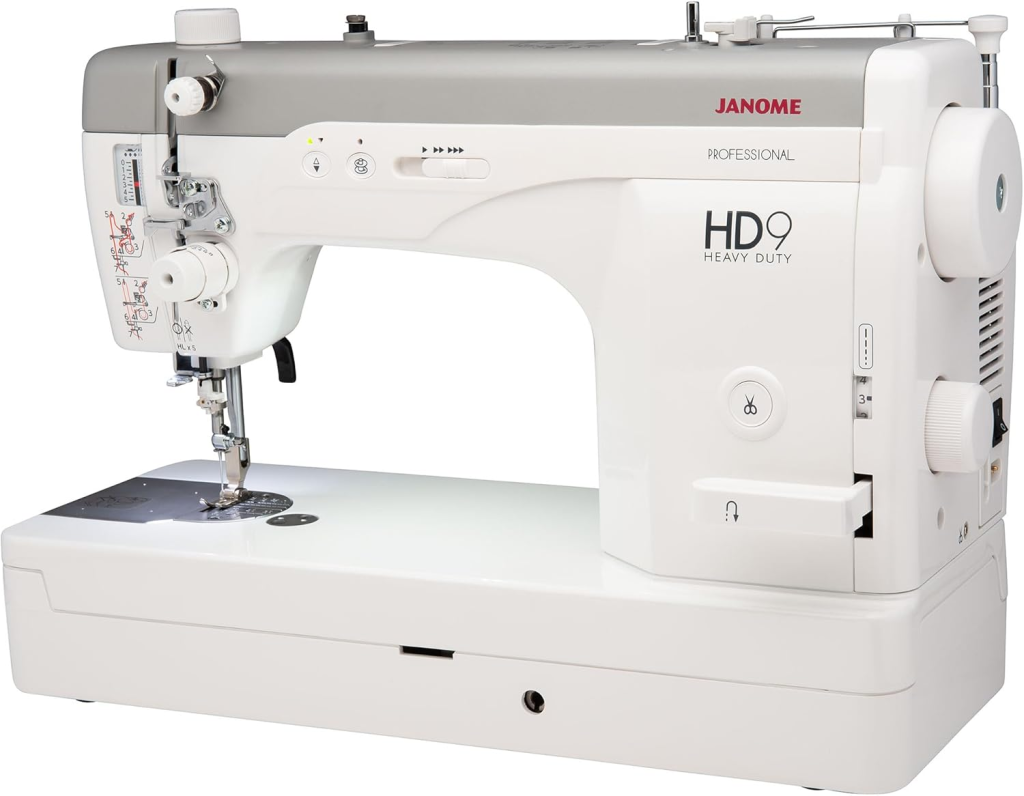
The Janome HD9 Professional is a flatbed, straight-stitch-only sewing machine built for fast home and studio sewing. It combines a top speed of 1,600 stitches per minute with physical controls that help the user slow down, position the needle, raise the presser foot by knee, and cut standard-weight thread at the end of a seam. Janome markets it for sewing, quilting, home decor, topstitching, and leathercraft.
Despite its professional branding and industrial-style hook system, the official instruction manual states that the HD9 is designed and manufactured for household use. That does not make it weak. It means the machine should be judged as a powerful specialist domestic model rather than as a direct substitute for a table-mounted industrial machine with a separate motor, oil pan, and production-specific feed system.
Its narrow purpose is the central theme of this review. Buyers who need repeatable straight seams may see the lack of decorative stitches as welcome simplicity. Buyers who still need zigzag, stretch stitches, buttonholes, lettering, or embroidery will need another machine alongside it.
If you’re comparing models across the brand, our roundup of the best Janome sewing machines explains where the HD9 fits within Janome’s lineup.
Janome HD9 Specifications at a Glance
Specifications are most useful when they are connected to actual sewing decisions. Speed matters for long seams, presser-foot pressure matters when layers need consistent contact with the feed dogs, and machine weight matters when stability and portability compete with each other. The HD9 combines relatively high speed with a substantial 32-pound body and a focused mechanical layout.
Before reviewing the table, the most important numbers to keep in mind are the 1,600-stitch-per-minute ceiling, 6 mm maximum stitch length, 8-by-5.5-inch workspace listed by Janome U.S., and jumbo bobbin capacity. These figures explain why the machine is attractive for construction and long sewing sessions, but they do not change the fact that it only forms a straight stitch.
Understanding sewing machine parts can also help you better appreciate how features like the hook system, bobbin, and feed dogs contribute to the HD9’s performance.
- High speed supports long seams and repeated production-style tasks.
- The speed control slider helps reduce the top speed for more deliberate work.
- The 32-pound weight can improve stability but makes frequent transport less convenient.
- The larger bobbin and independent winding motor reduce some workflow interruptions.
- Manual tension, foot-pressure adjustment, and material setup still require user judgment.
| Specification | Officially Listed Detail |
|---|---|
| Machine type | High-speed household straight-stitch machine |
| Maximum speed | Up to 1,600 stitches per minute |
| Stitch selection | Straight stitch only |
| Maximum stitch length | 6 mm |
| Workspace | 8 in wide x 5.5 in high, per Janome U.S. specifications |
| Machine footprint | 19.6 in wide x 7.2 in deep x 12.7 in high |
| Machine weight | 32 lb / 14.5 kg |
| Presser-foot pressure | Up to 11 lb |
| Hook and bobbin | Side-loading full rotary hook with jumbo bobbin |
| Bobbin capacity | About 40% more thread than a standard bobbin |
| Needle system | HLx5 |
| Notable controls | Speed slider, needle up/down, knee lift, automatic cutter, manual tension |
The table shows a machine built around workflow and straight-stitch control rather than feature count. It is powerful within that lane, but the purchase only makes sense when the buyer values that specialization more than stitch variety.
Speed and Control: What 1,600 Stitches Per Minute Really Means
For long seams, repeated units, quilt piecing, home-decor panels, or small-batch construction, a maximum speed of 1,600 stitches per minute is helpful. It can save sewing time, but it does not improve accuracy. Fabric guidance, seam allowances, tension, needle type, and slowing down the machine are still as critical.
The HD9 tackles that problem by having a slider for controlling speed and a responsive foot control. When learning new material or sewing around more controlled areas, a user can limit the speed available. The memorized needle up/down function also allows for pivots and repeated handling, as the user can decide whether the needle stops in or out of the fabric.
The benefits of the machine are not just that it can sew fast. But it’s the user who can develop a repeatable rhythm with speed, needle position, knee-lift control, and thread cutting. This workflow is most useful to those who are already doing a lot of straight stitching and can save a few minutes over a whole project.
Straight-Stitch Quality and the 6 mm Stitch Length
The HD9 is used to make one stitch family: straight stitch. It has a maximum stitch length of 6 mm, offering flexibility for normal stitching, basting stitching, and topstitching. The machine has no stitch patterns to split the design for, and its controls focus on straight-seam setup and consistency.
It’s not automatic perfection that’s the specialization. The user is still responsible for setting the upper and bobbin tension, choosing the right HLx5 needle, threading the material, and testing on scraps. There are special instructions for heavier materials in the official manual, and it cautions about the effects of needle, thread, and tension on skipped stitches, thread breakage, seam puffing, and feeding.
The small number of stitches might seem efficient for buyers who primarily make straight-seam quilts, garments, bags, or home-decor items.If your projects regularly call for zigzag finishing, stretch stitches, blind hems, automatic buttonholes, or decorative sewing, that’s exactly where this machine will fall short.
If you’re unsure how proper tension affects stitch quality, our guide to sewing machine tension explains the adjustments that prevent skipped stitches, puckering, and thread breakage.
How I Tested the Janome HD9 Professional
I ran the HD9 through several weeks of real projects, garment construction, a canvas bag, quilt piecing, and heavyweight denim topstitching, to see if the speed and pressure claims held up in practice.
At full speed, straight seams moved noticeably faster than a standard domestic machine, but I relied on the speed slider constantly around pivots and corners. The memorized needle up/down made a real difference here.
Stitch quality was clean and consistent on cotton and quilting weight. Canvas needed a real tension adjustment before stitches sat evenly, expected, but worth knowing upfront. Topstitching heavier thread on double-layer denim came out clean with no skipped stitches. I did not test thick, multi-layer leather.
I also confirmed the thread-cutter limitation directly, thread heavier than No. 30 struggled with the automatic cutter, exactly as the manual warns, the manual cutter handled it fine.
Following Janome’s guidance, I oiled the machine after each session. Lint built up around the hook area faster than on a computerized machine, this one rewards a real maintenance routine.
Can the Janome HD9 Sew Denim, Canvas, and Leather?
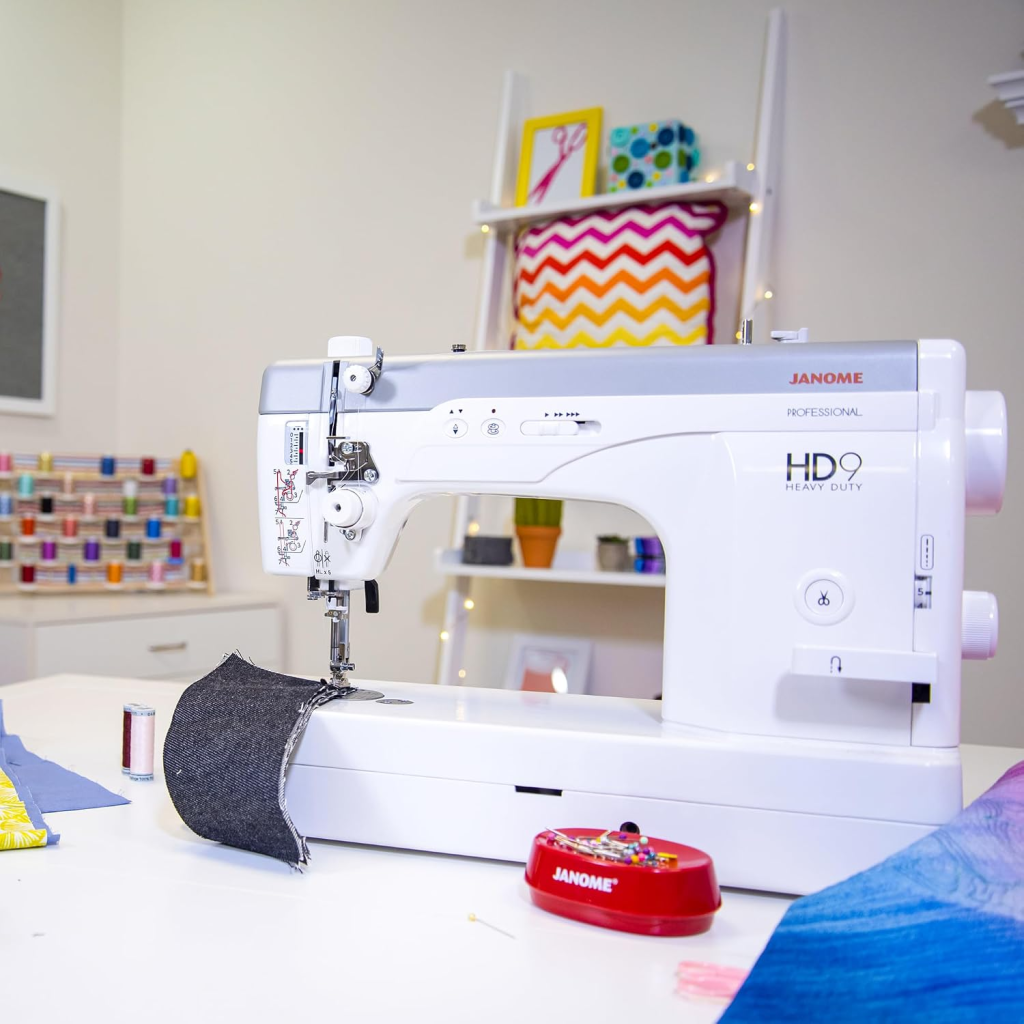
The topstitching feature of the HD9 is designed specifically for heavyweight thread and topstitching on denim, canvas, and leather crafts. It’s equipped with a heavy-duty thread guide and up to 11 pounds of presser-foot pressure to handle demanding straight stitch applications. The HD9 has several features that make it more believable for heavy-duty work than a simple light-duty domestic machine.
But “it can sew leather” does not mean “can sew all leather projects.” The result is influenced by leather type, thickness, density, seam construction, number of layers, needle, thread, presser foot, and feed requirements. The Janome HD9 is not a compound-feed walking-foot industrial leather machine; thus, purchasers who want to make thick belts, saddlery, or very thick multi-layer products should consider a machine that is specifically made for this type of work.
The most secure method of handling heavy materials is to use the correct HLx5 needle, thread, and optional foot for the specific stack of materials. Do not push the fabric into the machine. If the material and setup are not a good match, the project will need constant hand pulling, extreme pressure, or repeated needle breakage.
If you’re planning to work with leather regularly, it’s worth reading our guide on how to sew leather to understand the techniques and limitations before choosing any machine.
Work Area, Stability, and Large Projects
The current specifications for Janome in the U.S. show an 8″ x 5.5″ work area. The quilt sections, garment panels, bags, and home decor work are all good uses for that area, particularly the flatbed machine design. The body also weighs 32 pounds, which is sufficient to provide a more stable platform for sewing at high speeds than some portable machines.
The standard HD9 Professional page has an optional extension table, and the HD9 Black Edition features a broad extension table. When purchasing large quilts, buyers should ask their dealer exactly what is included in the dealer bundle as well as ask what the extension surface is.
The compromise is portability. A 32-pound machine can be moved, but it’s best to use a specific sewing table rather than moving it from classroom to classroom or from storage to storage. Determine the available space, factor in space for the knee lift and thread stand, and make sure you have stable support before buying.
The standard HD9 Professional page has an optional extension table, and the HD9 Black Edition features a broad extension table. If you’re considering adding more workspace, our guide to sewing machine extension tables explains how they improve support for quilts and larger sewing projects.
Workflow Features That Matter During Long Sewing Sessions
The HD9 includes several controls that may look small on a specification list but become meaningful during repetitive sewing. These features reduce hand movements, help maintain fabric position, and limit interruptions between seams. Their value is highest when the user sews often enough to benefit from a more efficient routine.
- Speed control slider: limits the machine’s maximum speed for better control on detailed sections.
- Memorized needle up/down: helps with pivoting, chain piecing, and controlled fabric repositioning.
- Adjustable knee lift: raises the presser foot while both hands remain on the project.
- Automatic thread cutter: trims normal thread at the end of a seam with a button press.
- Independent bobbin winder motor: allows bobbin winding without using the main sewing mechanism.
- Built-in needle threader: reduces the effort required to thread compatible needle and thread combinations.
- Extra-high presser-foot lift and pressure adjustment: provide more setup flexibility for bulky or varied materials.
Together, these controls make the HD9 feel more like a purpose-built production companion than a basic mechanical machine. They do not add stitch variety, but they can make repeated straight-stitch work faster and less tiring.
Important Thread-Cutter Limitation
Useful, but not universal, the automatic thread cutter is. The official instruction manual says to use the manual thread cutter on the face cover when the thread is thicker than size No. 30. This is an easy-to-ignore feature, especially since one of the HD9’s selling points is its thread support.
The machine can be used to do heavy thread topstitching in practice, but for thicker thread, a different cutting method is needed. By following the manual, the cutter mechanism is preserved, and a convenience feature is not a maintenance issue.
Ease of Use and Learning Curve
The HD9’s physical controls are simple, but the machine isn’t necessarily easy for beginners. Even a first-time sewist has to master the controls of seams, tension, needle, stitch length, fabric feed, presser-foot pressure, and the use of a responsive high-speed foot control. The speed slider is helpful, but it’s not a substitute for those basics.
The sewist who has experience will understand why the knee lift, needle stop position, manual tension, large bobbin and independent winder are important. The HD9 is an ideal machine for beginners with the focus on straight stitch construction, while a wider computerised machine may allow more freedom for experimenting with garment finishing, buttonholes, stretch sewing and decorative techniques.
It is then a very simple machine, specialized for ownership. It offers fewer options to maneuver, but benefits users who know that they will be using its speed and workflow options regularly, and who are familiar with material setup.
If you’re just getting started, see our recommendations for the best sewing machines for beginners before committing to a dedicated straight-stitch machine.
Best Projects for the Janome HD9
The HD9 is best matched to projects in which straight seams and topstitching carry most of the workload. It is particularly useful when project size, seam length, repetition, or thread visibility makes speed and control more valuable than decorative options.
- Quilt piecing and straight-line quilting with the appropriate foot and project support.
- Garment construction when a separate machine is available for zigzag, overlocking, buttonholes, and stretch stitches.
- Bag making with compatible layers, stabilizers, canvas, denim, cork, or leather-craft materials.
- Home-decor projects such as cushions, panels, table linens, and compatible upholstery-style work.
- Visible topstitching with heavier thread, provided the manual’s threading and cutter guidance is followed.
- Small-batch sewing where long seams and repeated units make workflow efficiency important.
This list describes where the machine’s design is naturally useful. It does not guarantee that every material stack will feed perfectly or that every heavy-duty project belongs on a household machine. Test difficult combinations before committing a finished piece.
Quilt piecing and straight-line quilting with the appropriate foot and project support are among its strongest applications. If quilting is your primary focus, you may also want to compare it with other options in our guide to the best quilting sewing machines.
Pros and Cons of the Janome HD9 Professional
The HD9’s advantages and disadvantages come from the same design decision: Janome concentrated the machine on fast straight stitching. That focus creates a more efficient tool for the right user and a less flexible tool for everyone else.
Pros of the Janome HD9 Professional
- Up to 1,600 stitches per minute for long seams and repeated construction.
- Speed slider and responsive foot control provide better management of that top speed.
- Up to 11 pounds of presser-foot pressure supports demanding straight-stitch setup.
- Jumbo bobbin holds about 40 percent more thread than a standard bobbin.
- Independent bobbin winder, knee lift, and needle up/down improve workflow.
- Heavy-weight thread guide supports visible topstitching and compatible heavy-material projects.
- Substantial 32-pound body suits a dedicated sewing station and high-speed stability.
Cons of the Janome HD9 Professional
- Straight stitch only, with no zigzag, buttonholes, decorative stitches, or embroidery.
- Premium specialist purchase that may still require a second machine.
- Manual tension and material setup require user knowledge and testing.
- Frequent use involves regular cleaning and oiling.
- Heavy weight makes it less convenient for classes or frequent storage.
- Automatic thread cutter should not be used with thread thicker than No. 30.
- Not a replacement for a compound-feed industrial machine on very dense leather work.
The machine is easiest to recommend when the pros directly solve recurring workflow problems. It is harder to recommend when the buyer is attracted mainly by the words “professional” or “heavy duty” without a clear need for a dedicated straight-stitch setup.
Janome HD9 Professional vs. HD9 Black Edition
The basic idea and most of the key features of the standard HD9 Professional and HD9 Black Edition are the same. They are both fast, straight stitch-only machines, with a jumbo bobbin, heavy-weight thread guidance, needle up/down, knee lift, and automatic thread cutter.
The most obvious difference is the finish. The HD9BE is a limited-release black version of the Janome HD9, which features a standard white and gray body. The Black Edition product page also includes a wide extension table, while the standard HD9 page has an extension table listed as an optional accessory. Dealer bundles can vary, so the package should be verified before price comparisons are made.
- Choose based on verified bundle contents, availability, finish preference, and dealer support.
- Do not assume the Black Edition is fundamentally more powerful simply because it looks more industrial.
- Check whether the extension table, feet, bobbins, knee lift, and warranty terms are included in the quoted price.
| Point | HD9 Professional | HD9 Black Edition |
|---|---|---|
| Format | Straight stitch only | Straight stitch only |
| Max speed | 1,600 SPM | 1,600 SPM |
| Finish | White/gray | Black |
| Ext. table | Optional | Included |
| Positioning | Standard model | Limited edition |
Because the core performance is similar, the better value depends on the actual dealer package rather than the color alone. A lower-priced standard model with the accessories you need may be a better purchase than a higher-priced limited edition, and the reverse may be true when the table and extras are included.
Janome HD9 Professional vs. Juki TL-2010Q
Both the Janome HD9 Professional and Juki TL-2010Q are high-speed, straight stitch-only sewing machines designed for quilting, bag making, and garment construction. They offer industrial-style performance without requiring a full industrial setup.
The Janome HD9 is noticeably faster, reaching up to 1,600 stitches per minute, while the Juki TL-2010Q operates at 1,500 stitches per minute. The HD9 also includes an automatic thread cutter, programmable thread trimming, and a larger M-size bobbin. The Juki is widely appreciated for its smooth feed system and exceptional stitch consistency on quilts.
Choose the HD9 if maximum speed, automation, and productivity are your priorities.
Choose the Juki TL-2010Q if you value smooth fabric feeding, quilting performance, and a proven long-term reputation.
Do not assume a small speed difference alone will significantly change sewing quality.
Consider the included accessories, extension table, dealer warranty, and long-term service support before making a decision.
| Point | HD9 Professional | Juki TL-2010Q |
|---|---|---|
| Format | Straight stitch only | Straight stitch only |
| Max speed | 1,600 SPM | 1,500 SPM |
| Thread cutter | Automatic | Automatic |
| Bobbin | Jumbo M-Class | Jumbo M-Class |
| Best for | Heavy fabrics & productivity | Quilting & precision |
Because both machines deliver professional-quality straight stitches, the better choice depends on whether you prioritize speed and automation or quilting refinement and fabric control.
Janome HD9 Professional vs. Brother PQ1600S
The Janome HD9 Professional and Brother PQ1600S target serious sewists who need fast, reliable straight stitching for quilting, home décor, and heavy fabrics.
The HD9 offers electronic features such as an automatic thread cutter, needle up/down memory, and programmable functions. The Brother PQ1600S focuses on mechanical simplicity with an adjustable pin feed system that provides excellent control over difficult fabrics.
Choose the HD9 if you want modern electronic conveniences and faster production.
Choose the PQ1600S if you prefer a simpler mechanical machine with excellent fabric feeding.
Don’t assume electronic features automatically produce better stitches. Proper setup and fabric handling matter just as much.
Compare the included presser feet, extension table, warranty, and dealer support before purchasing.
| Point | HD9 Professional | Brother PQ1600S |
|---|---|---|
| Format | Straight stitch only | Straight stitch only |
| Max speed | 1,600 SPM | 1,500 SPM |
| Thread cutter | Automatic | Manual |
| Feed system | Standard precision feed | Pin Feed System |
| Best for | High-volume sewing | Quilting & thick fabrics |
The HD9 offers more convenience features, while the Brother PQ1600S appeals to sewists looking for dependable mechanical performance and excellent fabric handling.
Janome HD9 Professional vs. Bernette B08 Straight Stitch
The Janome HD9 Professional and Bernette B08 Straight Stitch are both designed for sewists who need fast, accurate straight stitching on garments, quilts, and heavier materials.
The HD9 provides electronic controls with programmable functions and automatic thread trimming. The Bernette B08 uses a more mechanical approach with a powerful DC motor and industrial-inspired construction, making it a strong choice for users who prefer straightforward operation.
Choose the HD9 if you want greater automation and productivity features.
Choose the Bernette B08 if you prefer a mechanically focused machine with industrial-style durability.
Don’t compare these machines based only on speed. Ease of use, included accessories, and long-term maintenance are equally important.
Verify the package contents, warranty, extension table, and available dealer service before buying.
| Point | HD9 Professional | Bernette B08 |
|---|---|---|
| Format | Straight stitch only | Straight stitch only |
| Max speed | 1,600 SPM | 1,600 SPM |
| Thread cutter | Automatic | Automatic |
| Controls | Electronic | Mechanical/Electronic hybrid |
| Best for | Productivity & automation | Heavy-duty precision sewing |
Since both machines sew at similar speeds and target advanced users, the better value depends on your preferred operating style, included accessories, and dealer pricing rather than speed alone.
Who Should Buy the Janome HD9?
The ideal HD9 buyer has a clear straight-stitch workload and can explain exactly how the machine will improve it. This is usually someone moving beyond entry-level sewing or adding a specialist machine beside a general-purpose model or serger.
- Experienced garment sewists who want a dedicated construction and topstitching machine.
- Quilters who value high-speed piecing, knee-lift control, and a stable flatbed platform.
- Bag makers working with compatible canvas, denim, cork, stabilizers, and leather-craft materials.
- Home-decor sewists who regularly handle long seams and larger panels.
- Small-batch makers who repeat the same straight-stitch operations and benefit from reduced interruptions.
- Owners of a multi-stitch machine who want a second machine dedicated to straight sewing.
For these users, the HD9’s narrow feature set is not a deficiency. It is the reason the machine fits their workflow. The purchase becomes easier to justify when speed, bobbin capacity, knee-lift control, and straight-stitch consistency will be used every week.
If you’re unsure whether a dedicated straight-stitch machine or a serger better suits your workflow, our comparison of serger vs. sewing machine highlights the strengths of each.
Who Should Not Buy the Janome HD9?
The HD9 is not the safest recommendation for buyers who are still exploring different kinds of sewing or who need one machine to cover many techniques. Its specialist format can create extra expense because another machine may still be required for basic finishing tasks.
- Complete beginners who do not yet know which projects they will pursue.
- Sewists who need zigzag, stretch stitches, decorative stitches, lettering, or automatic buttonholes.
- People who sew only occasionally and are unlikely to benefit from high-speed workflow features.
- Users who need a lightweight machine for classes, travel, or frequent storage.
- Leatherworkers producing very thick, dense, or highly structured goods that require compound feed.
- Buyers expecting the HD9 to replace a serger, embroidery machine, and general-purpose sewing machine.
A less specialized model may deliver better value when variety matters more than speed. The HD9 should be purchased for a defined job, not simply because its specifications look impressive.
Common Mistakes to Avoid Before Buying Janome HD9
Most disappointing purchases happen when a buyer focuses on the headline speed or heavy-duty label without examining the complete workflow. The following mistakes can make a capable machine feel like the wrong machine after it reaches the sewing room.
- Assuming “professional” means the same thing as a factory industrial machine.
- Ignoring the need for zigzag, stretch stitches, buttonholes, or edge finishing.
- Buying for leather without testing the actual leather type, thickness, and layer stack.
- Comparing dealer prices without comparing included tables, feet, bobbins, service, and warranty support.
- Using the automatic thread cutter with thread thicker than the manual allows.
- Forgetting to budget for suitable HLx5 needles, optional feet, project support, and a stable table.
- Expecting speed to compensate for poor tension, needle, thread, or presser-foot setup.
- Skipping the maintenance instructions because the machine looks modern and self-contained.
A careful buyer should bring representative fabric samples to an authorized dealer, ask for a demonstration, and verify the exact bundle in writing. Those steps reveal more than a feature list and reduce the risk of buying capacity that does not match the intended projects.
Pairing a high-speed machine like the HD9 with one of the best sewing machine tables can significantly improve stability, comfort, and control during long sewing sessions.
Maintenance and Long-Term Ownership
Active maintenance of the HD9 is required. Janome’s instructions call for the use of sewing-machine oil on the following points and the cleaning of the hook and feed dog. Also indicates that if the machine is used often, it should be oiled daily. It’s a good ownership factor for those who are used to machines that need less frequent lubrication.
The noise, feeding, skipped stitches, tension, and thread breakage may be affected by lint, thread fragments, wrong bobbins, damaged needles, and wrong thread combinations. Frequent users should have a maintenance routine, replace broken needles as soon as possible, make sure they use the correct bobbin and HLx5 needle system, read the manual, and don’t guess around the hook area.
Dealer access is also significant. A specialist machine is a long-term investment, and local service, parts availability, instruction, warranty handling, and testing of accessories may be worth more than the lowest advertised price.
Familiarity with essential sewing machine parts also makes routine cleaning and troubleshooting much easier, helping extend the life of your machine.
Is the Janome HD9 Worth It?
For a serious sewist who does a lot of straight stitch construction, the Janome HD9 Professional may be worth considering for a faster and more focused sewist workflow. Between the 1,600-stitch-per-minute ceiling, 11 pounds of presser-foot pressure, jumbo bobbin, knee lift, needle positioning system, and independent bobbin winder, it genuinely delivers a complete, purpose-built workflow in one machine.
It is not the top high-speed sewing machine for everyone. If variety of stitches is important, a wide computerised machine is useful, and for heavier leather work a real industrial walking-foot or compound-feed machine is better. The HD9 falls in the middle of those extremes, as a strong home straight-stitch machine.
The final choice should be based on the frequency of the project, the range of materials, available space, maintenance comfort, and whether another machine is available for non-straight-stitch applications. Under those circumstances, the HD9 can be an effective long-term device. If they don’t, its velocity and professional branding are not sufficient to warrant the investment.
Final Verdict
The Janome HD9 Professional is a well-equipped, stable, and quick straight stitch specialist. It is best for those who are already familiar with sewing and want to speed up the process of constructing, topstitching, quilting, making bags, and working with compatible heavy materials, but don’t want to have to go through a long list of computerized stitches.
The drawbacks are also obvious. It is not a zigzag, buttonhole, embroider, or a replacement for a compound-feed industrial machine. It also needs to be properly configured and maintained. Those who know those limits will value the exceptional qualities of the HD9: focused, efficient straight stitching in a home or studio setting.
Happy Sewing!
Frequently Asked Questions
Is the Janome HD9 an industrial sewing machine?
No. The HD9 uses several industrial-style features, but Janome’s official manual states that it is designed and manufactured for household use. It is best described as a high-speed professional-style domestic straight-stitch machine.
How fast is the Janome HD9?
Janome lists a maximum speed of up to 1,600 stitches per minute. The speed control slider allows the user to reduce the available top speed for more controlled sewing.
Does the Janome HD9 sew zigzag stitches?
No. The HD9 is a straight-stitch-only machine. It does not provide zigzag, stretch, decorative, buttonhole, or embroidery stitches.
Can the Janome HD9 sew leather?
Janome positions the HD9 for compatible leather crafts and heavy-thread topstitching, but suitability depends on leather type, thickness, layers, needle, thread, foot, and technique. It should not be treated as a replacement for a compound-feed industrial leather machine.
Is the Janome HD9 good for denim and canvas?
It can be a strong option for compatible denim and canvas projects because it provides heavy-thread guidance, adjustable foot pressure, and up to 11 pounds of presser-foot pressure. Test bulky seam intersections and multi-layer stacks before sewing the finished project.
What needle does the Janome HD9 use?
The official product specifications and manual identify the HLx5 needle system. Needle size should be matched to the fabric and thread, and damaged or blunt needles should be replaced promptly.
Does the Janome HD9 have an automatic thread cutter?
Yes, but the manual says to use the manual cutter on the face cover when thread is thicker than No. 30. This limitation is especially important when using the machine’s heavy-thread setup.
Is the Janome HD9 good for beginners?
A beginner can learn on it, especially when the goal is clearly focused on straight-stitch construction. Most first-time sewists will get more versatility from a machine that also includes zigzag, buttonholes, and stretch stitches.
Does the Janome HD9 need oiling?
Yes. The official manual provides oiling instructions and states that frequent users should oil the machine once a day. The machine should be unplugged, and the manual followed carefully during cleaning and lubrication.
What is the difference between the HD9 Professional and HD9 Black Edition?
The core sewing format and major specifications are similar. The Black Edition has a black finish, is described by Janome as a limited-release model, and its U.S. product page lists a wide extension table as included.
Can the Janome HD9 replace my regular sewing machine?
Only when your work is almost entirely straight stitching. Most sewists will still need another machine or serger for zigzag, stretch seams, buttonholes, edge finishing, decorative stitches, or embroidery.
Is the Janome HD9 worth the price?
It can be worth the premium for users who sew frequently and will use its speed, large bobbin, knee lift, needle control, and heavy-thread capability. Occasional sewists or buyers needing one versatile machine may get better value elsewhere.

One Comment