Techsew 810 Review 2026: Is This Post-Bed Machine Worth It?
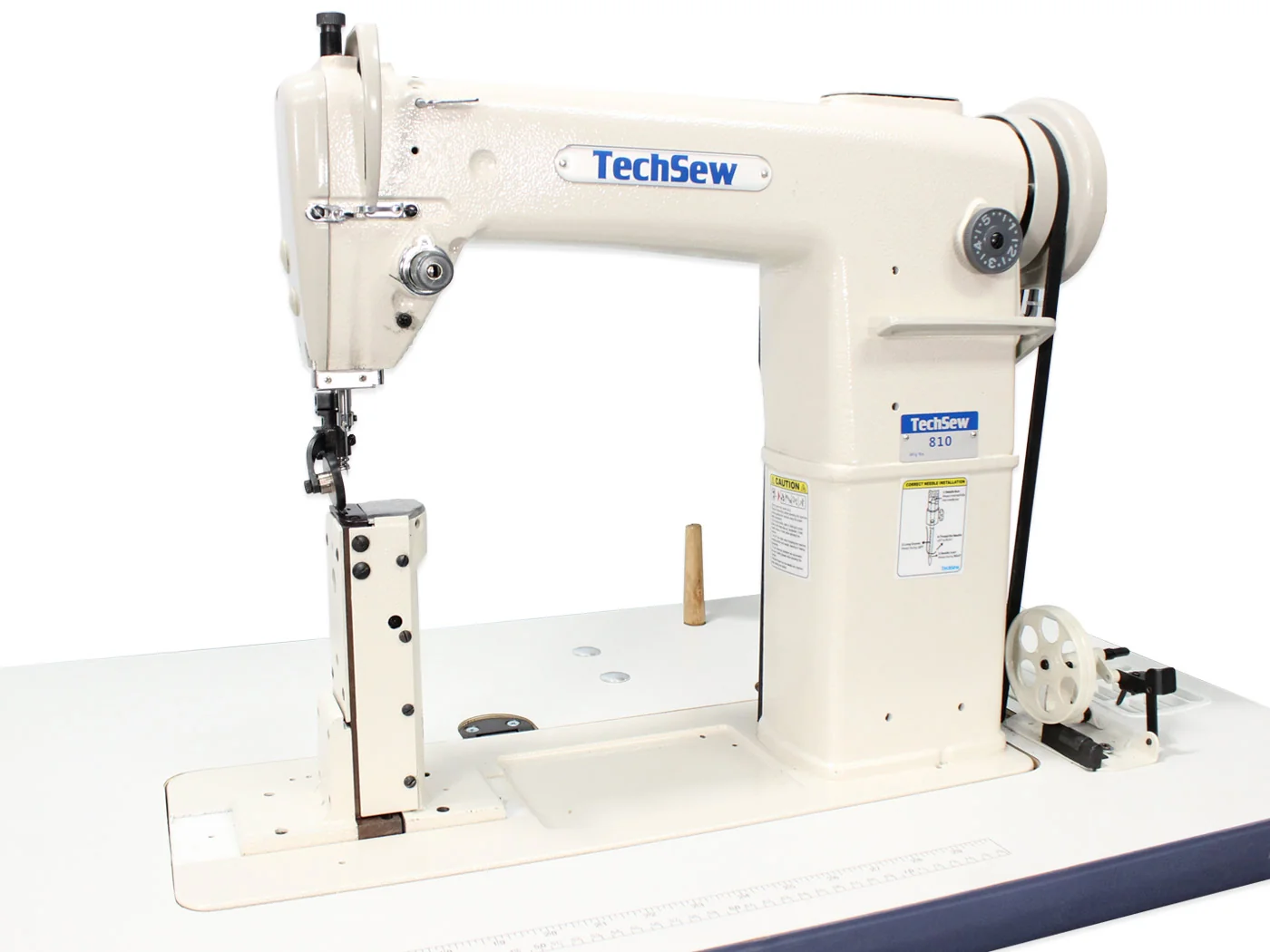
The Techsew 810 is a specialized industrial post-bed sewing machine designed for shaped work where a normal flatbed can make edges, curves, uppers, patches, and three-dimensional pieces awkward to position.
Its core setup combines a 7-inch post, a roller-foot/drop-feed system, 3/8-inch presser-foot clearance, up to 5/16-inch sewing capacity, reverse, 1-5 mm stitch-length adjustment, and a 750W SmartServo motor with speed reduction for very slow control. Techsew positions it for light-to-medium leather plus vinyl, canvas, denim, synthetics, footwear, patch sewing, bags, accessories, and garment repairs, so it should not be confused with a heavy harness or saddle stitcher.
In this review, I focus on what the 810 actually does well, where its roller-foot feed is different from a compound walking foot, how it compares with other industrial formats, and which alternative makes more sense if your leather is substantially thicker.
Quick Verdict: What Is the Techsew 810 Best Used For?
The Techsew 810 makes the most sense for shoemaking, patches, light leather goods, curved accessories, and repair work where post-bed access and precise edge control matter more than heavy-thread capacity. I like its 7-inch post, roller foot, reverse, complete table setup, and SmartServo/speed-reducer control, but I would not buy it for saddlery, thick holsters, or repeated 1/2-inch leather stacks. If your work is genuinely light to medium and three-dimensional, the 810 is a focused tool rather than an underpowered heavy-duty machine.
Key Takeaways
The standard 810 is $2,195 on Techsew’s US site (about $3,099 through SewingMachinesPlus but with Assembled Table and Motor), though pricing can change
- The 7-inch post bed is ideal for shoes, bags, patches, and curved pieces.
- The roller foot and drop feed suit light-to-medium materials but not very thick layers.
- It handles leather, vinyl, canvas, denim, and fabrics up to 5/16 inch.
- The 750W SmartServo and speed reducer provide excellent slow-speed control.
- The #23 to #92 thread range suits light leather goods, footwear, and apparel.
- It comes as a complete workstation with table, motor, lamp, and accessories.
- The 810 PRO adds needle positioning, an edge guide, and extra accessories.
- It is best for shaped, light-to-medium work rather than heavy leather or flat upholstery.
The 810 is therefore best judged by how often you sew shaped, light-to-medium work. If your weekly jobs are mostly flat upholstery panels or very thick leather, a different feed system and bed style will make more sense.
What Is the Techsew 810 Post-Bed Roller-Foot Industrial Sewing Machine?
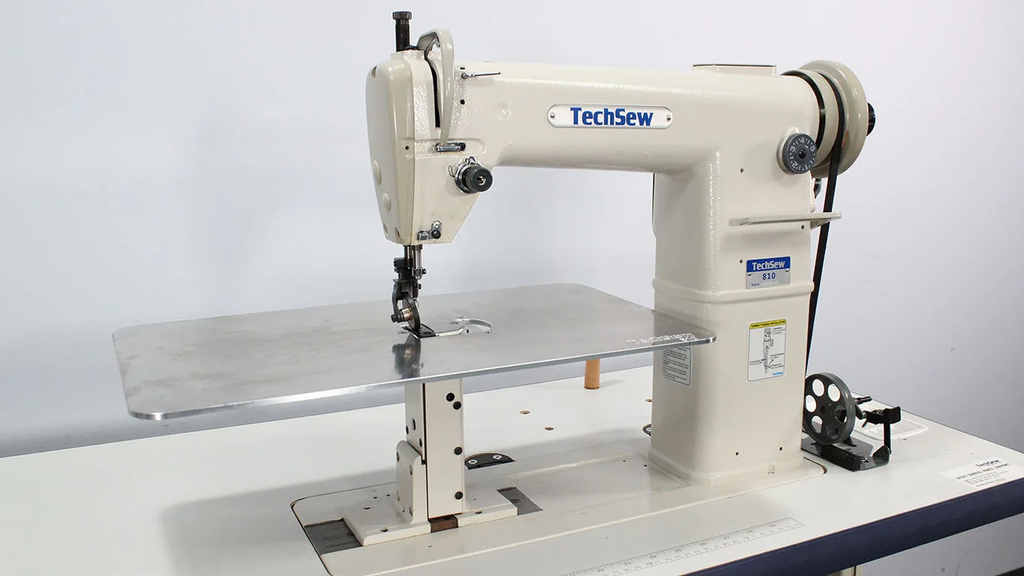
The Techsew 810 is a single-needle industrial lockstitch machine built around a raised post rather than a broad flat sewing bed. The post supports the needle and feed area while leaving the project free to hang and rotate around it, which is especially useful on shoe uppers, bags, patches, curved accessories, and other three-dimensional work.
Its roller foot applies pressure through a narrow rolling contact point while the lower feed system advances the material. That format improves visibility and edge access, but it is fundamentally different from a compound walking-foot system that coordinates the needle, feed dog, and alternating feet to pull thick layers together.
How I Test Industrial Sewing Machines at MariaSew
I personally use the sewing machines I recommend before I publish a verdict, and industrial machines need a different test routine from normal domestic models. For a post-bed machine like the Techsew 810, I care less about stitch variety and much more about feed control, visibility, slow-speed response, edge accuracy, reverse, tension consistency, and how naturally the work turns around the post.
I test light leather, vinyl, canvas, denim, coated material, layered edges, tight curves, patches, and three-dimensional pieces that force me to reposition the work. I start slowly, vary stitch length, check reverse, sew close to an edge, inspect both sides of the seam, and watch whether the roller foot marks or shifts the surface. Also compare the same type of job against cylinder-arm and compound-feed machines because the best machine is the one whose geometry reduces handling friction.
- Low-speed control. I test starts, stops, corners, one-stitch corrections, and whether the servo/speed-reducer combination remains predictable at the bottom of the pedal.
- Edge and curve accuracy. I follow curved samples and narrow edges to see whether the roller foot gives enough visibility and steering control.
- Layer feeding. I watch for top-layer creep and compare stable material with slippery or laminated stacks, because the 810 is not a triple-feed walking-foot machine.
- Material range. I stay within the documented light-to-medium leather and 5/16-inch fabric capacity rather than forcing the machine into heavy saddlery work.
- Stitch formation. I inspect the top and underside for balanced locking, skipped stitches, inconsistent length, and thread damage.
- Workshop ownership. I consider table footprint, threading, bobbin access, lubrication, motor adjustment, technical support, parts, and whether a specialist post bed will actually earn its floor space.
MariaSew publishes the same hands-on standard across its sewing coverage; Maria personally tests recommended sewing machines before publication.
Techsew 810 Features: What Each One Does in Real Work
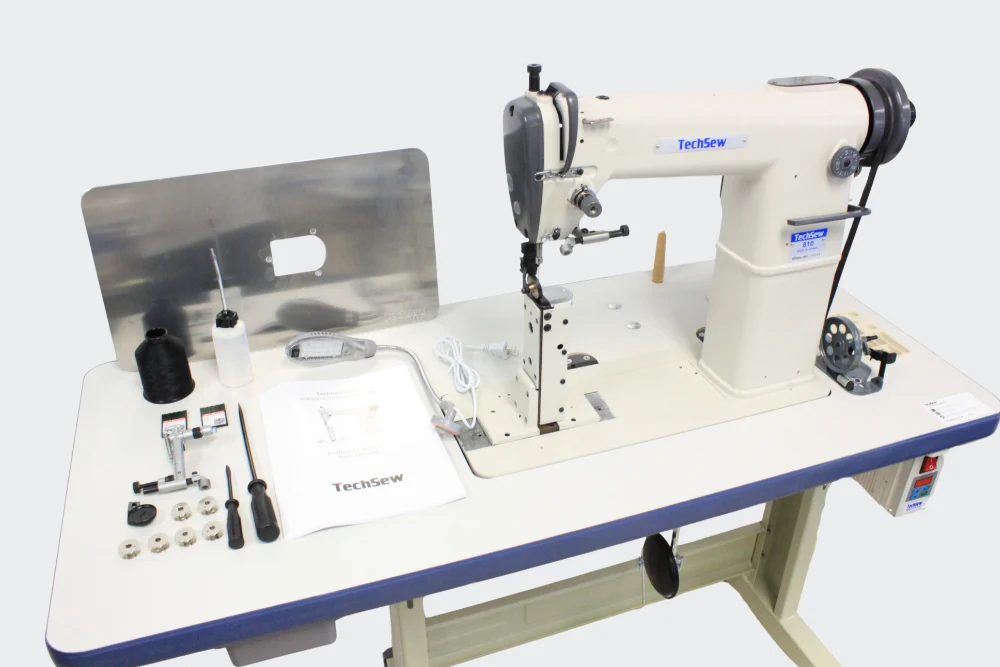
The 810 is not feature-heavy in the domestic-machine sense. Its value comes from a small number of industrial features that directly change how shaped work sits under the needle.
7-Inch Post Bed
The 7-inch post creates clearance around the sewing area so I can rotate footwear, curved accessories, patch work, and three-dimensional pieces without flattening them onto a conventional table. This is the main reason to choose the 810 over a flatbed industrial lockstitch machine.
Roller Foot / Drop-Feed System
Techsew classifies the 810 as roller foot with drop feed. The narrow roller improves visibility near edges and helps guide curves, but it does not give the same synchronized layer control as a needle-feed or compound walking-foot machine.
3/8-Inch Presser-Foot Clearance
The published 3/8-inch clearance gives room to position bulky seams and multilayered work beneath the roller foot. Clearance is not the same as rated sewing capacity, so I still stay inside the documented 5/16-inch material limit.
Up to 5/16-Inch Sewing Capacity
Techsew has 5/16 inch as the sewing capacity for medium-to-heavy fabrics, while leather is described as light to medium weight. That specification makes the 810 a footwear and light-leather specialist rather than a saddle or harness machine.
SmartServo Motor With Speed Reducer
The current standard configuration uses a 750W, 1HP, 110V SmartServo motor with speed reduction. Techsew says this setup can bring the machine below one stitch per second, which is exactly what I want for corners, starts, patches, and precision curves.
Reverse Feed
Reverse makes it easy to reinforce the beginning and end of a seam without turning the work. On shaped pieces, that is more convenient than repositioning the entire project just to lock the stitching.
1-5 mm Stitch-Length Adjustment
The 810 adjusts from roughly 25 stitches per inch down to 5 stitches per inch, equivalent to about 1-5 mm. That gives me a useful range for fine leatherwork, patches, apparel details, and visible topstitching.
Needle System and Size Range
Techsew has 135×5 needles in sizes #11 to #21 for the standard 810. The PRO page also references 135×8 compatibility; I would confirm the exact needle system supplied with the machine before ordering specialty points.
Thread Range #23 to #92
The published thread range tops out at #92, which is appropriate for light-to-medium industrial sewing but far below the #207-#415 thread common on heavy leather stitchers. That limit is one of the clearest indicators of the 810’s intended job range.
Standard G-Style Bobbin
Techsew’s current 810 family literature uses a standard G-style bobbin. It offers normal industrial capacity, but heavy cylinder-arm machines with U-style or barrel bobbins are better suited to long runs with very thick thread.
Complete Table and Workstation
The 810 package includes the table, motor, LED lamp, bobbin winder, thread stand, accessories, and manual. For a first industrial machine, buying a complete matched station is easier than sourcing a head, motor, belt, stand, and wiring separately.
Technical Support and Warranty
Techsew consistently advertises free lifetime technical support. Techsew’s US product page lists a limited lifetime warranty and free lifetime technical support. Read the written terms for your order before you buy.
Techsew 810 Full Specifications
The feature explanations above show how the machine behaves in the workshop. The table below collects the current Techsew specifications that matter most when matching needles, thread, thickness, table space, and power.
I treat the specifications as operating boundaries, not targets to exceed. Industrial leather and coated materials vary dramatically in density, surface finish, layer count, adhesive, thread, and seam construction, so a scrap test is still essential.
| Feature / Specification | Current Detail | Why It Matters |
|---|---|---|
| Machine type | Single-needle industrial post-bed lockstitch | Specialized shaped and three-dimensional work |
| Feed type | Roller foot / drop feed | Good visibility and edge control; not compound feed |
| Post height | 7 in | Room to maneuver footwear and shaped pieces |
| Sewing capacity | Up to 5/16 in (8 mm) | Published capacity for medium-to-heavy fabrics |
| Presser-foot clearance | 3/8 in (9.5 mm) | Room to position bulky or layered work |
| Material range | Light-to-medium leather; vinyl, canvas, denim, synthetics, coated/laminated materials | Footwear, patches, bags, accessories, repairs |
| Stitch length | 1-5 mm / about 25-5 SPI | Fine seams through visible topstitching |
| Reverse | Yes | Reinforces seam ends without turning work |
| Needle system | 135×5; Techsew PRO literature also lists 135×8 | Confirm point and exact supplied system for material |
| Needle sizes | #11-#21 | Light-to-medium thread/material range |
| Thread sizes | #23-#92 | Moderate industrial thread capacity |
| Bobbin | Standard G style in current 810 family literature | Standard capacity rather than heavy barrel/U bobbin |
| Motor | 750W / 1HP / 110V SmartServo | Variable-speed industrial power |
| Low-speed control | Below 1 stitch/sec with speed reducer | Useful for curves, corners and detail work |
| Package | Table, motor, LED lamp, bobbin winder, thread stand, accessories, manual | Complete workstation |
| Current listed price | $2,495 at time of writing | Verify current pricing and freight before purchase |
The specifications reinforce the same conclusion as the hands-on layout: the 810 is optimized for precision access and moderate thread/material sizes. Buyers who need heavy compound feeding, very large thread, or 1/2-inch leather should move to a different class of industrial machine.
Techsew 810 vs. Techsew 810 PRO: Is the Upgrade Worth It?
The standard 810 and 810 PRO share the same basic post-bed concept, light-to-medium material positioning, 5/16-inch capacity, 7-inch post, and roller-foot approach. At the time of writing, Techsew has the base 810 at $2599 and the 810 PRO at $2,595, so the decision is mainly whether the extra workflow accessories are worth the difference.
The PRO package adds an automatic needle-position system, swing-down roller edge guide, removable aluminum flatbed attachment, rubber roller foot, speed reducer, and an accessories pack. I would pay for the PRO version if I sew production footwear, patches, or repetitive edge work where needle-down pivoting and a guide save time. For occasional specialist work, the base 810 already contains the core post-bed and roller-foot advantages.
Techsew 810 Performance by Material and Project
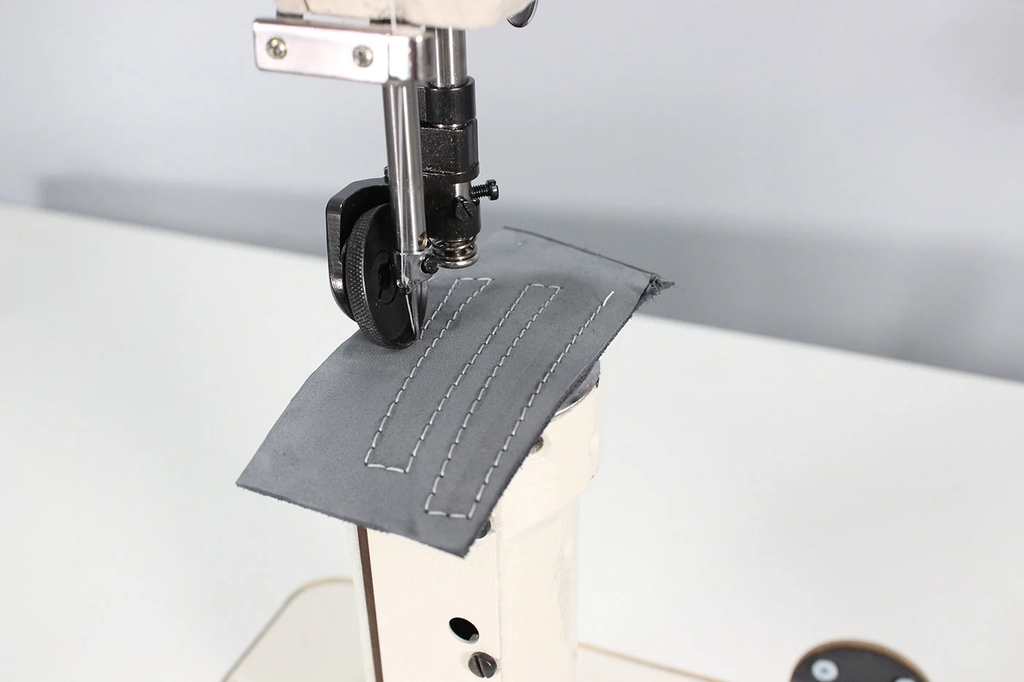
The 810 should be judged inside its documented material envelope. Its best results come from using the right needle point, thread size, pressure, stitch length, and speed rather than trying to prove how much thickness the machine can force through.
Light Leather, Wallets, Bags, and Accessories
This is one of the strongest fits for the 810. The post lets me turn shaped pieces freely and the roller foot keeps the sewing area visible near an edge. I would still test soft finished leather for roller marking and switch foot material or pressure when needed.
For anyone new to leather sewing, my how to sew leather guide covers the basic material, needle, thread, and machine considerations that also matter when working with an industrial machine.
Footwear and Shoe Uppers
Footwear is exactly the type of three-dimensional work a post bed is built around. The 7-inch post makes it easier to rotate uppers and curved panels while keeping the seam close to the roller, and very slow servo control helps at corners and decorative topstitching.
Patches and Hat / Garment Repairs
Patch sewing benefits from visibility and easy turning, especially when the piece cannot lie naturally on a flat bed. The 810 is more specialized than a normal garment lockstitch, but that specialization can reduce handling frustration on awkward repairs.
Vinyl, Synthetics, and Coated Materials
The roller-foot layout can be useful on smooth coated materials, but slippery stacks expose the limitation of bottom/drop feeding faster than stable leather. I slow down, reduce unnecessary drag, and test pressure so the top layer does not creep.
Canvas and Denim
Techsew has canvas and denim within the machine’s application range. For bags, patches, shaped panels, and repairs the post is useful; for long flat seams on large canvas panels, a flatbed or walking-foot machine may be easier to support.
Multilayered Work
The 3/8-inch foot clearance makes it physically possible to position bulky stacks, but the rated capacity remains 5/16 inch and feed remains roller/drop feed. I would not treat clearance as permission to turn the 810 into a heavy compound-feed stitcher.
Techsew 810 Pros and Cons
The 810 has a very coherent set of strengths, but only for the right job. Its weaknesses are mostly the result of specialization rather than poor design.
Pros of Techsew 810
- Excellent access for shaped work. The 7-inch post makes footwear, patches, bags, curved accessories, and three-dimensional seams easier to position.
- Very controllable low speed. The SmartServo and speed reducer are a real advantage when I need corner-by-corner or stitch-by-stitch precision.
- Good edge visibility. The roller foot keeps the needle area open and makes close edge stitching easier to see.
- Complete industrial station. Table, motor, lamp, bobbin winder, thread stand, accessories, and support reduce setup uncertainty for a first industrial purchase.
- Reverse and practical stitch range. Reverse plus 1-5 mm stitch adjustment cover the reinforcement and topstitching needs of many footwear and light-leather jobs.
Those pros are meaningful when the post and roller foot directly solve a handling problem. If they do not, a broader machine format can deliver more value for the same floor space.
Cons of Techsew 810
- Not a compound walking-foot machine. Bottom/drop feed plus a roller foot cannot match triple-feed control when thick or slippery layers need to move as one unit.
- Limited heavy-leather capacity. The #92 thread ceiling and 5/16-inch sewing capacity are not suitable for saddlery, thick holsters, harness, or repeated heavy stacks.
- Specialist footprint and purchase cost. A post-bed industrial station is difficult to justify if most projects are flat seams that a normal flatbed can handle more naturally.
I consider those limitations acceptable because Techsew is clear about the intended light-to-medium application range. The mistake is buying the 810 for a job it was never designed to perform.
Final Verdict: For footwear, patches, curved accessories, and light leather goods, I like the 810 because its geometry and low-speed control solve real handling problems. For heavy leather or mostly flat production seams, I would choose a cylinder-arm compound feed or a flatbed walking-foot machine instead.
Who Should Buy the Techsew 810?
I would put the 810 on the shortlist when shaped work is a recurring part of the business, not when it appears once or twice a year.
- Custom shoemakers and sneaker makers. The post bed and roller foot are well matched to uppers, curves, decorative edge stitching, and restricted areas.
- Patch and cap businesses. The raised post can make awkward garment and cap positioning easier than a broad flatbed.
- Light leather-goods makers. Wallets, small bags, accessories, and shaped panels fit the published thread and material range.
- Repair shops. Garment, footwear, and accessory repairs often benefit from access around existing three-dimensional construction.
- Small workshops that value support. A complete station plus Techsew technical support can reduce the setup barrier for a first specialist industrial machine.
The 810 is most convincing when I can identify several weekly jobs where a flatbed forces me to twist, fold, or fight the project around the needle.
Who Should Not Buy the Techsew 810?
The word industrial can make the 810 sound more universal than it really is. I would rule it out quickly when the work falls outside its feed system or thread capacity.
- Heavy saddlery and harness makers. Thick tack, belts, holsters, and dense stacks need heavier thread and compound feeding than the 810 provides.
- Mostly flat-panel shops. Large straight upholstery, canvas, or garment seams are easier to support on a flatbed machine.
- Shops that need one machine for every material. The 810 is a specialist; a cylinder-arm compound-feed machine may cover a broader leather range.
- Production requiring very thick decorative thread. Thread up to #92 is moderate compared with heavy leather machines that accept #207, #346, or #415.
- Anyone buying only because it is industrial. An industrial motor and table do not automatically make the bed style or feed system right for your projects.
If you are moving up from a domestic heavy-duty machine, MariaSew’s heavy-duty sewing machine guide explains why a true industrial machine should be chosen by feed system and production task, not just motor power.
Read the MariaSew heavy-duty sewing machine guide.
Techsew 810 vs. Competitors
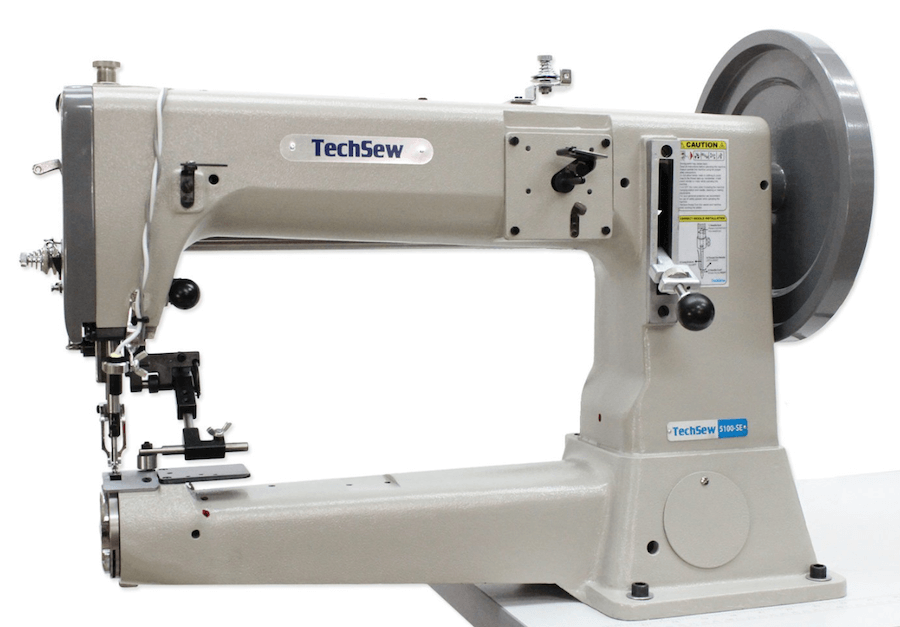
The three machines below are not identical competitors. That is important because industrial sewing machines are built around bed geometry, feed type, thread range, and material class. I compare them by the job they solve rather than by pretending that every machine aimed at leather belongs in the same category.
I would bring the same representative material to any dealer demonstration. A footwear upper, wallet edge, patch, bag gusset, or leather stack quickly reveals whether the post bed, cylinder arm, feed system, speed range, and foot geometry match the actual workflow.
Techsew 810 vs. JUKI PLC-1690
The JUKI PLC-1690 is the closest competitor here in the sense that it is also a post-bed industrial machine, but it sits in a heavier and more production-oriented class. JUKI specifies a 420 mm post, 1,600 stitches per minute, 6 mm maximum stitch length, a vertical-axis 1.6-fold-capacity hook, and alternating walking/presser-foot movement up to 7 mm. It is designed around bag production and multi-layered material, with substantially more presser-foot lift than the Techsew 810. The feed system is the decisive difference: the JUKI is built to control layers through a walking/alternating-foot arrangement rather than a simple roller-foot/drop-feed setup.
For light footwear, patches, small leather goods, and fine edge control, I prefer the simplicity and lower entry cost of the Techsew 810. For heavier bags, thick multilayered seams, larger thread requirements, and production work that needs more aggressive feeding, the PLC-1690 is the more serious platform. It is also a much larger, heavier head and should be purchased with the expectation of a permanent industrial station and professional setup. The JUKI is not a better 810; it is a step into a different class of post-bed production sewing.
Final Verdict: Choose the Techsew 810 for lighter, precision-shaped work and roller-foot visibility. Choose the JUKI PLC-1690 when multi-layer bag construction and stronger alternating-feed control are more important than a compact, affordable post-bed setup.
Techsew 810 vs. Consew 29BL
The Consew 29BL is a shoe-repair and mending machine with an 18-inch long, narrow cylinder arm rather than a post bed. Consew has a universal upper feed that can stitch in different directions without rotating the work, a 500 SPM maximum speed, up to 7 mm stitch length, 10.5 mm foot clearance, and an extra-small cylinder bed. That geometry is extremely useful when I need to reach deep inside boots, sleeves, bags, or repairs that cannot be opened flat. It solves a different access problem from the Techsew 810: reach and omnidirectional patching rather than precision around a raised post.
For custom shoe production and controlled edge stitching on uppers, I prefer the cleaner post-bed workflow of the 810. For repair shops that must reach far into finished products and sew in any direction without constantly rotating the piece, the 29BL can be more practical. Its 500 SPM speed and patcher-style feed make it less production-oriented for long conventional seams, but very specialized for mending. Buyers should therefore decide whether they need a post around which the work rotates or a long narrow arm that goes inside the work.
Final Verdict: Choose the Techsew 810 for footwear production, edge topstitching, patches, and shaped assembly. Choose the Consew 29BL when long-reach shoe repair, boot work, and omnidirectional mending are the jobs you perform most often.
Techsew 810 vs. Cowboy CB3200
The Cowboy CB3200 is a much heavier cylinder-arm compound-feed machine built around thick leather rather than light footwear work. Current Cowboy material describes a roughly 10-inch arm, triple/compound feeding through the needle, feed dog, and walking feet, up to 10 mm stitch length, very large thread capacity, and slow servo control. Manufacturer marketing rates it as high as about 5/8 inch depending on material and setup, while some U.S. dealers conservatively rate around 1/2 inch and #346 thread. Either way, that is far beyond the 810’s #92 thread and 5/16-inch capacity.
The trade-off is finesse and format. The Techsew 810 gives me a narrow roller foot and a post that feels natural for shoe uppers, close edge work, patches, and lighter accessories. The Cowboy is physically larger, heavier, and designed for belts, holsters, tack, harness, sheaths, and substantial leather stacks. I would not buy the CB3200 merely because it is more powerful, and I would not buy the 810 merely because it is easier to maneuver. The correct choice is dictated by thickness and seam shape.
Final Verdict: Choose the Techsew 810 when access, visibility, and light-to-medium precision matter most. Choose the Cowboy CB3200 when thick leather, heavy thread, cylinder-arm versatility, and compound feeding are the core requirements.
Competitor Comparison at a Glance
The detailed comparisons above explain why these machines should not be ranked by power alone. The table below is only a final orientation guide for bed style, feed type, and intended work.
Specifications can vary by configuration and dealer package, especially on leather stitchers. I would verify the current motor, table, needle, thread, and accessory setup before ordering.
| Model | Bed Style | Feed | Capacity Position | Best Fit |
|---|---|---|---|---|
| Techsew 810 | 7 in post bed | Roller foot / drop feed | 5/16 in; thread to #92 | Footwear, patches, light leather, curves |
| JUKI PLC-1690 | 420 mm post bed | Alternating walking/presser feet | Heavier multilayer class; 6 mm stitch | Bags, layered leather, production post-bed work |
| Consew 29BL | 18 in narrow cylinder arm | Universal upper feed | 10.5 mm clearance; 500 SPM | Shoe/boot repair, deep reach, omnidirectional mending |
| Cowboy CB3200 | ~10-10.5 in cylinder arm | Compound/triple walking feed | ~1/2-5/8 in depending setup; heavy thread | Holsters, belts, tack, heavy leather |
The Techsew 810 is the lightest-duty specialist in this comparison, and that is not a criticism. It occupies the narrow precision end of the industrial leather spectrum, while the JUKI and heavy cylinder-arm machines target different feeding and thickness problems.
Best Alternatives to the Techsew 810
The three alternatives below make sense only if the reason you are leaving the 810 is clear. The Dürkopp Adler and the two cylinder-arm machines all move toward heavier compound feeding and larger thread rather than simply offering another roller-foot post bed.
Because the Cowboy CB3200 also appears in the competitor section, I use the alternative profile here to focus on standalone ownership, features, pros, cons, and the types of projects that justify buying it instead of the 810.
Dürkopp Adler 205-370 – Best Legacy Heavy-Duty Alternative
The Dürkopp Adler 205-370 is a legacy heavy-duty free-arm/cylinder machine built for three-dimensional work in thick leather, upholstery, technical textiles, and other demanding materials. Official Dürkopp Adler literature describes a large barrel shuttle, bottom feed, needle feed, and alternating top feed, with a maximum 10 mm stitch length and about 800 stitches per minute. Its heavy mechanical construction and triple feed put it in a completely different strength class from the Techsew 810. The 205-370 is therefore an alternative only when the reason for leaving the 810 is that you need much heavier material and thread.
The major 2026 caveat is availability: the 205-370 is a legacy model rather than a current mainstream new-production option, so buyers normally encounter used, rebuilt, or dealer-stock machines. Dürkopp Adler still hosts technical documentation and has published parts information for the class, but condition matters enormously on a used industrial head. I would budget for inspection, transport, motor/stand compatibility, timing checks, hook condition, and a technician who understands the class. A good 205-370 can be a superb machine; a neglected one can become a restoration project.
Key Features
- Heavy-duty free-arm/cylinder format. Designed for three-dimensional work rather than fine post-bed edge sewing.
- Triple feed. Bottom feed, needle feed, and alternating top feed help control dense multilayer work.
- Large barrel shuttle. Higher bobbin/thread capacity for thick industrial thread.
- 10 mm maximum stitch length. Supports long visible stitches on heavy leather and technical materials.
- About 800 SPM maximum speed. A deliberate heavy-material pace rather than high-speed apparel production.
- Needle system 328 / heavy needle range. Official literature positions the class for medium-heavy and heavy materials.
Pros
- Excellent heavy-material feeding. Triple feed keeps thick layers moving together.
- Proven industrial construction. The class earned its reputation in upholstery, leather goods, and technical sewing.
- Large thread and stitch capability. Much more suitable than the 810 for bold heavy-leather seams.
- Three-dimensional access. The free-arm/cylinder layout handles bulky shaped work better than a flatbed.
- Strong used-market value when properly rebuilt. A serviced machine can deliver serious industrial capability without buying a new premium equivalent.
Cons
- Legacy/discontinued platform. Availability is mostly used or rebuilt, so condition and parts sourcing matter.
- Far heavier and more demanding than the 810. It needs more floor space, setup knowledge, and operator technique.
- Overkill for light footwear and patchwork. Fine edge access and light thread are not the reason to buy this class.
Final Verdict: The Adler 205-370 is the alternative I would consider when the Techsew 810 is simply too light-duty. Buy it for proven triple-feed heavy leather capability, not as a modern like-for-like post-bed replacement.
COBRA Class 26 – Best Versatile Cylinder-Arm Alternative
The COBRA Class 26 is a current medium-to-heavy cylinder-arm leather machine designed to cover a wider range of leathercraft than the Techsew 810. Leather Machine Co. A 10-inch arm, large U-style bobbin, thread sizes #46 to #207, material capacity up to 7/16 inch, 135×16 or 135×17 needles, 3-10 stitches per inch, a brushless DC servo motor, and a heavy speed reducer. The compound-feed walking-foot layout makes it much better suited to thicker layered leather, bags, belts, upholstery, webbing, and structured accessories than the roller-foot 810.
What I like about the Class 26 is that it still stays manageable compared with the huge 441-style heavy stitchers. The cylinder arm makes bag gussets, curved pieces, wallets, belts, and three-dimensional leather easier to reach, and optional/packaged work platforms can give flat-project support. The trade-off is that it does not provide the same narrow post-bed geometry or roller-foot visibility for footwear uppers. If my business mixes bags, belts, wallets, and thicker leather more than shoes and patches, the COBRA is the broader one-machine choice.
Key Features
- 10-inch cylinder arm. Gives access inside bags, curved leather goods, and tubular pieces.
- Compound-feed walking foot. Needle/foot/feed movement helps thick layers stay aligned.
- Up to 7/16-inch material capacity. A major step above the 810 for leather thickness.
- Thread #46-#207. Supports much heavier visible leather stitching.
- Large U-style bobbin. Longer sewing runs with thicker thread before bobbin changes.
- Servo motor and heavy speed reducer. Provides the slow control leatherworkers need around hardware and tight shapes.
Pros
- Broader leather range than the 810. Handles wallets through substantially heavier bags, belts, and accessories.
- Excellent layer control. Compound feed is a real advantage on thick or slippery stacks.
- Useful cylinder-arm geometry. More versatile than a flatbed for gussets and three-dimensional leather.
- Heavy thread capability. #207 thread gives stronger and more visible topstitching than the 810.
- Complete leather-focused workstation. Current packages include servo power, speed reduction, stand, lamp, and tools.
Cons
- Not a post-bed roller-foot machine. Footwear uppers and very close curved edge work may feel less natural than on the 810.
- Bigger and heavier investment. It occupies more space and costs more to ship and install.
- More machine than light repairs need. If the work never exceeds thin leather and patches, the extra capacity is wasted.
Final Verdict: The COBRA Class 26 is my broader leathercraft alternative to the Techsew 810. It sacrifices the post-bed/roller-foot specialty but gains compound feeding, heavier thread, a large bobbin, and much more thickness capacity.
Cowboy CB3200 – Best Budget Heavy-Leather Alternative
The Cowboy CB3200 is the alternative for buyers who are leaving the 810 because they need a serious jump in leather thickness and thread size without moving to the largest 16-inch heavy stitchers. Current Cowboy material describes a roughly 10-inch cylinder arm, compound/triple feed, up to 10 mm stitch length, high presser-foot lift, very slow servo control, and heavy thread reaching #346 to #415 depending on dealer configuration. Manufacturer marketing places the maximum leather stack as high as 5/8 inch, while some U.S. dealers use a more conservative 1/2-inch rating. I would therefore confirm the exact dealer setup using the leather and thread I intend to sew.
The CB3200 is aimed at belts, holsters, knife sheaths, tack, harness, saddle bags, webbing, and other thick work that sits outside the Techsew 810’s comfort zone. Its cylinder arm and compound feed make it far more capable on dense multilayer leather, but the machine is larger, uses much heavier needles and thread, and is less delicate around fine shoe-upper work. This is not the alternative for someone who merely wants a little more power. It is the alternative for someone whose project list has fundamentally moved into heavy leather.
Key Features
- About 10-10.5-inch cylinder arm. Useful for belts, bags, holsters, tack, and curved heavy leather.
- Compound/triple feed walking foot. Controls heavy multi-ply leather more positively than a roller/drop-feed setup.
- Heavy material capacity. Dealer ratings generally fall around 1/2 inch, with manufacturer marketing up to about 5/8 inch depending on material.
- Heavy thread support. Common configurations support #69 through #346, with manufacturer literature extending to #415.
- Up to 10 mm stitch length. Provides long decorative stitches for heavy leather.
- High-torque servo and speed reduction. Designed for very slow control despite the machine’s heavy piercing capability.
Pros
- Huge capacity increase over the 810. Suitable for thick holsters, tack, belts, sheaths, and heavy accessories.
- Strong compound feeding. Keeps dense layers synchronized through long heavy seams.
- Heavy thread capability. Supports the bold seam appearance expected in saddlery and thick leathercraft.
- Cylinder-arm versatility. Handles shaped products while still accepting flatbed conversion accessories from some dealers.
- Slow-speed control despite high torque. The servo/reducer setup makes stitch-by-stitch detail practical on thick leather.
Cons
- Too heavy for fine footwear work. The feed, feet, needle system, and thread range are optimized for a different class of material.
- Large, heavy workstation. Freight, assembly, floor space, and moving the machine are significant considerations.
- Published capacity varies by dealer. I would verify the exact supported thickness and thread size with the seller rather than buying from the largest marketing number.
Final Verdict: The Cowboy CB3200 is the best alternative here when you need heavy leather capability on a budget. It is not a refined replacement for the Techsew 810; it is a move into compound-feed cylinder-arm leather stitching.
Setup, Learning Curve, and Ownership
The 810 arrives as a complete industrial station, but a table-mounted servo machine still feels different from a domestic sewing machine. I would learn threading, bobbin installation, needle orientation, oiling points, reverse, stitch-length control, roller-foot pressure, and servo settings before putting a finished leather piece under the needle.
The safest learning process is to use scrap material from the same project, start with a moderate thread and needle, sew slowly, inspect the underside, and change one setting at a time. The post bed changes how the work is supported, so operator handling is part of the learning curve even when the stitch itself is simple.
If leather sewing is new to you, pair the industrial manual with MariaSew’s how to sew leather guide and always verify the exact needle point and thread combination for the leather you are using.
Maintenance Tips for the Techsew 810
Industrial machines stay consistent when cleaning, lubrication, needle condition, threading, and tension are handled before problems become serious. The 810 is mechanically straightforward, but leather dust, adhesive, thread lint, and coated materials can build up around the hook and feed area.
- Follow the Techsew lubrication schedule. Oil only the points and with the lubricant specified in the machine instructions.
- Change damaged needles early. A bent or dulled industrial needle can cause skipped stitches, damaged leather, thread shredding, or hook damage.
- Clean around the bobbin and feed path. Remove lint, leather particles, and adhesive residue that can affect smooth feeding.
- Match thread and needle sizes. Stay within the published #23-#92 thread and #11-#21 needle range unless Techsew specifically approves another combination.
- Check the roller and pressure. Too much pressure can mark soft leather; too little can reduce control.
- Use technical support before forcing adjustments. Timing, hook clearance, motor alignment, and internal feed problems should be diagnosed correctly rather than changed at random.
If you are troubleshooting stitch quality, MariaSew’s guide to sewing machine tension is also relevant because incorrect tension can affect stitch balance and thread appearance.
A clean machine with the correct needle will usually give me more reliable production than a machine with more power but poor setup. Industrial maintenance is part of the workflow, not an occasional emergency task.
Common Techsew 810 Mistakes to Avoid
Most disappointment with the 810 comes from buying it for the wrong class of work or treating the post-bed/roller-foot format like a universal leather solution. The machine is much easier to appreciate when its limits are respected.
- Buying by the word industrial. Industrial describes the construction and work format, not unlimited thickness or thread capacity.
- Confusing roller foot with compound feed. The 810 does not synchronize the needle and alternating feet the way heavy walking-foot leather machines do.
- Using presser-foot clearance as sewing capacity. The 3/8-inch clearance is higher than the 5/16-inch published sewing capacity.
- Pushing thread beyond the #92 range. Heavy decorative thread requires a different hook, needle, tension, and machine class.
- Expecting a post bed to improve long flat seams. The raised geometry helps shaped work; a flatbed supports broad panels more naturally.
- Running too fast on curves. The SmartServo/speed reducer exists so I can slow down before the corner rather than fight the work after it drifts.
- Skipping scrap tests on soft leather. Roller material, pressure, needle point, and thread can all affect marking and seam appearance.
- Ignoring freight and floor space. A complete industrial table is a permanent workstation, not a machine I casually store in a closet.
- Buying a legacy alternative without service planning. Used industrial machines such as the Adler 205-370 should be inspected and supported before purchase.
- Assuming the current warranty from one line of a product page. Techsew’s current 810 page uses differing warranty wording; confirm the exact written terms for your order.
A specialist machine rewards a specialist buying process: define the material, thread, seam shape, layer count, daily volume, and floor space before comparing brands.
Is the Techsew 810 Worth It in 2026?
Yes, if post-bed access is a recurring production need and your materials stay inside the light-to-medium range. At the current $2,495 listed price, I am paying for a complete workstation, precise low-speed control, a practical 7-inch post, roller-foot visibility, reverse, and Techsew support rather than for maximum thickness.
I would not call it good value for a shop that mainly sews flat panels or heavy leather. In that situation, the same budget should be directed toward the feed system and bed style the work actually needs. The 810 earns its price when it reduces handling time on the exact jobs it was designed to sew.
Final Verdict: Should You Buy the Techsew 810?
I would buy the Techsew 810 when my work repeatedly involves shoe uppers, patches, curved accessories, light leather goods, repairs, and other pieces that become awkward on a flat bed. The 7-inch post, roller foot, reverse, complete industrial station, and very slow servo control form a sensible package for that niche.
I would not buy it simply because I want an industrial leather machine. If my real workload is thick belts, holsters, tack, harness, or heavy bag construction, I would move to a compound-feed cylinder arm such as the COBRA Class 26 or Cowboy CB3200. If I need heavier production post-bed feeding, the JUKI PLC-1690 is closer to that requirement. The right verdict depends on the seam geometry and material range, not the biggest specification number.
For readers who want to understand how machine components interact, My guide to sewing machine parts is useful background.
Frequently Asked Questions
What is the Techsew 810 used for?
Techsew is used for footwear production, patch sewing, light leather work, wallets, bags, accessories, garment repairs, vinyl, canvas, denim, synthetics, and coated or laminated materials.
Is the Techsew 810 a walking-foot machine?
No. Techsew classifies the 810 as a roller-foot/drop-feed post-bed machine. It does not use the compound or triple feed found on heavy walking-foot leather stitchers.
How thick can the Techsew 810 sew?
Techsew has a maximum sewing capacity of 5/16 inch, with 3/8-inch presser-foot clearance. The two measurements should not be treated as the same thing.
What thread can the Techsew 810 use?
The current Techsew specification has thread sizes #23 through #92.
What needle system does the Techsew 810 use?
The standard 810 product page has 135×5 needles in sizes #11-#21. The PRO family page also references 135×8, so verify the exact supplied configuration before buying specialty needles.
Can the Techsew 810 sew leather?
Yes, Techsew positions it for light-to-medium leather. It is not intended as a universal heavy-leather saddle or harness stitcher.
Is the Techsew 810 good for shoes?
Yes. Footwear and custom shoes are among Techsew’s stated applications, and the post bed is particularly useful for curved uppers and edge stitching.
Can the Techsew 810 sew patches on hats?
Patch sewing is a listed application, and the post-bed geometry can make curved or awkward products easier to position than a flatbed.
How slow can the Techsew 810 sew?
Techsew states that the SmartServo motor with speed reducer can operate below one stitch per second, which is useful for corners and precision work.
What is the difference between the Techsew 810 and 810 PRO?
The PRO package adds automatic needle positioning, a swing-down roller edge guide, flatbed attachment, rubber roller foot, and extra accessories while keeping the same core post-bed application range.
Is the Techsew 810 better than a Cowboy CB3200?
They solve different jobs. The 810 is better suited to light-to-medium precision post-bed work; the CB3200 is a heavy cylinder-arm compound-feed machine for much thicker leather and heavier thread.
What is the best alternative to the Techsew 810?
For broader medium-heavy leathercraft, the COBRA Class 26 is the most versatile current alternative in this guide. For substantially heavier work, the Cowboy CB3200 is stronger; the Adler 205-370 is a legacy used-market option for serious heavy material.