
SINGER Heavy Duty 500 Classic Sewing Machine Review: My take on this Heavy Duty Machine ??
A rough time trying to decide what sewing machine would suit me best, as a desperate sewist, I started my search and Singer HD500 came up.
It has that funky period appearance, and Singer’s ‘Heavy Duty’ line typically means a lot of slinging power.
I figured I would do a deep dive into this machine and see what it is all about. In this singer HD500 review, I will discuss what I found.
SINGER Heavy Duty 500 Classic (HD500)
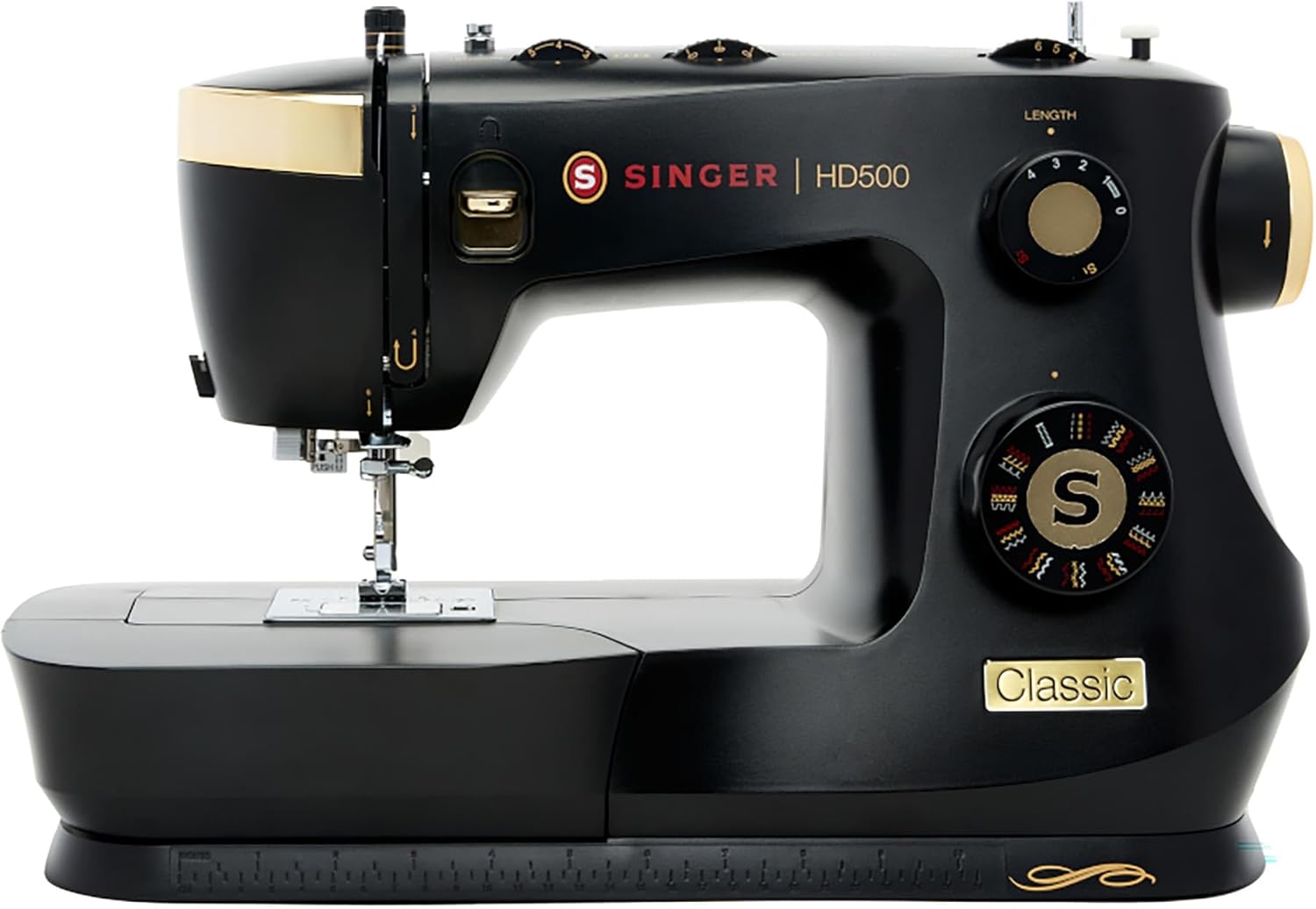
The SINGER Heavy Duty 500 Classic is a functional, beginner-friendly machine with genuine retro charm. Its full metal frame and strong, high-piercing motor sew cotton, linen, denim, and knits cleanly, and the one-step buttonhole and LED light are welcome at this price.It isn’t intended for industrial-level heavy-material work and tension is set by hand, but for everyday sewing and new sewists who love a vintage look, it is an affordable, easy pick.
What We Loved
- Attractive retro black and gold styling
- Simple mechanical controls, great for beginners
- Full metal frame with a strong, high-piercing motor
- One-step buttonhole, automatic needle threader, and LED light
- Jam-resistant top drop-in bobbin and 5 presser feet
- Backed by a 25-year limited warranty
Keep In Mind
- Thread tension is set manually
- Fewer stitches than computerized machines
- Not for thick, multi-layer heavy fabric
- Picture-only manual is not very clear
Verdict based on hands-on use and verified owner reviews. Prices change often. As an Amazon Associate, MariaSew earns from qualifying purchases, at no extra cost to you.
Singer HD500 Review: An Overview
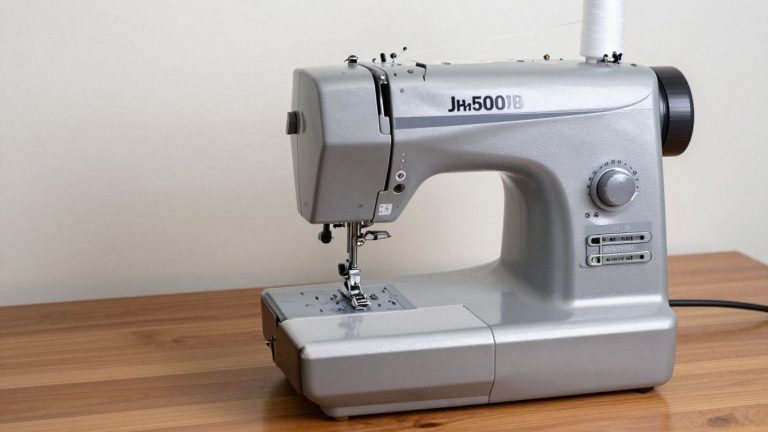
I’ve been playing around with the Singer HD500 for a little while now, and I wanted to give you some of my first impressions. Now, this machine has a bit of presence almost a retro feel with the curved body and gold accents, which are actually kind of appealing to me.
That is also why it fits so nicely on my sewing table. Upon my initial unboxing of it, to be honest, I was a bit disappointed with the instructions, they mainly consisted of pictures that seemed more like a puzzle than a helpful guide. That might be an obstacle for a beginner. If you’re completely new, I’d strongly suggest learning basics like how to thread a sewing machine first.
But when I threaded it up and began sewing, it worked pretty well. This is an old-school mechanical machine, so there aren’t a lot of high-tech digital features to deal with here. It doesn’t feel as substantial as some heavier machines I’ve used, but it remained stable enough on the table and handled basic sewing tasks without much trouble. If you’re still figuring things out, reading about how to learn sewing can make things much easier.
It operates on different kinds of fabric, from lighter cottons to possibly some heavier fabric. I can’t wait to test this out on more complex projects like how to sew an apron or even simple DIYs like how to make a simple tote bag at home.
If you are looking for something straightforward and affordable, the HD500 makes a lot of sense. It keeps the controls simple while still giving you 23 built-in stitches, a one-step buttonhole, an automatic needle threader, and a top drop-in bobbin.
Accessories and What Comes in the Box
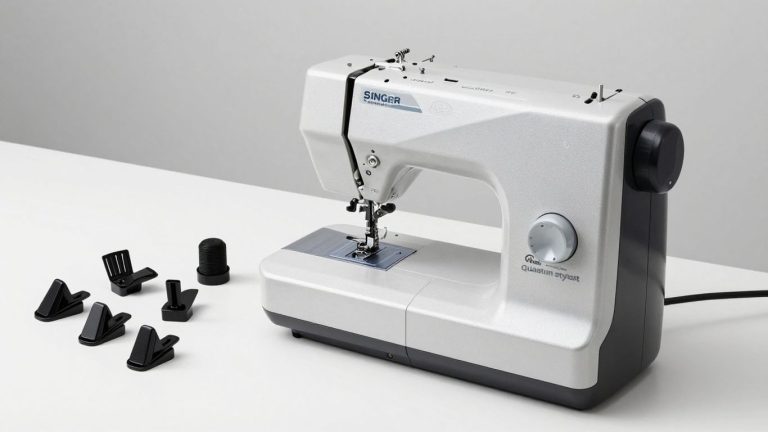
The HD500 comes with a useful starter set of feet and tools, which is nice to see at this price. In the box you get an all-purpose foot, a zipper foot, a buttonhole foot, a blind-hem foot, and a satin-stitch foot, along with the usual bobbins, needles, and a seam ripper.
That covers most everyday sewing right out of the box, so you can start your first project without buying extras. If you are just getting going, pairing it with one of these sewing kits for beginners rounds out your toolkit nicely.
Top Features of Singer HD500
The Singer HD500 caught my eye as soon as I first laid eyes on it for its attractive, retro styling. It has a nice black body with gold accents, it looks good on my sewing table. However, aside from the looks, what actually counts are the features that help me accomplish my sewing tasks. The simplicity of this machine is a huge plus in my book.
| Feature | SINGER HD500 Classic |
|---|---|
| Built-in stitches | 23 (utility, stretch, decorative) |
| Buttonhole | One-step, automatic |
| Sewing speed | Up to 1,000 stitches per minute |
| Bobbin | Top drop-in, jam-resistant |
| Needle threader | Built-in automatic threader |
| Presser feet | 5 (all-purpose, zipper, buttonhole, blind hem, satin stitch) |
| Frame | Heavy-duty metal frame |
| Work light | LED |
| Warranty | 25-year limited |
| Price | $379.99 |
Stitch Selection and Capabilities
It is equipped with 23 different stitches that are built into the machine. That might not seem like a lot compared to some of the super high tech computerized machines out there but honestly it handles most everything I need for everyday type projects. It has your basic stitches, some stretch stitches for knits, and a few decorative ones to add a touch here and there. Not to mention the one-step buttonhole (major lifesaver!).
This makes it so much easier than trying to do a buttonhole on your own. These stitches are totally fine for general sewing, mending, or small home decor projects.
This gives you a practical selection without overwhelming you with features you may never use. The stitch selection covers basic utility sewing, stretch stitches, decorative stitches, and a one-step buttonhole, which is plenty for most everyday projects.
If you’re unsure what stitches and components actually do, you should check out sewing machine parts explained to understand things better.
Build Quality and Durability
Singer positions the HD500 as a heavy-duty machine, and the internal frame is constructed from heavy-duty metal. The outer housing is not entirely metal, but the metal frame provides the rigid support that keeps the machine stable while sewing. It weighs around 13.7 pounds, so it has enough weight to stay planted without being excessively difficult to move.
It doesn’t feel weak, or likely to fall apart. I never had any big problems with it and it looks like it can easily sew through heavier fabrics. It is not the heaviest machine I have ever used, but it is heavy enough to stay put when I am sewing, which is crucial.
If your goal is quilting or heavier projects, you’re better off exploring something like best quilting sewing machines instead of relying only on this one.
Ease of Use for Beginners
In my opinion, this is the real strength of the HD500. Being a mechanical machine, that means less confusing buttons and screens to navigate with. It’s got a dial that is fairly easy to click through stitches and threading is fairly standard. The assembly directions were mostly images, which was fine except I had to look up a couple of things to make sure it was assembled correctly.
If you’re just starting out, pairing this machine with a proper starter setup like sewing kits for beginners will save you a lot of frustration.
Based on being a beginner, I definitely feel this machine is best due to being non-intimidating. This way you can concentrate on the basics of sewing without becoming too overwhelmed in the technology. That means this is a great beginner sewing machine to start your journey with.
Performance: What to Expect
Sewing Different Fabric Types
So, when I received the Singer HD500, I wondered what kind of things it could make. I used some standard quilting cotton to get started and it sewed right through, as expected. Next, I tackled something a little more challenging, possibly a sheer linen. It sewed through the fabric cleanly, and the stitches remained consistent.
The next sample was from a knit fabric. This is where most machines can fail, but the HD500 handled it OK, aside from a tiny bit of waviness in the stitches on the some of the stretchiest parts. For heavy-duty I tested some denim. It certainly got through, but I decreased the speed a little to ensure it was feeding properly.
It didn’t skip a beat. I also tested several layers of a quilt sandwich, and the HD500 handled them without a major problem. I was surprised with how competent it looks across the board for most everyday fabric types. For beginner-friendly projects using similar fabrics, you can try how to sew an apron or small DIY home projects.
Thread Tension and Stitch Quality
The tension of the thread is very much part science, part art (and I fiddled with the HD500 dial for a little while on this). In fact, I found the default setting to be pretty decent for most of my cotton and linen tests. The stitches appeared nicely formed, no looping on the back side and no puckering on the front.
On the knit fabric I had to slightly loosen the top tension so the fabric would not be pulled too badly. Bobbin tension appeared to remain uniform in my testing. If you’re struggling with consistency, revisiting basics like how to thread a sewing machine actually helps more than people think.
On the whole, the stitch is neat and uniform, particularly on stable woven fabrics. It was nice to be mostly problem-free – no nests of thread, no rejecting stitches, or any other major problems. I believe stitch quality will be just fine for your average sewing tasks.
Advantages and Disadvantages of Singer HD500
Advantages of Singer HD500
The initial thing that attracted me to the Singer HD500 when I started researching sewing machines was its beautiful vintage appearance. Nice round body with gold trim, which looks pretty perched atop my sewing table. Despite the appearance, I thought it was a decent basic sewing machine.
For simple projects, such as sewing a tote bag or hemming pants, it sews well enough. Because it is mechanical, the controls are straightforward, and there are fewer electronic features to complicate the sewing process; I was never fighting against any convoluted computer menus. It’s an ok workhorse for someone who is more of a novice and/or just doing mostly basic projects. It seems like it can take quite a bit of straight stitching, which is always what I do anyway.
For similar entry-level machines, you can also compare it with options like Brother CS7000X review or Brother CS7205 review
Disadvantages of Singer HD500
However, the HD500 isn’t perfect. Its feature set is more limited than what you’ll find on many computerized machines, and the instruction manual could be clearer.
That the HD500 was not the toughest machine on the block. Choice of materials is somewhat on the lighter side, not that it looks nice but some other machines carry a heavy-duty feel that is absent here.
As for the instructions that came with it, they were mostly pictures, which isn’t exactly helpful. And became a bit frustrating when you want to deliver something.
The features are pared down too, so don’t expect a huge library of decorative stitches. It does include a handy one-step buttonhole, though if you need advanced or specialty buttonholes, this is not the machine for that.
This option may not suit advanced projects or heavy, specialized work. It has issues with really heavy-weight fabric layers, but it is manageable. Sometimes the thread tension is a bit finicky, and if I am not careful, I get uneven stitches.
If you want something more powerful or feature-rich, machines like Janome MC6650 review or Brother SE2000 review are on a completely different level.
Comparison of Singer HD500 with Other Sewing Machines
Singer HD500 vs Singer 4432
When I first started searching for sewing machines, I kept coming across the Singer HD500 and the Singer 4432. They come under the ‘Heavy Duty’ label both of which is a decent start out, no? However, the differences are quite clear after you have been with them for several minutes.
The retro vibe of the HD500 just seems to embody the past. It is just a machine, and quite frankly, it does the bare minimum. I thought it was decent for DIY level stuff, if you like that “vintage” vibe anyway It’s an OK starting point if you’re a beginner and don’t require an expansion of impressive stitches. More details on build and features will be available on pages such as this Singer HD500 review.
The 4432 however is more of a work horse. It is fast and powerful enough that they can sew through much heavier materials such as denim or canvas. I see it comes with a slightly stouter motor which means it can push through more hardy materials with relative ease.
In contrast, the HD500 is more focused on looks and ease of use compared to the Singer 4432, which is aimed at getting your projects done sooner and able to handle heavier materials. It doesn’t have the same old-school appeal, but in terms of simply getting the job done, particularly with denser material, it has a leg up. Ultimately, it really comes down to the look, with the vintage, classic aesthetic of the HD500 versus true sewing basics, or the speed and force of the Singer 4432 if you’re tackling heavier sewing projects.
Singer HD500 vs Singer 4452
To me, looking at the Singer HD500 and comparing it to something like the Singer 4452 is almost like comparing apples and oranges in the sewing world, they are both Singer and they are both named ‘Heavy Duty’, but the approach to sewing is so different! The HD500, dressed in its retro style, has the air of a simple, no-frills, classic.
You’re right, for an old clunker, it’s got that nice vintage charm, and it actually does seem to work for basic sewing. However, I think if you like the look of the machine you will find it a pretty reasonable machine for most day to day projects.
The Singer 4452, on the other hand, appears to be engineered for speed and power. I remember it being sold as a machine that can pierce through heavier materials, something I have definitely found a need for at times.
The HD500 is a solid machine for everyday sewing, but the Singer 4452 tends to make more appearances whenever that talk turns to sewing heavier stuff, like denim or canvas.
But the devil is in the details, right? The instruction manual that came with the HD500 is more picture than text and sometimes looks like a crossword puzzle. There are steps that took me more time to understand which I remember fondly.
The Singer 4452 typically feels a tad more direct in its operation, even if it doesn’t have the same fancy styling, but some users say it gets a bit noisy. The HD500 is good for me, but if I am doing lots of straight stitching on regular fabrics However, if I’m working on something with several layers of heavy stuff or I’m just trying to make progress, I’ll probably go with the 4452, even though it’s not as glamorous.
If you want a full breakdown, check out our detailed Singer Heavy Duty 4452 sewing machine review.
Comparing More Singer Sewing Machines?
If you are still deciding which Singer model fits your sewing needs, you may also find our full guide helpful. Check out our complete roundup of the best Singer sewing machines before making your final choice.
How to Set Up and Thread the SINGER HD500
Threading the HD500 is quick once you have done it once, and the numbered guides printed on the machine walk you through it. Here is how I set mine up. If you are brand new, our full guide to how to thread a sewing machine covers the basics in more detail.
- Turn the handwheel toward you to raise the needle fully, then lift the presser foot so the tension opens up.
- Place your thread on the spool pin and add the spool cap so it does not bounce.
- Wind a bobbin, then drop it into the top drop-in bobbin case so the thread unwinds counterclockwise, following the arrows. The jam-resistant design makes this easy.
- Lead the top thread through the numbered guides: down the right channel, up the left channel, and through the take-up lever from right to left.
- Bring the thread down to the needle and use the built-in automatic needle threader to pull it through the eye.
- Hold the top thread, turn the handwheel one full turn, and pull up the bobbin thread loop. Lay both threads under the foot toward the back.
- Sew a few stitches on a scrap first. If the top thread loops underneath, rethread with the presser foot raised.
Not sure what each part is called while you follow along? Our guide to sewing machine parts explained makes it click.
Common SINGER HD500 Problems and Easy Fixes
Most issues on a mechanical machine like the HD500 come down to threading or tension, not the machine itself. Here are the ones I ran into and how I fixed them fast.
- Loose or looping stitches underneath: almost always a top-threading slip. Rethread with the presser foot raised so the thread seats in the tension. Our guide on why your bobbin thread shows on top explains why this happens.
- Thread bunching or jamming: clear the bobbin area and rethread top and bobbin. See why your sewing machine keeps jamming for the full checklist.
- Puckering on lightweight fabric: lower the top tension a little and use a finer needle.
- Skipped stitches on knits: switch to a ballpoint or stretch needle and slow down slightly.
Who is the Singer HD500 Suitable For?
So, who is ideal to use the Singer HD500 Sewing Machine? After experimenting with it, I definitely see it excelling in a few particular areas of sewing. This should be a decent option if you are relatively new and just want something simple.
It’s not too complicated and has the right stitches to get you through most beginner projects to begin with, like basic garments, some homeware or just for mending clothes. It was surprisingly simple to get up and running with it without having to study the manual for hours on end.
If you do a lot of straight stitching that also looks like a good option. Imagine quilting projects, straight seams on apparel, or sewing with a little bit bulkier fabrics.
By the way, this machine does all this stuff quite easily; it seems solid enough for that sort of thing. I wouldn’t recommend it for super intricate, detailed work or for sewing really thick, tough materials, like several layers of leather, but for everyday sewing tasks, it does help us out.
Conversely, if you’re a seasoned sewer searching for more advanced features and have a need for a number of decorative stitches and more specialized functions like more complex buttonholes, you may find the HD500 a bit lacking.
It covers the basic workhorse role well, but lacks some of the extra features found on more advanced computerized models along the way. Therefore for the beginner or the intermediate sewer who will be doing the basic stuff as I have mentioned- then I think the HD500 is certainly one to take a look at. And it looks great, which is a bonus if you enjoy vintage living the way I do.
This machine is best for beginners or intermediate sewists. If you’re planning to move beyond basics into more advanced or decorative work, something like Singer HD4411 Prisma review might be a better stepping stone.
So, Is the Singer HD500 a Good Buy?
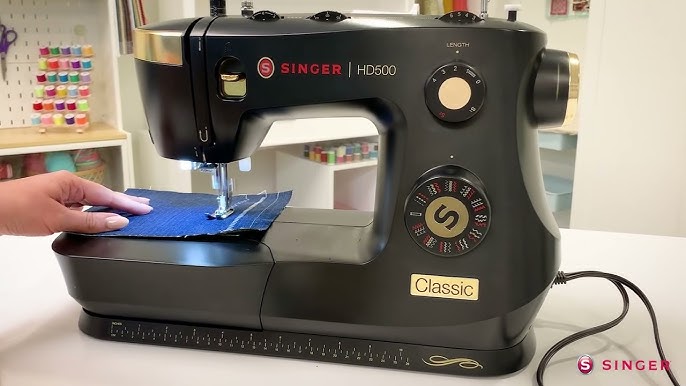
The Singer HD500 is a fairly nice machine based on overall runtime, especially for the price point, but we spent some time with it and here are our thoughts. It’s functional, and it does the most basic tasks with the sewing machine without much fuss.
When I was only sewing simple things, I didn’t have any real issues. But I did feel like it was a little too light, and the instructions could be better (which could be a barrier for complete newbies).
The HD500 may be suitable for beginner users or for transitioning into it for knock-out, less complex efforts. However if you want to sew more difficult fabrics or require more stitch options and features, you will have to consider some of the other available machines. Not a bad bike, but also not for everybody.
You are still choosing between brands rather than models. Our Brother vs Singer guide gives you a direct verdict based on 12 years of testing machines from both.
Anchor text: Brother vs Singer guide
SINGER HD500 Alternatives Worth Considering
The HD500 is a lovely retro pick, but it is not the only option at this level. If you are weighing your choices, here are three worth a look:
- Want more power for less money? The SINGER Heavy Duty 4452 sews faster and pierces heavier fabric, usually for well under the HD500’s price.
- On a tighter budget? See our roundup of the best sewing machines under $100 for affordable beginner picks.
- Set on SINGER? Compare the whole lineup in our guide to the best SINGER sewing machines before you decide.
Frequently Asked Questions
Why should beginners go with the Singer HD500?
The Singer HD500 is a good choice for beginners who want a straightforward mechanical sewing machine that can handle everyday projects and thicker fabrics without the complexity of a computerized interface. Its straightforward design and ease of use allow me to focus on sewing rather than constantly adjusting or tinkering with the machine. That makes it especially useful when I’m working on costumes, alterations, or other projects with tight deadlines.
Is the Singer HD500 beginner-friendly?
Yes, I think it is! I found the Singer HD500 fairly easy to use. It has a logical stitch selection and does not bombard you with unnecessary information on how to use complicated features. As a beginner, I thought it was a decent method to learn the fundamentals of a product without the risk of too much annoyance. Sewing instructions are straightforward and you can start sewing pretty quickly!
Does the Singer HD500 sew different varieties of fabric?
I tested the HD500 on cotton, linen, knit fabric, denim, and multiple layers of a quilt sandwich. It handled the lighter fabrics well and was also capable with denim and multiple layers. SINGER specifically highlights denim, canvas, multiple fabric layers, and quilts as suitable applications.
What Are the Main Benefits of Having a Singer HD500?
The main advantages for me are the straightforward mechanical operation, sturdy internal frame, useful stitch selection, and vintage-inspired design. It feels very durable, as if it can last you a while. I also like how it is all simple, it does its job without much drama. Also, that retro vibe makes for a cute feature on my sewing table! It’s not going to take your breath away, but it’s a workhorse.
What are the negatives of Singer HD500?
Honestly,its depend upon what kind of user you are ??.Perhaps the stitch selection dial can be stiff at times, and the manual was a little lacking. And even worse, while nice, it’s not computerized and isn’t one of those computerized machines that do all the work for you,it takes a bit to get to the tread cutting feature, not that I’ll use that much anyway. However, those are just small quibbles from my end.
How does the Singer HD500 compare to more advanced computerized machines?
Imagine the HD500 as a reliable vessel or truck, while advanced computerized machines are sports cars. The sewing core and the durability of HD500 are excellent. Computerized machines typically have more stitches to choose from, automatic capabilities and, in some cases, a more streamlined, quieter operation. Me, if I need tons of decorative stitches or way-too-custom settings then I pull out a computer, but otherwise, I grab the HD500 (unless it needs to do tough work.

2 Comments