PFAFF Ambition 620 Sewing Machine Review: Tested Verdicts By MariaSEW
A long feature list means very little until you’re actually feeding real fabric through it, matching seams, fighting a slippery lining, keeping a quilt sandwich from shifting. The PFAFF Ambition 620 is a full-size computerized machine built for sewists who want more control over feeding, stitch placement, and larger projects, without moving into embroidery territory. Its standout features are the Original IDT dual-feed system, 200 mm of workspace, 136 stitches, automatic tension, and a speed slider topping out at 800 SPM.
This review is based on hands-on testing across quilting cotton, denim, knits, and layered fabric, where the Ambition 620 feels genuinely premium, and where it gives up speed or workspace to faster, larger machines.
 Written By
Maria— click to view bio
Written By
Maria— click to view bio
Key Takeaways
- Original IDT is the headline feature. The integrated dual feed moves fabric from the top and bottom, which is especially useful when matching seams, feeding quilt layers, or sewing fabrics that shift.
- The official stitch count is 136. PFAFF also lists two sewing fonts, stitch widths up to 7 mm, stitch lengths up to 5 mm, mirror imaging, elongation, and sequencing.
- The workspace is generous but not class-leading. You get 200 mm, or about 7.9 inches, to the right of the needle. That is comfortable for many quilts and garments, but larger flatbed machines provide more room.
- Maximum speed is 800 SPM. That is fast enough for everyday construction and quilting while still prioritizing control, but it is slower than performance-focused models such as the Janome MC6700P or Juki HZL-DX7.
- Automatic tension simplifies fabric changes. The machine sets thread tension automatically for the selected stitch, which removes one adjustment from routine sewing while still requiring correct needle, thread, and fabric preparation.
- It is a sewing machine, not an embroidery machine. The two sewing fonts and decorative stitches can personalize projects, but the Ambition 620 does not use embroidery hoops or imported embroidery designs.
PFAFF Ambition 620
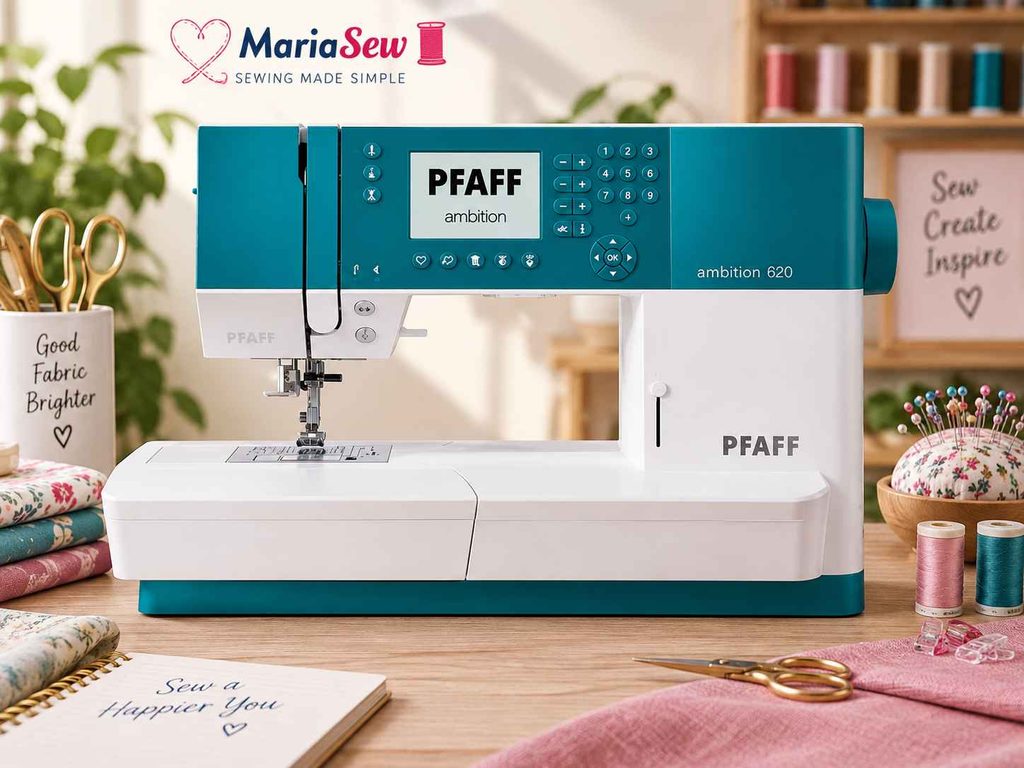
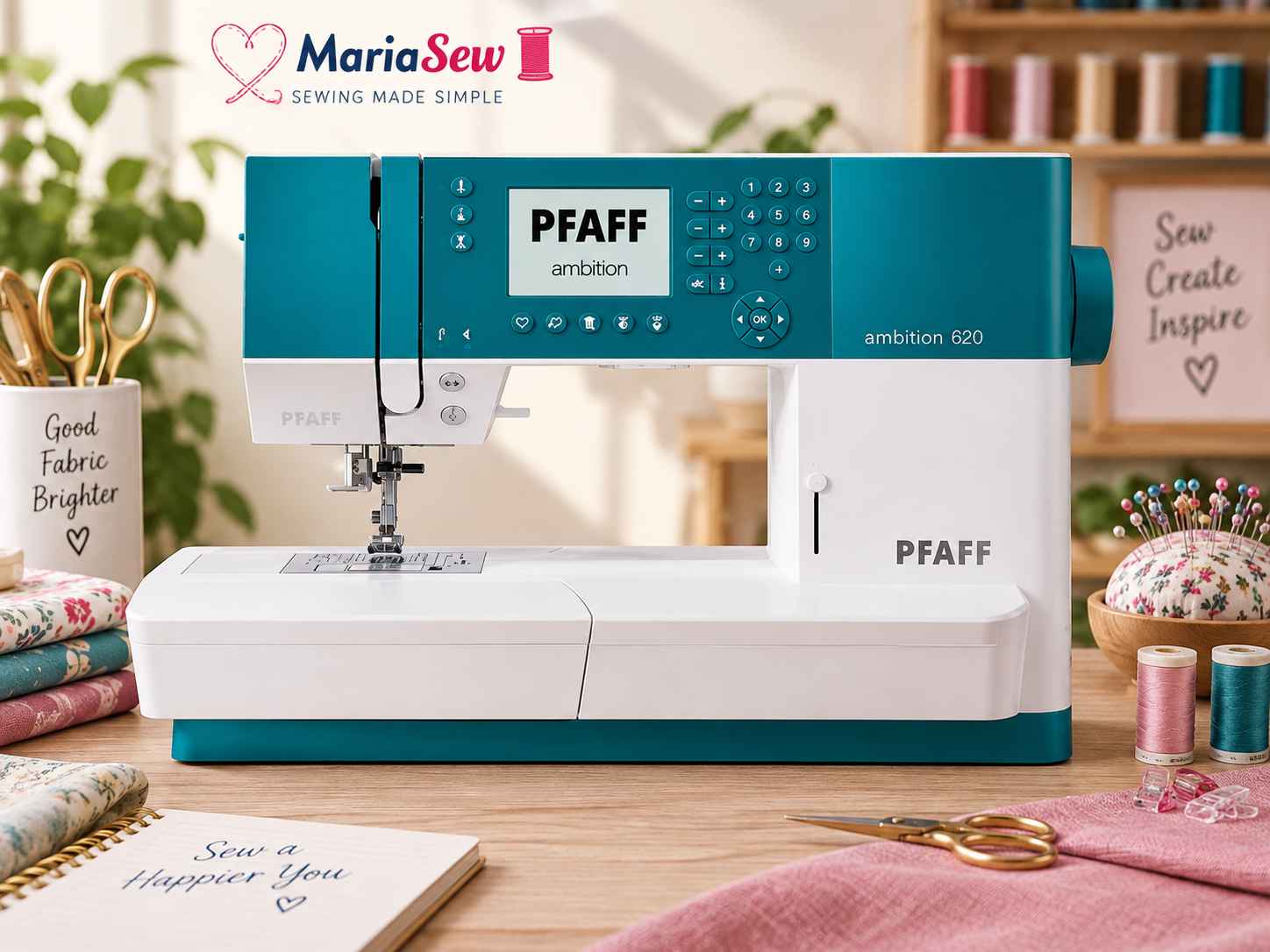
The PFAFF Ambition 620 makes more sense at the needle than on a spec sheet. Its Original IDT dual-feed system feeds fabric from the top and bottom, so layers, quilt sandwiches, and slippery fabrics stay aligned without a separate walking foot. Add automatic tension, 29 needle positions, thread snips, and a roomy 7.9-inch workspace, and you get a machine built for accurate, controlled sewing. It is not the fastest or largest in its class, but for garments, quilting, and mixed-layer work, it is a precise, premium pick.
What We Loved
- Original IDT integrated dual feed keeps layers aligned
- Automatic tension plus 29 needle positions for precise placement
- Useful 200 mm (7.9 in) workspace for quilts and coats
- Thread snips, speed slider, start/stop, needle threader
- 136 stitches, 2 fonts, and a free arm for garments
Keep In Mind
- 800 SPM is moderate for a premium machine
- 7.9-inch space is good, not class-leading
- Dealer-exclusive, so it is a real investment
Verdict based on hands-on testing across quilting cotton, denim, knits, and layered fabric. Prices change often. This post contains affiliate links; MariaSew may earn a small commission at no extra cost to you.
PFAFF Ambition 620 at a Glance
PFAFF currently lists the Ambition 620 as a dealer-exclusive machine in the United States. As of August 2026, the official Price is around $1,799, though dealer packages and pricing can change. Warranty terms vary by dealer, typically 1 year of service coverage in the US; confirm directly with your authorized PFAFF dealer before purchase.
- Best for: Intermediate sewists, ambitious beginners, garment makers, quilters, home décor sewing, precision topstitching, and mixed-layer projects.
- Machine type: Computerized domestic sewing machine with free-arm capability and integrated dual feed.
- Main strength: Controlled fabric feeding and precise placement without requiring a separate walking foot for many tasks.
- Main limitation: Moderate 7.9-inch workspace and 800 SPM speed compared with larger, faster premium quilting machines.
- Current U.S. positioning: Dealer-exclusive PFAFF model with 136 stitches, automatic tension, thread snips, speed control, and 21 listed accessory items.
The Ambition 620 makes the most sense for someone who sews regularly and will actually use IDT, automatic tension, adjustable speed, needle positioning, and sequencing. If you mainly mend hems twice a year, much of the feature set will sit unused.
Introduction to the Pfaff Ambition 620
The Pfaff Ambition 620 is aimed at home sewists who want more control than a basic mechanical machine provides. It combines an LCD screen, adjustable sewing speed, a large sewing area, and a substantial selection of built-in stitches. I see it as a practical middle ground: capable enough for clothing, repairs, decorative work, and quilting, but not presented as an embroidery machine.
The main attraction is the Original IDT System, which feeds fabric from both the top and bottom. That arrangement is particularly relevant when keeping layers aligned matters, although the result still depends on needle choice, thread, pressing, and careful preparation.When I think about Pfaff sewing machine reviews generally, I want to look beyond the stitch count and ask whether the machine makes ordinary sewing less frustrating.
Here, the answer comes largely from the feeding system and the amount of control available at the needle.
This review focuses on the machine as a domestic sewing tool rather than treating every specification as equally important. A long stitch menu can be fun, but the everyday experience is shaped more by threading, fabric handling, speed adjustment, and workspace. Those are also the details I would use when comparing options described as the best Pfaff sewing machine for home or the best Pfaff sewing machine for beginners.
How I Test Sewing Machines at MariaSew
I have more than 12 years of sewing experience, and I personally use every sewing machine I review before I recommend it. I do not score a machine from the box, a retailer page, or the stitch count alone. I thread it, wind bobbins, change feet, sew real fabric, repeat the same seams at different speeds, and pay attention to the small frustrations that only show up after the setup stage.
- Stitch quality. I inspect the top and underside for balanced locking, consistent stitch length, skipped stitches, puckering, and changes when speed increases.
- Fabric feeding. I compare ordinary feeding with Original IDT engaged, especially on multiple layers, seam matching, slippery fabric, and quilt sandwiches.
- Control and ergonomics. I test the speed slider, 29 needle positions, needle up/down, start/stop, reverse, tie-off, screen navigation, thread snips, and foot changes.
- Fabric range. I move from ordinary cotton to denim, lightweight fabric, stretch fabric, and layered quilting, so the machine has to adapt rather than repeat one easy seam.
- Ownership experience. I consider threading, bobbin access, accessory storage, free-arm conversion, weight, cleaning, dealer support, and whether the features save enough time to justify the price.
For a computerized machine like the PFAFF Ambition 620, I test straight stitches on quilting cotton, layered seams with IDT engaged, denim seam transitions, lightweight woven fabric, stretch fabric, buttonholes, decorative stitches, needle-position changes, pivoting with needle-down, thread snips, free-arm work, and a small quilt sandwich. I also compare low-speed control with full-speed sewing and check whether the machine stays intuitive after switching between construction and decorative tasks.
PFAFF Ambition 620 Features: What Each One Actually Does
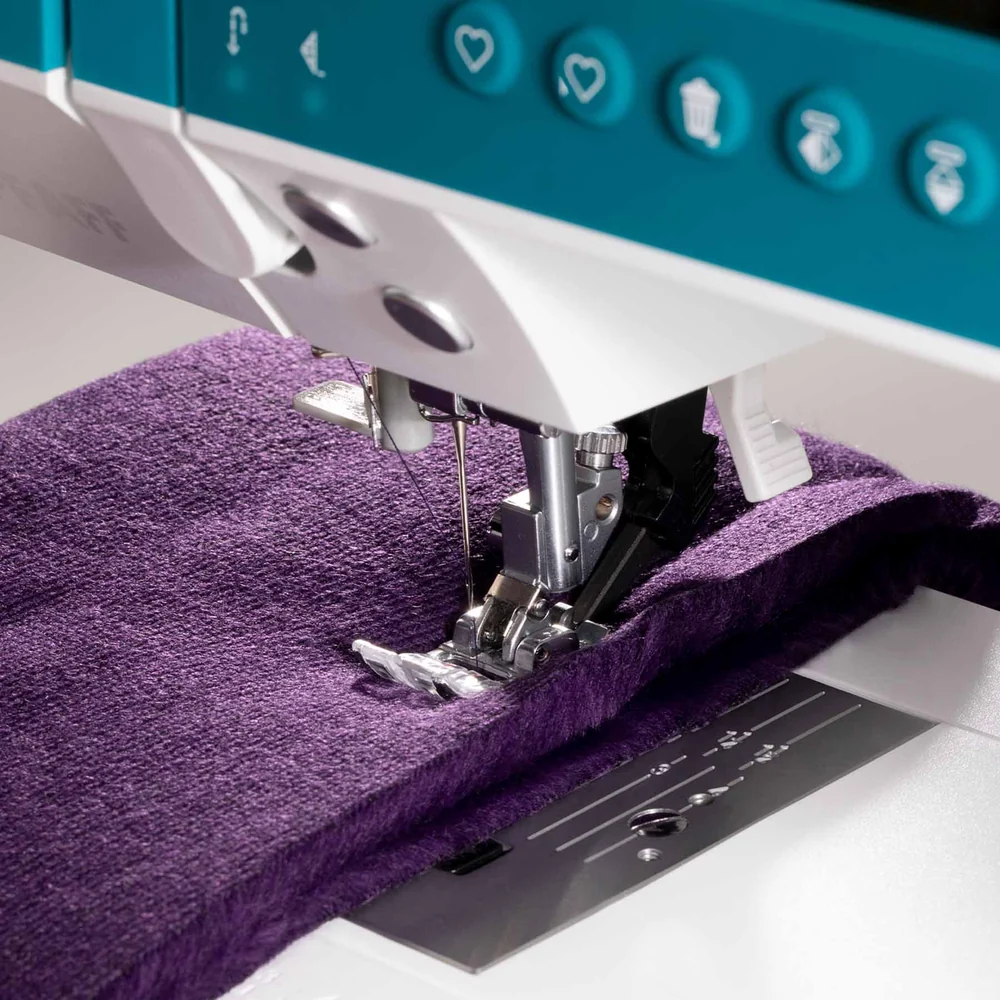
The Ambition 620 has a long feature list, but not every feature has the same value. I rank the following functions by how much they affect fabric control, sewing accuracy, workflow, and the range of projects the machine can handle.
Original IDT Integrated Dual Feed
PFAFF’s Original IDT System feeds fabric from both above and below instead of relying only on the lower feed dogs. In practice, this is the feature I notice most when matching stripes, sewing quilt layers, feeding slippery fabrics, or keeping long seams from creeping out of alignment.
200 mm / 7.9-Inch Sewing Space
The space to the right of the needle measures 200 mm, or about 7.9 inches. That gives quilt sections, coats, bags, and home décor fabric more room than an entry-level compact machine, although dedicated quilting models with 10-inch or larger flatbeds still feel roomier.
136 Built-In Stitches
PFAFF officially lists 136 stitches, covering utility, stretch, quilting, decorative, satin, and specialty applications. The real value is not using all 136; it is having enough construction stitches plus decorative options without the interface feeling overloaded.
Two Built-In Sewing Fonts
The Ambition 620 includes two sewing fonts for labels, initials, and simple personalization. These are sewing alphabets rather than embroidery fonts, so they work within the machine’s stitch system and should not be confused with hoop embroidery.
7 mm Maximum Stitch Width and 5 mm Length
A maximum 7 mm width gives zigzag and decorative stitches enough presence for garment and craft work, while the 5 mm maximum stitch length covers ordinary construction, basting, and topstitching needs. Some premium competitors offer 9 mm decorative width.
Automatic Thread Tension
The machine automatically sets thread tension for the selected stitch. I still check the result when changing to unusual thread, very light fabric, or dense layers, but automatic tension removes a common manual adjustment from normal sewing.
800 Stitches per Minute with Speed Slider
PFAFF lists a maximum speed of 800 stitches per minute. The speed slider matters more to me than the top number because I can slow the machine for curves, appliqué, buttonholes, or tricky layers and then increase speed for long straight seams.
29 Needle Positions
Twenty-nine needle positions make it easy to fine-tune seam placement without physically shifting the fabric. I use that control for edge stitching, zipper work, topstitching, understitching, quilting lines, and stitching in the ditch.
Needle Up/Down
The needle can be programmed to stop in the fabric, which makes pivoting around corners and curves much more controlled. It is one of those features that sounds minor until you sew appliqué, patchwork, pockets, or repeated topstitching.
Automatic Thread Snips
The built-in thread snip function trims the threads without reaching for scissors at the end of every seam. During repetitive piecing and garment construction, this is a genuine workflow improvement rather than just a convenience button.
Start/Stop Sewing Button
The machine can sew without the foot controller when the start/stop button is used. Combined with the speed slider, this can be helpful for long controlled seams or for sewists who prefer hand-operated speed control.
Mirror Image of Stitches
Decorative stitches can be mirrored for symmetrical layouts and border work. This is most useful for embellishment, garment details, and pattern balancing rather than basic seam construction.
Stitch Elongation
Satin stitches can be lengthened while maintaining their density. That allows a decorative motif to become longer without simply stretching the gaps between stitches.
Twin Needle Program
After entering the twin-needle size, the machine limits stitch width to reduce the risk of the needle striking the presser foot or needle plate. It also previews the twin-needle stitch on the display.
Built-In Needle Threader
The built-in needle threader reduces eye strain and speeds up routine setup. It is especially useful if you change thread colors frequently or sew for long sessions.
Stitch Sequencing
The Ambition 620 can build and save stitch sequences, which is useful for decorative borders, repeated motifs, and lettering combinations. This feature is more valuable to creative sewists than to someone using only utility stitches.
Free Arm
Removing the accessory tray exposes a free arm for sleeves, trouser hems, cuffs, and other tubular pieces. That makes the Ambition 620 more garment-friendly than fixed-flatbed machines that prioritize quilting space over narrow openings.
Drop Feed and Free-Motion Capability
The user guide provides for lowering the feed dogs for free-motion work. That supports free-motion quilting, thread painting, and darning, although success still depends on the correct foot, needle, thread, speed, and hand movement.
Included Presser Feet and Hard Cover
The current PFAFF package lists seven presser feet, including several IDT-compatible feet, a zipper foot, blindhem foot, fancy-stitch feet, and a one-step buttonhole foot. A hard cover and the usual bobbins, tools, needles, and guides are also included.
PFAFF Ambition 620 Full Specifications
The feature explanations above show how the machine behaves in normal use. The specification table below collects the current official numbers in one place so you can compare the Ambition 620 with other computerized sewing and quilting machines.
Specifications alone do not tell you whether the machine will suit your projects, but they do reveal the design priorities: moderate-to-large workspace, controlled 800 SPM speed, 7 mm stitching, integrated dual feed, automatic tension, and a practical rather than enormous stitch library.
| Feature / Specification | Official Detail | What It Means in Practice |
|---|---|---|
| Machine type | Computerized domestic sewing machine | Garments, quilting, crafts, home décor, repairs |
| Built-in stitches | 136 | Utility, stretch, quilting, satin, decorative and specialty stitches |
| Sewing fonts | 2 | Stitched lettering and simple personalization |
| Maximum stitch width | 7 mm | Decorative and zigzag width |
| Maximum stitch length | 5 mm | Construction, basting and topstitching range |
| Maximum sewing speed | 800 stitches per minute | Controlled domestic sewing speed |
| Speed control | Speed slider | Limits maximum speed for detailed work |
| Feed system | Original IDT integrated dual feed | Feeds fabric from top and bottom |
| Sewing space | 200 mm / 7.9 in to right of needle | Useful for quilts and larger projects |
| Screen | 2.8″ x 1.4″ LCD display ( | Shows stitch and setting information |
| Needle positions | 29 | Fine seam and topstitch placement |
| Needle up/down | Yes | Controlled pivoting and quilting |
| Thread cutter | Automatic thread snips | Trims threads at seam end |
| Thread tension | Automatic | Sets normal tension by stitch selection |
| Needle threader | Built-in | Faster threading and less eye strain |
| Start/stop | Yes | Sewing without foot controller |
| Stitch sequencing | Yes | Combines decorative stitches and lettering |
| Mirror image | Yes | Side-to-side decorative mirroring |
| Stitch elongation | Yes | Lengthens satin motifs while retaining density |
| Twin needle program | Yes | Width protection and on-screen twin-needle preview |
| Free arm | Yes | Sleeves, cuffs and trouser hems |
| Machine dimensions | 18.9 x 7.6 x 11.8 in / 48 x 19.3 x 30 cm | Full-size domestic footprint |
| Machine weight | 19.4 lb / 8.8 kg | Stable but still movable |
| Included presser feet | 7 | Standard, fancy stitch, blindhem, zipper and buttonhole use |
| Current U.S. listed price | $1,799 as of Aug. 2026 | Dealer-exclusive pricing may change |
The table makes the machine’s positioning clear. It is more feature-rich and controlled than an entry-level computerized model, but it deliberately stops short of the extreme speed, 9 mm decorative width, huge throat space, and advanced touchscreen systems found on higher-tier quilting machines.
Stitch Quality and Real-World Performance
The Ambition 620 makes the strongest impression when stitch quality and fabric feed are evaluated together. An even stitch is only useful if the layers arrive under the needle in the same alignment you intended, and that is where IDT changes the experience.
Straight Stitch on Quilting Cotton
On ordinary quilting cotton, the machine produces the kind of stable, predictable straight seam I expect from a mid-range computerized PFAFF. The automatic tension keeps normal thread balance straightforward, while the 29 needle positions make it easy to fine-tune seam allowance or edge-stitch placement.
I do not need IDT to make basic cotton sew well, but engaging it makes long seams feel more controlled. The benefit becomes more obvious when two pieces need to finish at the same length rather than when I am simply sewing one easy test strip.
Layered Quilting and Piecing
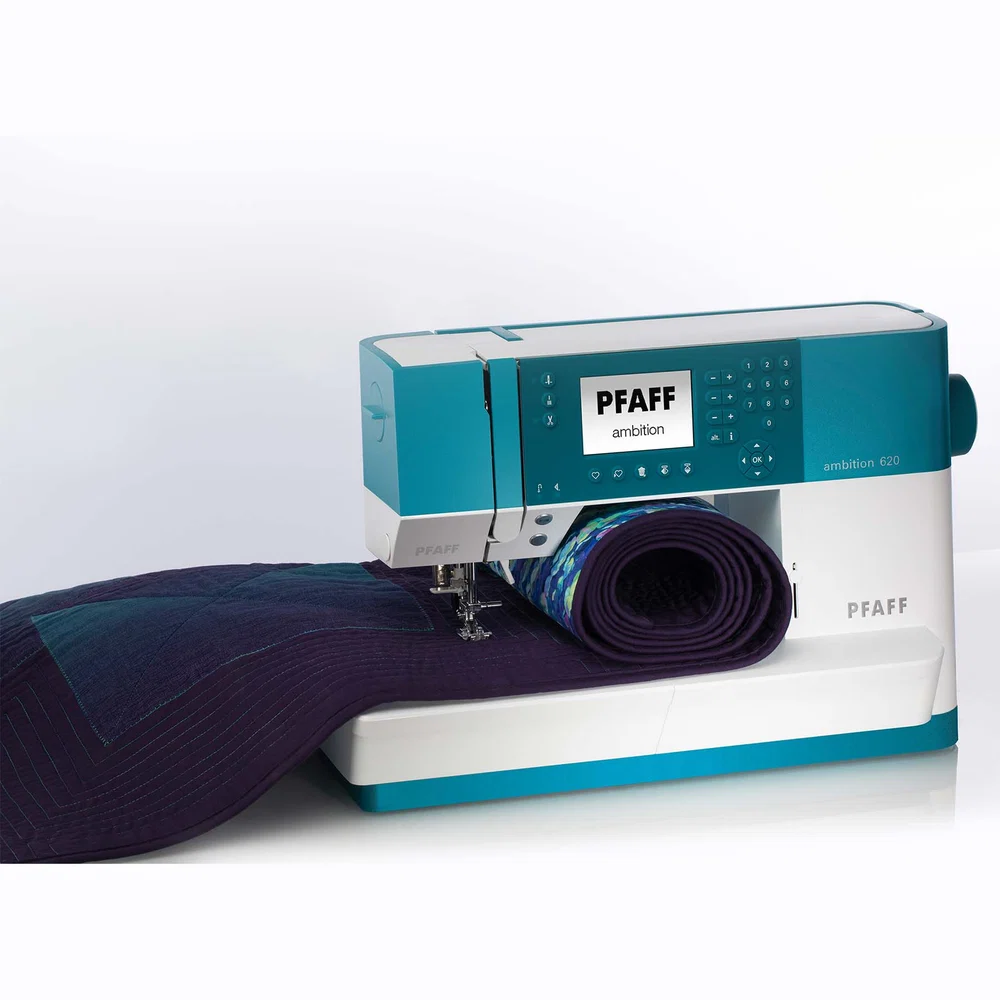
For quilt piecing and layered cotton, IDT is the Ambition 620’s strongest practical advantage. It reduces the tendency for the upper layer to creep ahead of the lower layer, which helps matched seams and long borders stay where they were pinned or clipped.
The 7.9-inch throat gives useful working room for blocks and smaller quilt sections. For very large quilts, I still prefer the extra support and 10-inch-plus flatbeds available on larger quilting-focused machines, but the Ambition 620 is far more comfortable than a compact beginner machine.
If quilting is your main priority, compare it with the best quilting sewing machine guide before deciding how much throat space you really need.
Denim, Canvas, and Bulky Seam Crossings
The Ambition 620 handles ordinary garment denim, canvas, and layered seams well when I use the correct needle, sensible stitch length, and a slower approach at thick intersections. IDT helps keep the layers moving together, but it does not turn the machine into an industrial leather or upholstery machine.
At bulky hem transitions, I still level the presser foot and reduce speed instead of forcing the motor. That protects the needle and gives the feed system time to maintain stitch length as the foot climbs and descends the seam stack.
Lightweight and Slippery Fabrics
Lightweight fabrics are a useful test because feed problems show up quickly as puckering, creeping, or distorted seam lines. The combination of automatic tension, controlled speed, narrow needle-position options, and IDT gives the Ambition 620 more control than a basic machine with one fixed feeding setup.
I still switch to the right fine needle, use a stable seam start, and test on scraps before sewing chiffon or similarly delicate fabric. Feeding technology helps, but technique and stabilization still determine whether a lightweight seam looks clean.
Stretch Fabrics and Knits
The built-in stretch stitches and controlled feeding make the machine useful for knit garments, but the result depends heavily on needle choice and stitch selection. I use a stretch or ballpoint needle when appropriate and avoid pulling the fabric behind the presser foot.
IDT can help keep paired layers feeding together, especially on long seams, but it is not a substitute for testing seam stretch and recovery. The finished seam has to move with the garment without popping or becoming wavy.
For more guidance on working with knits, see the guide to sewing stretch fabric.
Buttonholes and Decorative Stitches
The one-step buttonhole foot simplifies repeated buttonholes, while the 136-stitch library gives enough decorative variety for garments, crafts, labels, and home décor. Mirror imaging, elongation, sequencing, and the two fonts make the creative side more useful than a basic menu of isolated motifs.
For decorative work, I always stabilize first and test the full repeat on a scrap. Wide satin stitches can expose feeding or tension problems that are invisible in a normal straight seam.
Free-Motion Quilting and Darning
With the feed dogs lowered and the correct free-motion foot, the Ambition 620 can handle free-motion quilting, stippling, thread painting, and darning. The 800 SPM maximum is not a disadvantage here because free-motion control usually matters more than outright speed.
I use the speed slider to cap the machine at a comfortable pace and focus on moving the fabric smoothly. Free-motion quality depends as much on the operator’s hand speed and rhythm as on the machine itself.
Ease of Use: Beginner-Friendly or Too Advanced?
The Ambition 620 is approachable, but I would not call it a stripped-down beginner machine. A new sewist can start with straight stitch, zigzag, automatic tension, slower speed, and needle up/down, then gradually add IDT, sequencing, twin-needle settings, and decorative functions.
- What beginners will like. Automatic tension, built-in threading, clear stitch information, speed control, start/stop, and needle up/down reduce several common setup frustrations.
- What requires learning. IDT engagement, stitch sequencing, decorative settings, twin-needle programming, free-motion work, and the broader stitch library reward time with the manual.
- Why it can be a good long-term first machine. A motivated beginner is unlikely to outgrow the workspace, feeding control, or stitch range quickly.
- Why some beginners should choose simpler. If the goal is occasional repairs and straight seams, the price and feature depth are difficult to justify.
I would recommend the Ambition 620 to an ambitious beginner who wants a machine to grow into, not to someone looking for the cheapest or most portable way to learn basic sewing.
For beginners comparing simpler options, the best sewing machines for beginners guide provides a useful point of comparison.
Pros and Cons of the PFAFF Ambition 620
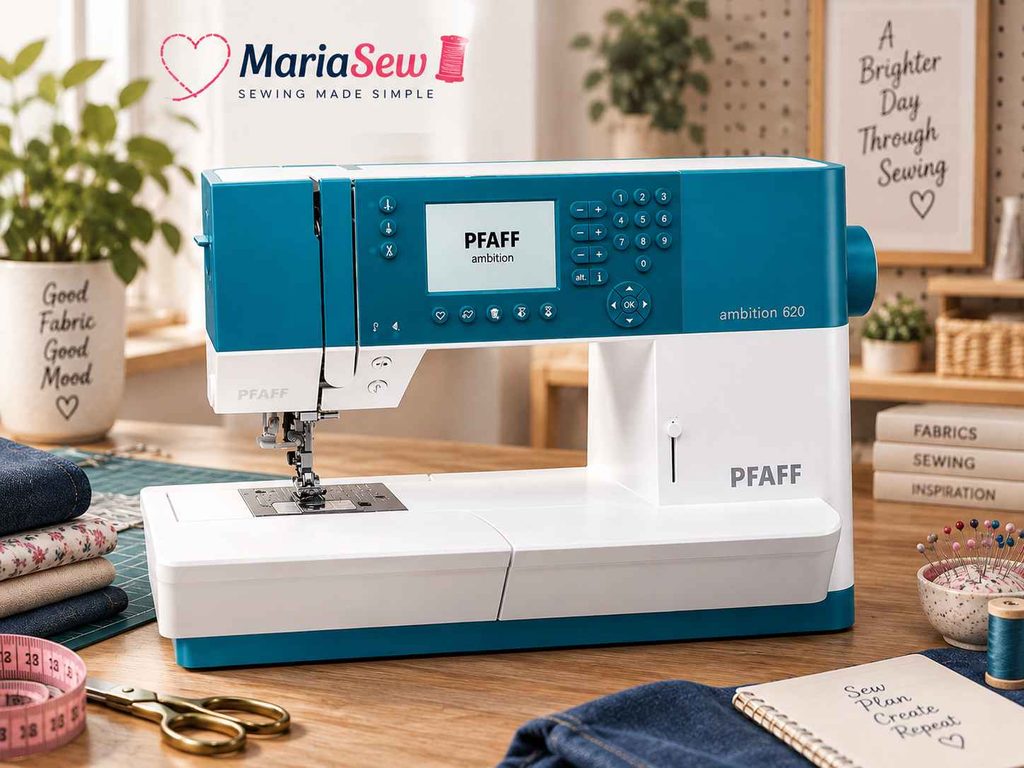
The strengths of the Ambition 620 are tightly connected to precision and fabric control. Its weaknesses come mainly from where it sits in the market: it costs much more than beginner machines but does not reach the speed, workspace, or interface sophistication of the most expensive quilting platforms.
Pros of the PFAFF Ambition 620
- Original IDT integrated dual feed. Excellent for keeping layers aligned without fitting a separate walking foot for many everyday tasks.
- Automatic tension with precise needle control. Automatic tension, 29 needle positions, and needle up/down make garment and quilting setup more repeatable.
- Useful 200 mm workspace. Roomy enough for quilting, coats, bags, and home décor without the bulk of an extra-large studio machine.
- Strong workflow features. Thread snips, speed slider, start/stop, built-in needle threader, sequencing, and a clear screen reduce repetitive steps.
- Balanced stitch library. 136 stitches and two fonts give creative range without turning the machine into an embroidery-centered system.
These advantages matter most to a sewist who regularly changes fabrics, matches layers, topstitches, quilts, or switches between construction and detail work.
Cons of the PFAFF Ambition 620
- 800 SPM is moderate for the price. Faster premium sewing machines reach 1,000 to 1,200 SPM, which matters for high-volume piecing or long production-style seams.
- The 7.9-inch workspace is good rather than huge. Large-quilt specialists may prefer a 10-inch or larger flatbed.
- Dealer-exclusive pricing is a significant investment. At the current $1,799 U.S. listing, buyers should be certain they will use IDT and the advanced controls rather than paying mainly for unused features.
None of these issues makes the machine weak. They simply narrow the ideal buyer: the PFAFF Ambition 620 is a precision-focused mid-to-premium domestic machine rather than the fastest or largest option in its class.
Final Verdict: I recommend the PFAFF Ambition 620 to home sewists who care more about smooth layered feeding, accurate seam placement, automatic tension, and controlled workflow than headline speed. It is especially strong for garments, quilting, topstitching, home décor, and mixed fabric weights, but value drops quickly if you only need basic straight and zigzag sewing.
Who Should Buy the PFAFF Ambition 620?
The right buyer already knows which frustrations they want the next machine to solve. If layer shifting, limited needle control, inconsistent speed, or cramped workspace are regular problems, the Ambition 620 is a meaningful upgrade.
- Intermediate sewists upgrading from a starter machine. You gain automatic tension, IDT, thread snips, more workspace, more needle positions, and much better speed control.
- Garment makers. Free-arm access, precision needle placement, top-and-bottom feeding, buttonholes, zipper feet, and decorative options all support clothing construction.
- Quilters and patchwork sewists. IDT, needle down, speed control, free-motion capability, sequencing, and the 200 mm workspace are useful across piecing and quilting.
- Home décor and bag makers. Layered feeding and controlled stitching help when fabrics, interfacing, batting, or multiple panels need to stay aligned.
- Sewists who value automation without embroidery. The machine adds automatic tension, thread cutting, and computerized controls while staying focused on sewing rather than hoops and imported designs.
For a lower-cost large-flatbed alternative, the hands-on Janome MC6650 review is worth reading before you decide.
Who Should Not Buy the PFAFF Ambition 620?
A good sewing machine can still be the wrong purchase. I would not recommend paying for the Ambition 620 if your routine does not use the systems that make it different.
- Occasional menders. A simple mechanical or entry-level computerized machine can handle hems, repairs, and basic seams for much less.
- Sewists who prioritize maximum speed. The 800 SPM ceiling is controlled and comfortable, but performance-oriented machines run faster.
- Large-quilt specialists. A 10-inch or larger workspace can be easier when wrestling with full-size quilts.
- Embroidery-focused buyers. The Ambition 620 has decorative stitches and fonts, but it does not replace a hoop embroidery machine.
- Frequent class or travel sewists. At 19.4 pounds, it is movable but not as convenient as a dedicated portable machine.
If you want a more portable computerized option, the Janome 3160QDC-G review shows what you gain and give up with a lighter quilting machine.
PFAFF Ambition 620 vs. Janome MC6700P vs. Juki HZL-DX7 vs. BERNINA 570 QE
These four machines overlap in serious home sewing and quilting, but they are not direct twins. The PFAFF emphasizes integrated feeding and controlled domestic sewing, the Janome emphasizes speed and a large all-metal flatbed, the Juki combines faster sewing with extensive computerized convenience, and the BERNINA moves into a more premium quilting and embroidery-capable platform.
I would decide by the feature that solves the biggest problem in your sewing room. If you constantly fight shifting layers, PFAFF’s IDT is compelling. If you want maximum flatbed space and speed, the Janome is stronger. If you want a free arm with 1,050 SPM, automatic trimming, and a large stitch library, the Juki deserves attention. If budget is secondary to a premium interface, integrated dual feed, BSR support, and embroidery expansion, the BERNINA sits in a different tier.
PFAFF Ambition 620 vs. Janome Memory Craft 6700P
The Janome Memory Craft 6700P is the stronger choice if sewing speed, workspace, and a large stitch selection are your priorities. It reaches up to 1,200 SPM, offers 10 inches of space to the right of the needle, and includes 200 stitches with up to 9 mm stitch width. For quilting and larger projects, that extra workspace can make fabric handling more comfortable.
The PFAFF Ambition 620 is slower and more compact, but its Original IDT integrated dual-feed system gives it a clear advantage when working with multiple or shifting fabric layers. Its free arm also makes it more versatile for garment sewing and smaller projects. Choose PFAFF for controlled fabric feeding, or Janome for greater speed and workspace.
PFAFF Ambition 620 vs. Juki HZL-DX7
The Juki HZL-DX7 offers a much broader set of computerized features, making it an appealing alternative for sewists who want versatility. It reaches 1,050 SPM and includes 287 stitches, four fonts, 16 buttonholes, automatic thread trimming, electronic presser-foot lift, and a free arm. These features give the Juki an edge for decorative sewing, garments, and feature-rich projects.
The PFAFF Ambition 620 takes a more focused approach, with fewer stitches and a lower maximum speed but a strong emphasis on precise fabric control through its Original IDT system. It can be a better fit for sewists who care more about consistent feeding than having a large library of stitches and automation. For maximum functionality, Juki has the advantage, while PFAFF offers a more focused sewing experience.
PFAFF Ambition 620 vs. BERNINA 570 QE
The BERNINA 570 QE sits in a more premium category, with a 1,000 SPM maximum speed, 9 mm stitch width, around 8.5 inches of workspace, integrated dual feed, automatic thread cutting, and a 4.3-inch color touchscreen. It also supports BSR and optional embroidery, making it attractive to quilters and advanced sewists looking for room to expand.
The PFAFF Ambition 620 is the simpler and more sewing-focused option, particularly for buyers who want integrated fabric feeding without moving into a premium platform. Its Original IDT system is a major selling point for managing layers, while the BERNINA offers more advanced features and expansion potential. Choose PFAFF for straightforward sewing and value, or BERNINA for a premium quilting platform with more advanced capabilities.
Quick Comparison
The comparisons above explain the design differences. The table below is only a final reference for the headline specifications, not a substitute for testing the controls and fabric feed in person.
Bring your own fabric to a dealer if possible. A machine can look perfect on paper and still feel wrong if the pedal response, screen, feeding system, free arm, or workspace does not match the way you sew.
Premium Sewing & Quilting Machines Compared
| Machine | Speed | Stitches | Throat Space | Stitch Width | Feed System | Best Fit | Buy |
|---|---|---|---|---|---|---|---|
| PFAFF ambition 620Computerized · layered work | 800 SPM | 1362 fonts | 7.9 in | 7 mm | Original IDT | Best for controlled layered feeding | Check Price |
| Janome MC6700PComputerized · large flatbed | 1,200 SPM | 200 | 10 in | 9 mm | AcuFeed Flex option / HP system | Best for speed & large flatbed | Check Price |
| Juki HZL-DX7Computerized · automation | 1,050 SPM | 2874 fonts | ~8 in class | 7 mm | Juki box feed | Best for automation & free arm | Check Price |
| BERNINA 570 QEPremium · quilting/embroidery | 1,000 SPM | 1,450stitches/chars | 8.5 in | 9 mm | BERNINA Dual Feed | Best premium quilting & embroidery platform | Check Price |
Specs at a glance: speed, stitch count, throat space, width, and feed system. Prices change often. As an Amazon Associate, MariaSew earns from qualifying purchases, at no extra cost to you.
For most buyers, the important split is straightforward: choose the PFAFF for IDT and controlled garment/quilt versatility, Janome for maximum speed and flatbed room, Juki for computerized convenience and a free arm, or BERNINA for a significantly more premium ecosystem.
Maintenance and Ownership Tips
Like any computerized sewing machine, the Ambition 620 needs basic cleaning and correct consumables to stay consistent. The user guide includes dedicated maintenance procedures for the bobbin area, feed area, needle plate, and troubleshooting.
- Clean lint from the bobbin and feed area. Quilting cotton, flannel, fleece, batting, and some garment fabrics can build up lint quickly.
- Replace dull or bent needles. A damaged needle can cause skipped stitches, shredding, poor penetration, or apparent tension problems.
- Use the correct bobbins and presser feet. IDT works best with compatible IDT feet designed for the system.
- Rethread before blaming automatic tension. Threading errors, lint, bobbin placement, or a damaged needle can make a correct tension setting look wrong.
- Have internal service done by an authorized technician. Timing, electronics, damaged LED components, or internal drive issues should not be treated as normal user maintenance.
If a seam starts looping or pulling unexpectedly, use the sewing machine tension troubleshooting guide before changing multiple settings at once.
The best maintenance routine is simple and repeatable: clean after lint-heavy projects, change the needle before it becomes a problem, and test the machine after every major fabric or thread change.
Common PFAFF Ambition 620 Mistakes to Avoid
Most frustration with the Ambition 620 comes from using an advanced feature without matching the rest of the setup. The machine is designed to give you more control, but that control works best when changes are deliberate.
- Leaving IDT engaged with an incompatible foot. Use IDT-compatible feet when the system is engaged and follow the presser-foot instructions.
- Expecting IDT to replace fabric preparation. Dual feed helps alignment, but accurate cutting, pinning, clipping, pressing, and basting still matter.
- Running full speed across bulky seam stacks. Slow down, level the foot, and let the needle and feed system climb the thickness instead of forcing the machine.
- Treating automatic tension as infallible. Specialty thread, unusual fabric, stabilizers, and decorative stitches can still need testing and adjustment.
- Ignoring the needle-position setting after a foot change. A wide stitch or offset needle can strike a foot or plate that was intended for centered straight stitching.
- Buying for 136 stitches instead of project fit. If you never use decorative work, sequencing, fonts, or precision controls, a simpler machine may offer better value.
- Comparing only MSRP. Dealer lessons, warranty service, included feet, and local technical support can change the real cost of ownership.
The PFAFF Ambition 620 is easiest to live with when you treat the screen, speed control, IDT, and needle positioning as a coordinated system rather than isolated buttons.
PFAFF Ambition 620 vs. Ambition 610
| Feature | Ambition 620★ Our Pick | Ambition 610Budget option |
|---|---|---|
| Built-in stitches | 136 | 110 |
| Sewing fonts | 2 alphabets | None |
| Thread tension | Automatic | Manual / adjustable |
| Stitch sequencing | Yes (combine up to 60) | No |
| Mirror image (end-to-end) | Yes | No |
| Automatic thread snips | Yes | No |
| Free-motion (drop feed) | Yes | No |
| Screen | Larger 3″ LCD | Smaller 2.8″ LCD |
| Included presser feet | 7–8 | 6 |
| Original IDT dual feed | Yes | Yes |
| Max stitch width | 7 mm | 7 mm |
| Max speed | 800 SPM | 800 SPM |
| Sewing space | 7.9 in | 7.9 in |
Which should you buy? Both machines share the same core: Original IDT dual feed, 800 SPM, 7 mm stitches, and the same 7.9-inch workspace, so they sew alike on everyday fabric. Step up to the Ambition 620 if you want the automation and creative extras, automatic tension, stitch sequencing, mirror imaging, thread snips, free-motion capability, two fonts, and a bigger screen. Save with the Ambition 610 if you mainly want IDT feeding and solid construction stitches and are happy to set tension yourself.
Is the PFAFF Ambition 620 Worth It in 2026?
Yes, for the sewist who will use its feeding and precision features. The machine combines Original IDT, automatic tension, a useful 7.9-inch work area, 136 stitches, two fonts, thread snips, speed control, 29 needle positions, free-arm sewing, and solid computerized convenience without forcing the buyer into embroidery.
It is less compelling if you mainly care about maximum speed or huge quilting space. At $1,799, the Ambition 620 has to earn its keep through smoother fabric handling and workflow. If that is exactly where your current machine frustrates you, the upgrade makes sense.
Final Verdict
The PFAFF Ambition 620 is one of those machines that makes more sense at the needle than on a feature-count spreadsheet. Its strongest advantages are the Original IDT System, automatic tension, precise needle control, thread snips, free arm, useful 200 mm workspace, and a speed range that feels easy to manage.
I would buy it for serious home sewing that moves between garments, quilting, layered projects, topstitching, and decorative work. I would choose something cheaper for occasional repairs, something faster and wider for high-volume quilting, or an embroidery-capable platform if stitched designs are a major goal.
Frequently Asked Questions
Does the PFAFF Ambition 620 support embroidery attachments?
No, the Ambition 620 is a sewing and quilting machine only. It does not accept an embroidery module or hoop attachment. For embroidery capability, look at PFAFF’s dedicated creative/embroidery combo lines instead.
How does PFAFF’s IDT compare to a separate walking foot?
IDT is built into the machine itself, feeding fabric from above and below without needing to attach a separate foot. A walking foot accomplishes something similar on machines that don’t have integrated dual feed, but IDT is generally considered more consistent since it’s engineered directly into the feed mechanism rather than added on top of it.
What’s the difference between the PFAFF Ambition 620 and Ambition 610?
The 610 is a step below the 620 in PFAFF’s Ambition line, typically with a smaller stitch library and fewer workflow features like sequencing and mirror imaging. If budget is the primary concern, it’s worth comparing directly with your dealer.
Does PFAFF offer financing for the Ambition 620?
Many authorized PFAFF dealers offer financing, commonly 0% interest plans ranging from 6 to 48 months depending on the dealer and purchase amount. Check with your local authorized dealer for current offers.
Is the PFAFF Ambition 620 good for beginners?
Yes, for a motivated beginner who wants room to grow. Automatic tension, speed control, needle up/down, and built-in threading are approachable, but IDT, sequencing, twin-needle settings, and the larger stitch library create more learning than a basic mechanical machine.
How many stitches does the PFAFF Ambition 620 have?
PFAFF currently lists 136 built-in stitches plus two sewing fonts. Maximum stitch width is 7 mm and maximum stitch length is 5 mm.
How fast does the PFAFF Ambition 620 sew?
The official maximum is 800 stitches per minute, and the speed slider lets you limit the machine for slower, more controlled work.
What is the PFAFF Original IDT System?
IDT is PFAFF’s integrated dual-feed system. It feeds fabric from the top while the lower feed dogs move it from below, helping multiple layers and shifting fabrics stay aligned.
Does the PFAFF Ambition 620 have automatic tension?
Yes. PFAFF’s current specification lists automatic thread tension for the Ambition 620.
Does the PFAFF Ambition 620 cut thread automatically?
Yes. The current specification lists automatic thread snips, which trim thread at the end of a seam.
Is the PFAFF Ambition 620 good for quilting?
Yes. IDT, needle down, speed control, free-motion capability, thread snips, and 200 mm of sewing space make it well suited to piecing and many quilting tasks.
Can the PFAFF Ambition 620 sew denim?
It can handle normal garment denim and layered seams with the correct denim needle, thread, stitch length, foot setup, and reduced speed at bulky transitions. It should not be treated as an industrial leather machine.
Does the PFAFF Ambition 620 have a free arm?
Yes. Removing the accessory tray exposes the free arm for sleeves, cuffs, trouser hems, and other tubular projects.
Is the PFAFF Ambition 620 an embroidery machine?
No. It includes decorative stitches and two sewing fonts but does not use embroidery hoops or imported embroidery design files.
What is the best alternative to the PFAFF Ambition 620?
For more speed and flatbed space, look at the Janome MC6700P. For stronger computerized automation and 1,050 SPM, consider the Juki HZL-DX7. For a premium quilting and embroidery-expandable system, compare the BERNINA 570 QE.