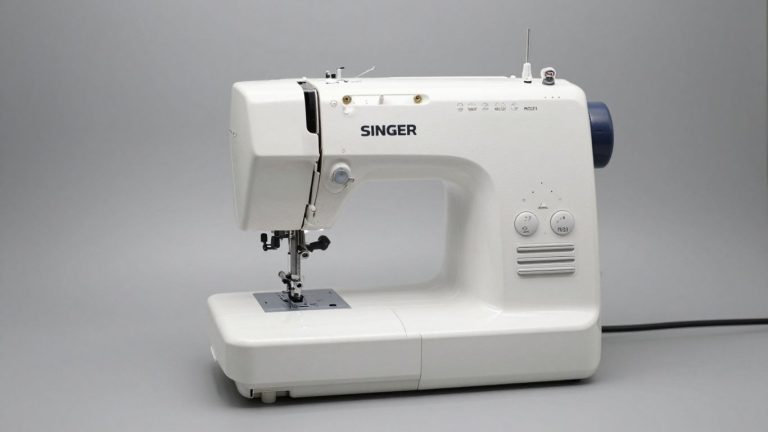
SINGER M3330 Review: Best Sewing Machine for Home Projects?
I’ve been looking for a sewing machine that can handle my weekend projects without breaking the bank or my patience. This SINGER M3330 Review is all about whether this particular model fits the bill.
I wanted to see if it’s really the best choice for home sewers, especially those of us who aren’t exactly pros. Let’s break down what this machine offers and if it’s worth adding to your craft room.
Key Takeaways
- The SINGER M3330 comes with 97 stitch applications, giving you plenty of options for different fabrics and projects. It includes basic, stretch, and decorative stitches.
- It’s generally considered easy to use, with a built-in needle threader and a free arm for tricky areas, making it a good pick for beginners.
- While many users find it reliable for everyday tasks and repairs, some have reported issues with thread jamming and the needle threader being finicky.
- The machine handles a variety of fabrics, from light materials to denim, though performance on very thick materials might vary.
- It’s a solid option for home projects and basic alterations, especially if you’re just starting or need a machine for simple mending.
Introduction to the SINGER M3330
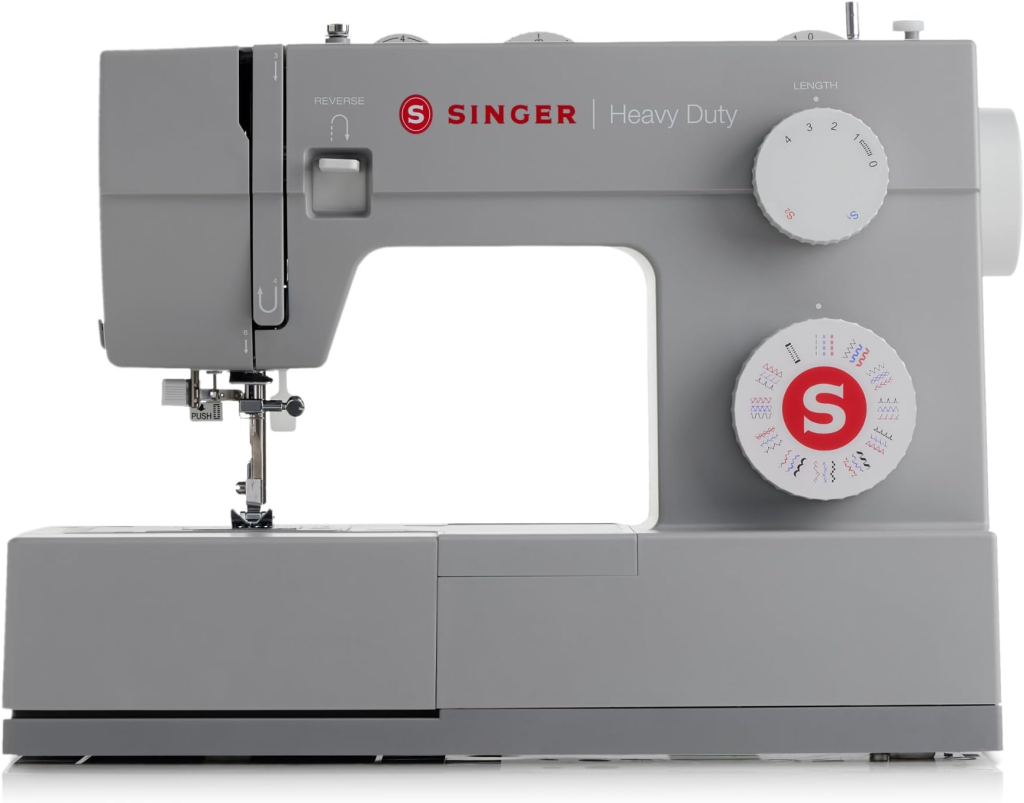
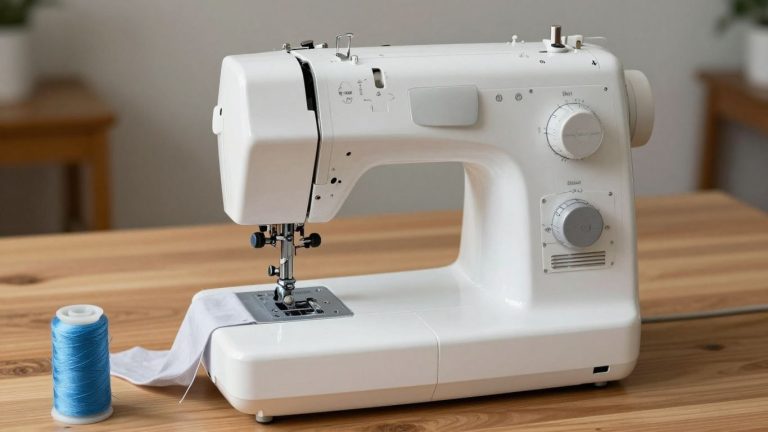
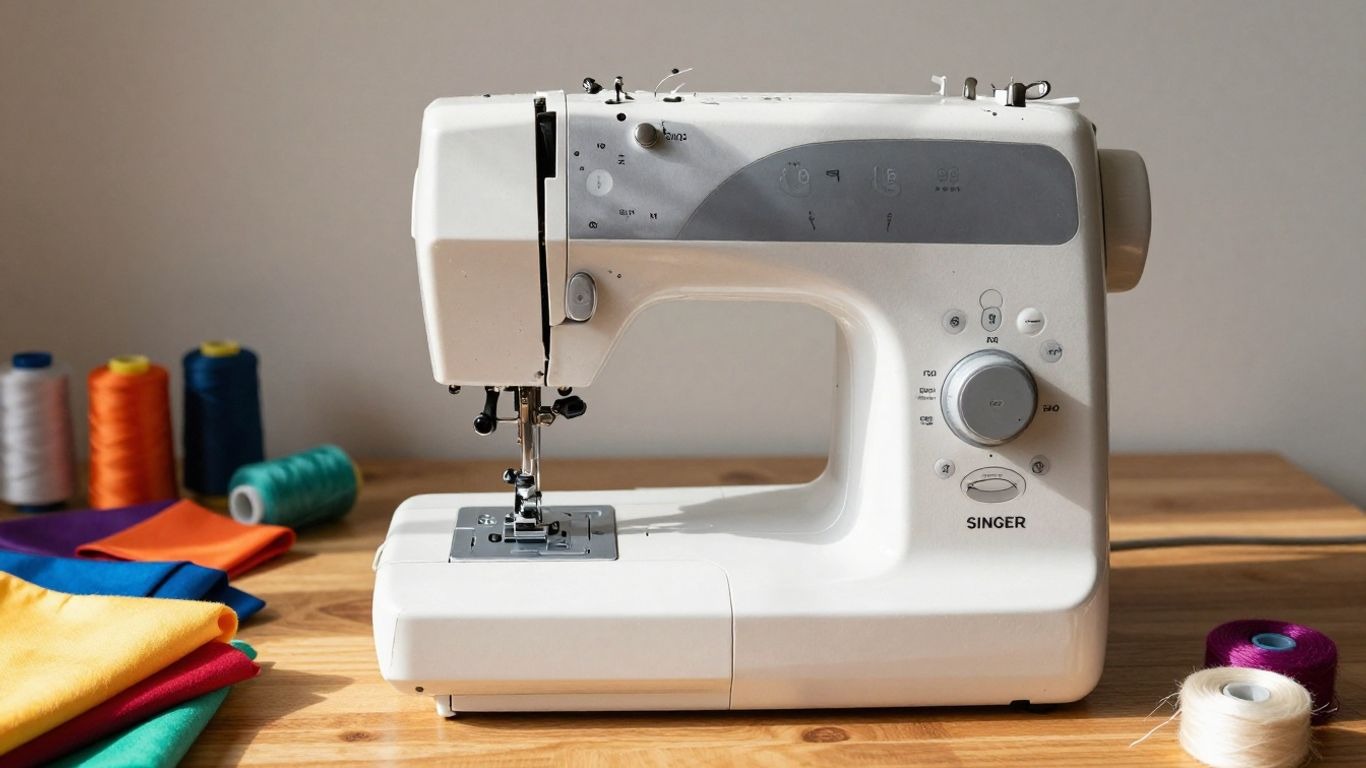
I have been researching the SINGER M3330 sewing machine, and I thought I would share some of my initial observations. If you’re like me and have a big stack of home projects waiting for some attention, this machine might be worthwhile to check out. It’s billed as a good fit for those just getting started, and that makes sense to me. The setup is pretty simple and comes with a good amount of accessories as standard.
On first unboxing, I noted how it felt quite solid. It’s not particularly heavy, but it also doesn’t feel flimsy. The idea of a machine that’s simple to understand is a nice benefit for anyone new to sewing. M3330, the singer, is hyped for beginners — and it lives up to that hype. It offers a decent range of stitch options, which is good since you don’t want to feel limited to only a straight stitch.
Here’s a quick rundown of what it offers:
- 97 stitch applications: A lot of options for varied fabrics and decorative elements.
- Built-in needle threader — This is a lifesaver, honestly. Whatever else you do, no more squinting and struggling to get that damned thread through the blessing needle.
- Free arm: Useful for sewing small things like sleeves or pant legs.
- It’s got a nice set of feet and tools included, which ups the value.
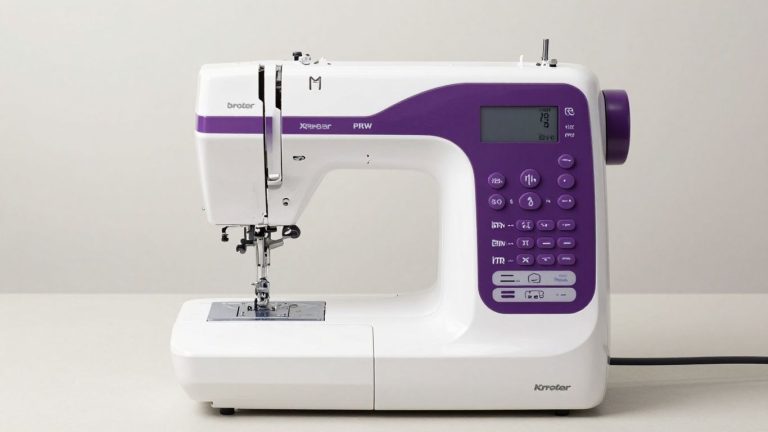
I’ve been really trying to get a feel for the features of the m3330 singer sewing machine, and in my opinion, they’ve done well to create a user-friendly practice. Of course, the singer m3330 user manual is not physical but can also be found on the internet. It’s nice to have a reference, so I suggest downloading the singer m3330 user guide before you begin.
For home projects such as a tote bag or apron, it feels more than capable. If you enjoy simple DIY projects like how to make a simple tote bag at home or how to sew an apron, this model offers enough stitch variety without overwhelming controls.
Key Features and Specifications
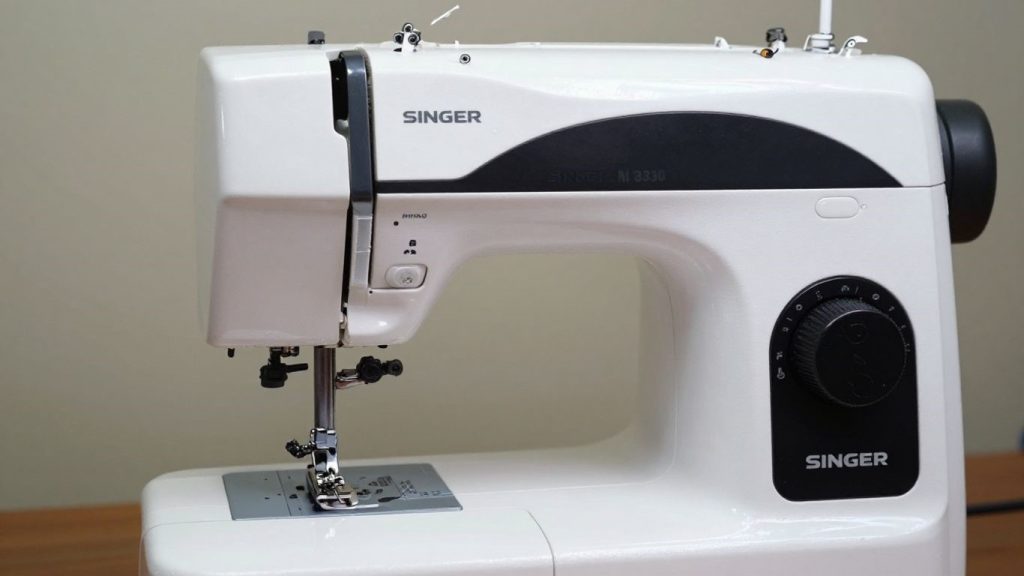
Let’s talk about the things that make the SINGER M3330 stand out when you actually get down to the nuts and bolts—or, in this case, needles and bobbins.
Stitch Options and Capabilities
What struck me immediately was the variety of possible stitches. The SINGER M3330 provides me with 23 built-in stitches and up to 97 stitch applications. These include basic stitches, such as straight and zigzag, but you also have the option of stretch stitches for knits, plus decorative ones that can make customizing projects much more fun.
If you are focused on quilting, you may prefer checking our guide on the best quilting sewing machine, since workspace size matters for larger projects.
Here’s a quick look at some of the most useful functions:
- One-step buttonhole: Just pop the button in, and the machine sizes it for you.
- Built-in needle threader: This really speeds things up.
- Adjustable length and width: If you want your stitches a bit tighter or wider, you just twist the knob.
| Feature | Specification |
|---|---|
| Built-in Stitches | 23 |
| Stitch Applications | 97 |
| Buttonhole Options | One-step automatic |
| Stitch Width Range | Adjustable |
| Stitch Length Range | Adjustable |
| Needle Threader | Built-in |
Some machines only offer basic stitch types—especially starter models like the SINGER M1000. In comparison, the M3330 feels like a big upgrade if you want room to experiment.
Ease of Use for Beginners
Honestly, so far, the most challenging part for me was threading the sewing machine; it was like solving a puzzle with missing pieces. The M3330 simplified things somewhat in several ways:
- The diagrams are clearly marked on the machine and are easy to follow.
- Picking a stitch seems pretty worry-free with the easy-to-use stitch selection dial.
- Snap-on presser feet swap out in seconds—no tools required.
There’s even an LED light so you can see what you’re doing, plus a front-loading bobbin that’s easy to replace. So all that said, while I felt like there were holes in the directions in this book where a more descriptive methodology would have helped, YouTube videos fill in the gaps pretty darn well.
The snap on presser feet and clear stitch dial make it less intimidating than some computerized alternatives like the Brother CS7205 review.
Build Quality and Durability
Let’s talk body. The metal frame that supports the machine means it doesn’t feel like it’ll break if you sneeze on it. That’s soothing after dealing with wobbly, lightweight models. At 13.6 lbs, it’s portable but not sliding all over the table while I work.
Here are some build highlights:
- Metal caging keeps stitching steady.
- Free arm for cuffs and other things accessed by a removable storage compartment.
- Very high presser foot position for thick or multi-layer fabric.
- Cool-to-the-touch LED lighting after extended sessions.
| Specification | Detail |
|---|---|
| Machine Size | 15” x 6.2” x 12” |
| Weight | 13.6 lbs |
| Power Consumption | 60 Watts |
| Bobbin Type | Class 15 (transparent) |
No complaints on overall durability. That said, it’s not a heavy-duty model, so if you’re planning on doing lots of use with very thick fabrics, you might check out something better designed for that.
The SINGER M3330 nails the fundamentals and adds a few bonuses for more advanced projects. It feels like a machine that fills the space in between outgrowing a beginner model and tackling bigger sewing projects.
Performance: What Can You Sew with the M3330?
I wondered how versatile the SINGER M3330 could be when I finally put it to the test, but I had plenty of projects at home lined up. And the variety of stitches made me want to use it on everything from thin, slippery fabrics to heavy denim. As it turns out, the M3330 can really process a surprising range of materials and projects on your kitchen table.
For decorative home items such as macrame inspired textile decor, you might enjoy exploring macrame wall hanging patterns for creative inspiration beyond basic seams.
Handling Different Fabric Types
I initially tested the M3330 on some lightweight cotton for a pillow cover. The feed was smooth and even, so I didn’t have to battle puckered seams. Then I picked up some stretchy knit fabric, basically, T-shirt material, and used one of the designated stretch stitches.
The M3330 produced a clean, flexible seam that did not pop when I tugged on it (which, to be honest, surprised me). To take it a step further, I hemmed a pair of jeans.” Using the extra high presser foot lifter, I was able to slide the thick denim under that needle very easily. I wouldn’t necessarily call it an industrial powerhouse, but for everyday household tasks, it more than keeps pace.
Here’s a quick rundown of how it performs on various fabrics:
| Fabric Type | Feed and Stitch Quality | Ease of Use | Recommended Setting |
|---|---|---|---|
| Lightweight Cotton | Smooth, flat seams | Very easy | Standard straight stitch |
| Stretch Knits | Even flexible lines | Easy with practice | Designated stretch stitches |
| Denim or Canvas | Steady, no skipped | Moderate, slows down | Heavy-duty needle, slow pace |
Speed and Stitch Consistency
I’m not a speed demon, but I strained the M3330 to see how reliable it could be. The speed is good, not as fast as professional equipment, but sufficiently fast for most home-use projects. More than that, the machine kept my stitches even and neat, even at its fastest speed.
Some things that stood out to me:
- The stitch length and width are adjustable, so you can really mess with the look for things like visible topstitching or basting.
- The automatic reverse lever is useful for finishing seams, though I would prefer it to be just a bit wider.
- The LED light is incredibly useful, particularly late at night as I wrap up a last-minute project.
For those who want something that will help with the occasional home improvement, some simple clothes-related repairs, and sometimes even crafty projects, I think the SINGER M3330 fits right into that category. For more challenging fabrics, I’d likely still gravitate toward a heavy-duty option like the SINGER 6700C, but as a general home sewing machine for light to medium-weight fabrics, the performance of the M3330 works for everything I typically sew most days.
Pros and Cons of the SINGER M3330
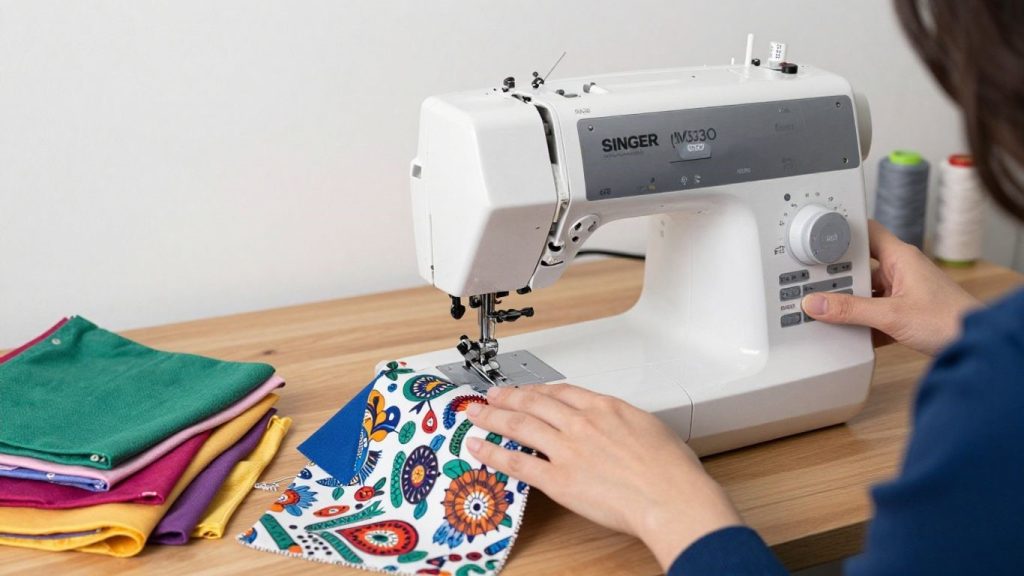
To the m3330 experiences I’ve written about, from a beginner’s point of view, that has also been an apparent trade-off between some beginner-friendliness vs. minor hitches in everyday (weekend) use. Here’s how things shake out after plenty of use and a surfeit of customer stories.
Pros of the SINGER M3330
- Straightforward to set up and thread, even if you are a beginner.
- Another 97 stitch applications for basic, decorative, and even a few stretch.
- Easy as a feather to move around, thanks to its light and compact body
- Includes a few helpful accessories included in the box
- Will negotiate a reasonable range of fabrics from sheer to denim
- Less expensive than more advanced models
Cons of the SINGER M3330
- The front-loading bobbin is a bit finicky and can get jammed for some.
- No built-in manual—everything’s online, not great for a quick reference
- Noise level varies: Some say it’s quiet, while others find it clunky
- Not always reliable with thick layers; can break needles and jam threads
- Stitch selection dial is basic / feels slightly low-cost
If you’re simply after a simple, lightweight machine for some home projects or even to learn how to sew, this ticks plenty of boxes. However, there are some time-consuming irritants you may encounter, particularly with the bobbin, and for simple instructions on how to get help.
People who want something a little more sturdy or with more workspace might look into a model like the Janome MC6650, though it comes at a higher price and with its own strengths and weaknesses.
Who is the SINGER M3330 Best Suited For?
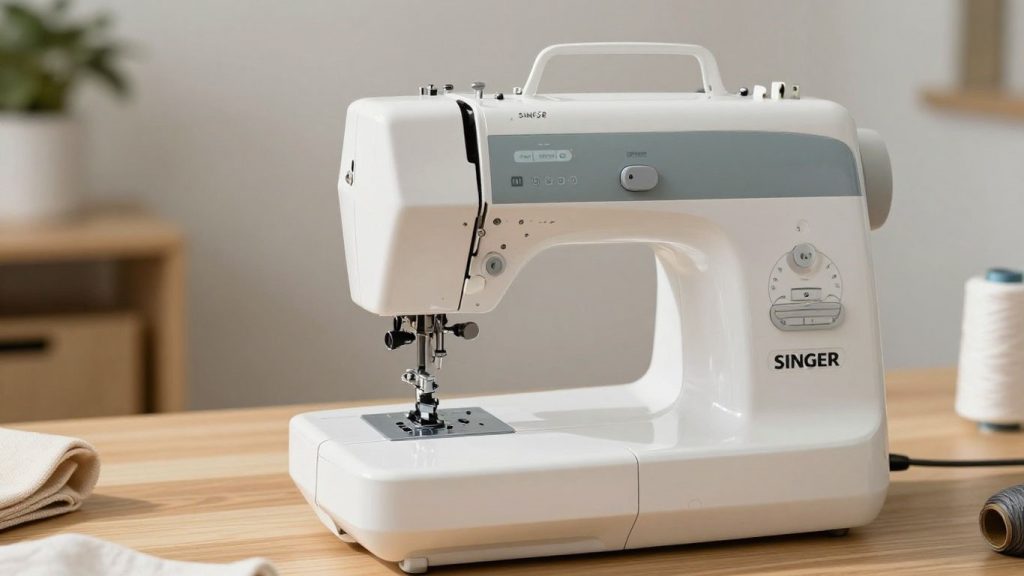
A few days with the SINGER M3330 convinced me that it’s perfect for a certain type of person. If you’re like me and are occasionally tempted by quick repairs, small home projects, or crafting with all sorts of textiles, this model hits a great sweet spot between utility and simplicity. It’s especially useful if you don’t want to fiddle with too many complicated settings or options but still need enough variation to keep your projects fun.
Here’s who I think will get the most out of the SINGER M3330:
- Novices in search of an easygoing, user-friendly machine
- Hobbyists who like to create crafts, costumes, or even décor on weekends
- For anyone who loves the singer m3330 for sewing or occasional fixing
- People using different fabrics, from basic cotton to lightweight denim, even stretch knits
- People who want the best singer machine for small projects and don’t need a bulky investment
If you want something on the affordable side that still addresses most home sewing needs, minus any overwhelming features, this is a good pick. It’s easy to navigate, gets up and running quickly, and has more than enough stitches for most folks’ needs without getting cluttered or confusing.
Personally, if garments and accessories or quick DIYs are the bulk of your sewing (i.e., a garment every six months on average), the SINGER M3330 feels like a good little partner to hang with. It isn’t a heavy-duty workhorse, so if you have big ambitions or are planning thick upholstery, you may outgrow it. But for more everyday household projects, it is really satisfying to use.
If you mainly sew garments and light accessories, it works well. But if embroidery is your goal, reviewing the Brother SE2000 review would be smarter.
Alternatives to Consider
Even though the SINGER M3330 is a good option for lots of home projects, I find I like to compare products before ultimately deciding on one. Sometimes another machine simply better suits your precise needs, or there’s a great deal on something else.
If you want something a little more decked out or maybe just with a different brand profile, here are some other machines that frequently enter the good home sewing machine discussion:
- Brother CS6000i: This machine is incredibly popular, especially among the new sewers. It’s a computerized machine, meaning you get many more stitch options and often a few extra features like an automatic threader that tends to be more reliable than I’ve found on some mechanical models. It’s also known for its light weight.
- Janome 2212: The Janome 2212 is another mechanical machine that works on a similar principle to the M3330. Its ease of operation and rugged construction often earn it high marks.” If you enjoy the minimalism of a mechanical machine but want something to compare against, this is one to take a look at.
- JUKI HZL-29Z: Juki machines are known for being workhorses. This one is a little more basic, but it’s rugged and does well with different fabrics. That might be worth considering if the extreme durability is your primary concern.
When I do comparative or head-to-head reviews of machines, I generally consider what types of projects I make on the most regular basis. Am I only repairing garments, or am I trying to construct clothing from scratch? Am I working with delicate silk or heavy denim? Answering these questions lets me find out which features are important vs. if I’m just getting distracted by a big stitch count.
If you are unsure whether you even need a standard machine or something more specialized, reading serger vs sewing machine can clarify the difference. French and Spanish readers can also explore Surjeteuse vs machine à coudre and Remalladora vs máquina de coser.
Comparison with Other Sewing Machines
Whenever I’m reviewing a new sewing machine, I like to see how it compares to some of the other popular choices available. It gives me a better sense of what I’m actually buying for my money. So, let’s pair the SINGER M3330 up against a couple of its typical rivals.
SINGER M3330 vs Janome 2212
For good reason, the Janome 2212 is often viewed as a direct competitor. Both are relatively simple machines, ideal for beginners. The M3330 has more stitch applications, 97, than Janome’s 12. That’s a huge difference if you play around with different decorative stitches.
The Janome 2212 is a workhorse of a sewing machine, and it comes with ease in handling slightly heavier fabrics than some lighter machines. As far as the built-in needle threader goes, I found what came on the M3330 to be somewhat finicky, while the Janome doesn’t come equipped with one, but its whole threading process is regarded as very effortless in general.
SINGER M3330 vs Brother CS6000i
That’s where things get interesting. The Brother CS6000i is what’s known as a computerized machine, which generally means it has many more stitch options (60 stitches built in, plus lettering) and can have features like a speed control slider and needle up/down button. Since the SINGER M3330 is a mechanical machine, it makes it simple to use, which some people enjoy. The CS6000i has a wider space for sewing, which is excellent for larger projects like quilting.
On the other hand, the M3330 is typically more affordable and could be deemed as the finest singer sewing machine for small to medium-sized projects because of its size and simple functionality. The Brother is certainly a better machine if you need more advanced features and variety in stitches, although the M3330 isn’t slacking for basic sewing needs.
SINGER M3330 vs JUKI HZL-29Z
Another mechanical machine that we see often in comparisons is the JUKI HZL-29Z. It also happens to be very quiet and well-built, which I appreciate. With 97 applications (compared to 8 basic stitches on the JUKI), the M3330 has more stitch variety, so it’s better for sewing decorative stitches. But the JUKI is frequently lauded for its ability to sew thicker fabrics with ease, which can be a trickier task for lighter-weight machines.
When testing the M3330, I consider its performance for denim decent, but the JUKI may have a leg up there. Both are solid for newbies, but the M3330 has more creative stitch options if that’s your goal. The M3330 offers more stitch flexibility for creative endeavors, but those with durability and a smooth-quiet stitch on the mind can’t go wrong by opting for the JUKI.
In the end, it comes down to what you most value in your sewing machine: whether it’s stitch variety, ease of use, build quality, or features (e.g., computerized controls). I thought the SINGER M3330 was a great option for those looking to strike a middle ground. You want more stitch options than what a super-basic machine can offer, but don’t necessarily need all the bells and whistles of one of those computerized machines.
So, Is the SINGER M3330 the One?
Having spent some time with the SINGER M3330, I can tell you that it’s a pretty good machine for what it is. It’s got a lot to recommend it, especially if you’re just getting started or need something for basic home repairs and simple projects. I thought it was nice that it came with a lot of accessories, as a bonus. Still, I did encounter a couple of hiccups, as others have noted online, particularly with the needle threader and intermittent thread jams.
It wasn’t a deal breaker for me, and I eventually figured it out, but it’s worth being mindful of. It does a decent job for casual work for the price, but if you want to do real hardcore type functions or need something really reliable with no drama, probably best to look elsewhere. In short, I think it is a good introduction machine for beginners and casual sewers who are just looking for a no-fuss sew in the home.
Frequently Asked Questions
Is the SINGER M3330 good for someone who has never sewn before?
Absolutely! I found this machine to be super easy to get started with. Many beginners, like myself, have had great success using it for simple projects and repairs. The instructions might seem a bit basic, but there are tons of helpful videos online that make learning a breeze.
What kinds of fabrics can I sew with this machine?
I’ve been able to sew a good variety of fabrics with the M3330. It handles basics like cotton and denim nicely, and it’s even pretty good with stretchier materials. You can adjust the stitches, which really helps when you’re working with different types of cloth.
Does the machine come with everything I need to start sewing?
It comes with a good set of accessories, including different presser feet for various tasks like making buttonholes and sewing zippers. I’ve found that these are usually enough to get most projects going. You’ll also get bobbins and needles, but it’s always a good idea to have extras on hand.
I’ve heard some people have trouble with thread jamming. Is this a common problem?
I have heard that some users have experienced thread jamming, especially around the bobbin area. It can be a bit frustrating when it happens. I found that making sure everything is threaded correctly and the bobbin is inserted just right usually solves the issue for me. Taking it slow and double-checking my steps has helped a lot.
Is the built-in needle threader easy to use?
Honestly, I’ve had a bit of a tricky time with the automatic needle threader. It’s a neat idea, but it can be a little finicky and sometimes needs a gentle nudge or adjustment. For me, threading the needle by hand is often quicker and more reliable, though I know some people have better luck with the built-in feature.
What’s the difference between stitch ‘applications’ and stitch ‘types’?
That’s a great question! Think of stitch ‘types’ as the basic patterns the machine can make, like a straight stitch or a zigzag. Stitch ‘applications’ are more about how you use those types for specific jobs. For example, a basic straight stitch can be used for a simple seam, but it’s also an application for hemming. The M3330 offers 97 different ways you can use its stitches for various sewing tasks.