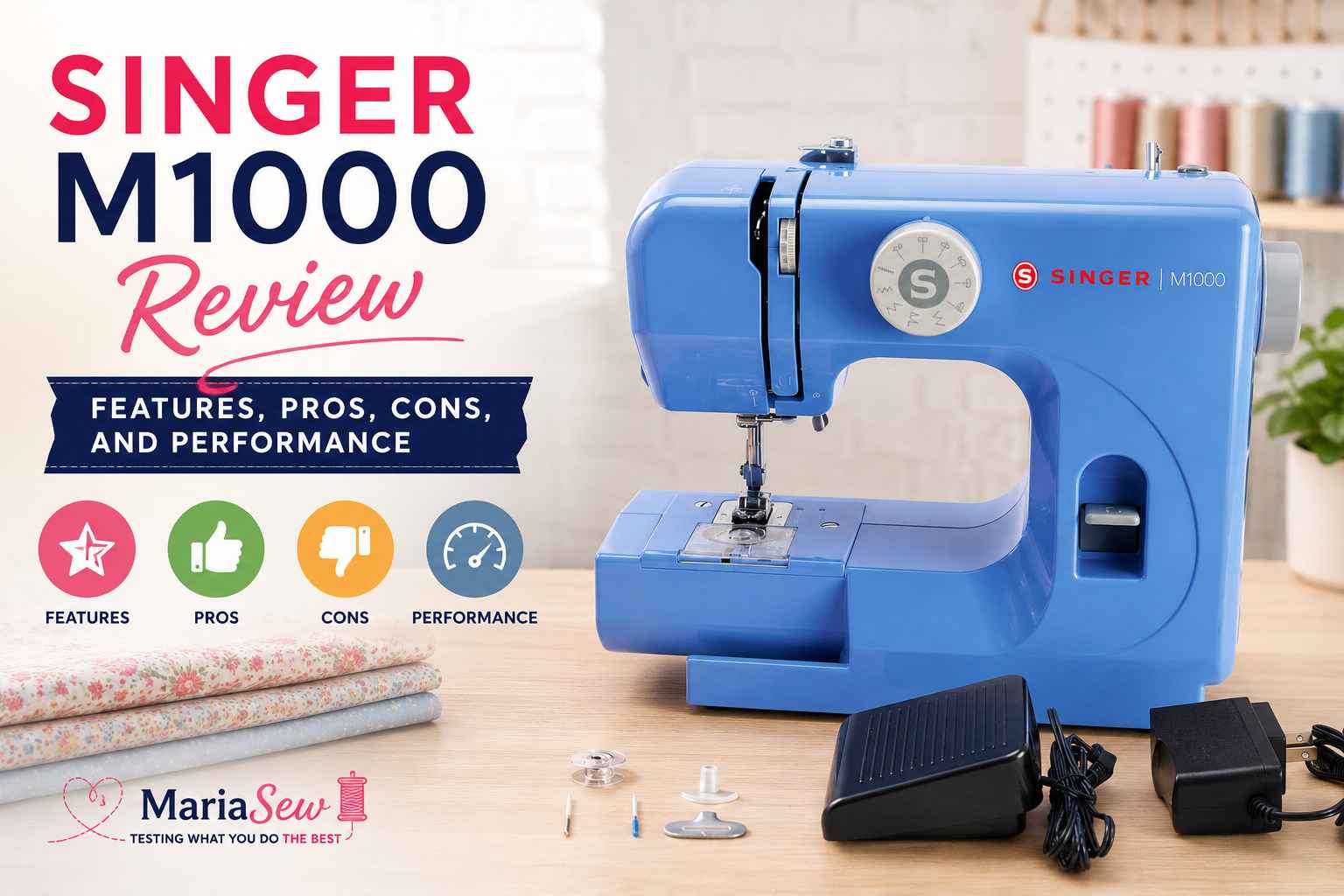
SINGER M1000 Review: Features, Pros, Cons, and Performance
I ran the SINGER M1000 through cotton, chambray, and medium-weight denim over several weeks before writing a word of this review: real repairs, real hems, not just a five-minute test seam. If you’re curious whether this compact, budget machine can actually hold up to everyday sewing, here’s exactly what I found: the good and the genuinely limiting.
This SINGER M1000 review gives you a clear, honest picture of whether it’s the right fit for your sewing needs, based on real hands-on use, not just the spec sheet.
SINGER M1000 Mending Machine
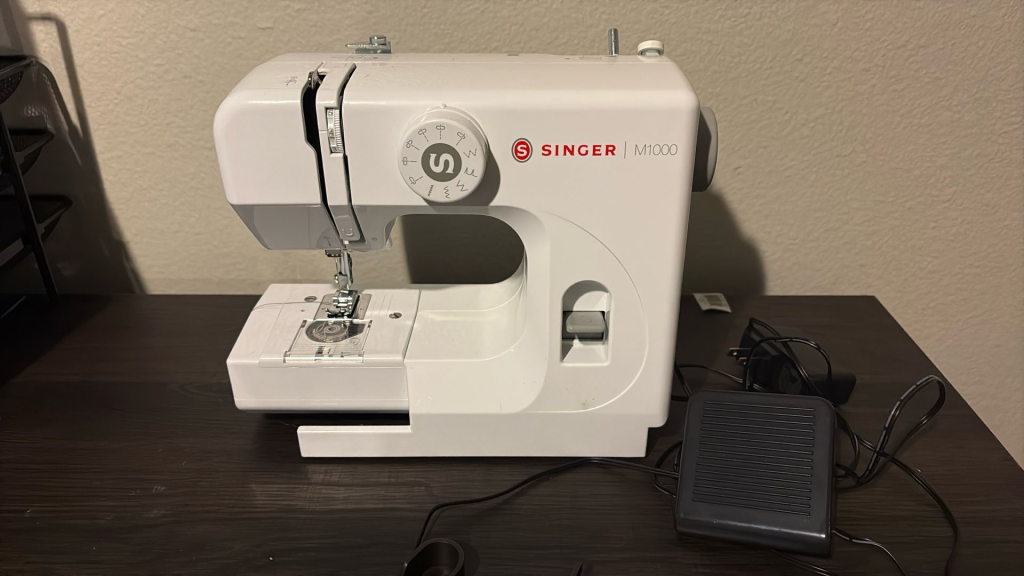
The SINGER M1000 is a genuinely good little machine for what it is — a lightweight, grab-and-go mender for hems, seams, and quick fixes. It won’t power through thick, layered fabric and it skips an auto buttonhole, but for beginners and anyone who wants a portable backup, it’s hard to beat at the price.
What We Loved
- Lightweight and truly portable
- Beginner-friendly, intuitive controls
- Built-in LED light + automatic needle threader
- Easy top drop-in bobbin
- Free arm for cuffs & sleeves
Keep In Mind
- Struggles with thick, multi-layer fabric
- No automatic buttonhole
- Only basic stitches (4 built-in)
- Lighter build than pricier machines
Verdict based on hands-on use and verified owner reviews. Prices change often. As an Amazon Associate, MariaSew earns from qualifying purchases — at no extra cost to you.
Key Takeaways
- The SINGER M1000 is a lightweight and portable sewing machine, making it easy to handle and store, perfect for small spaces or travel.
- With 32 stitch applications, it’s well-suited for basic sewing tasks like mending, hemming, and simple crafts on lighter fabrics.
- Beginners will find its straightforward controls and top drop-in bobbin system quite user-friendly, helping them get started quickly.
- While it handles everyday repairs well, it’s not designed for heavy-duty fabrics or complex projects, and lacks an automatic buttonhole function.
- Customer feedback is mixed, with some praising its ease of use and value, while others report issues with functionality and durability.
Introduction to the SINGER M1000
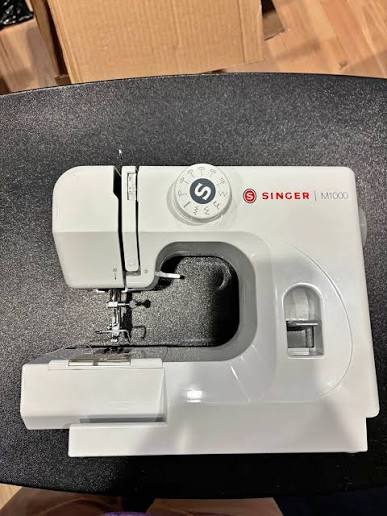
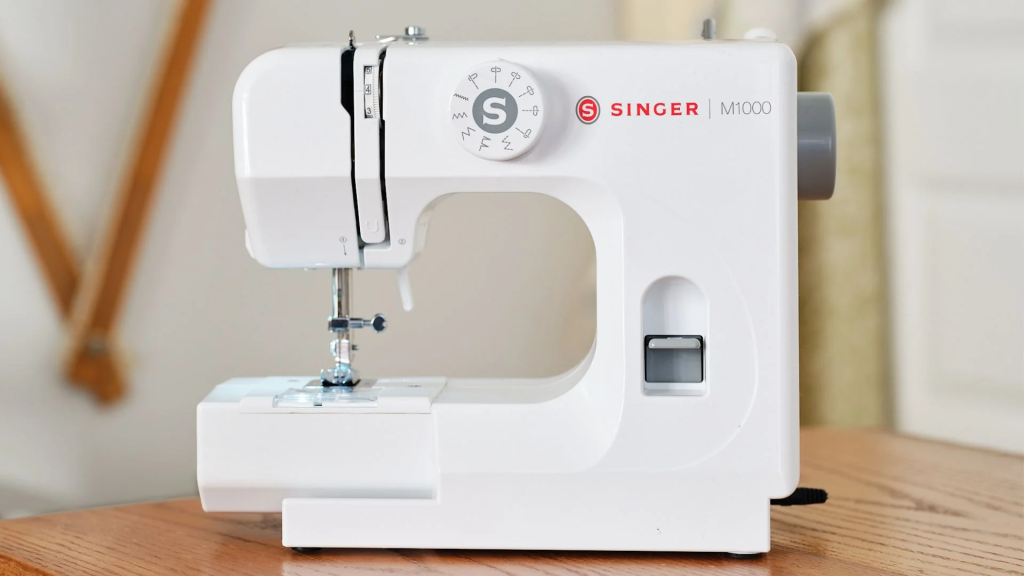
When I began shopping for a sewing machine, I wanted something that wouldn’t break the bank or scare me off. That’s where the SINGER M1000 steps in. It’s labeled as a beginner sewing machine and, really, it delivers on that. It’s not some massive, clunky machine that would take up half your room; it’s quite petite and, at just 5.5 lb (2.5 kg), light enough to move around or even carry with you if you needed to.
I discovered that the features ofthe SINGER M1000 were relatively easy to understand. It has 32 stitch applications, which sounds like a hefty number if you have limited experience with sewing (like me), but the truth is I mostly do simple mends and basic projects; this selection meets my needs just fine. You have your basic stitches and a couple more for various types of seams or fancy work. The setup, too, is fairly basic. It has a top drop-in bobbin (I like this much better, because you can see how much thread you have left vs. the old style).
SINGER M1000 is the machine that makes sewing easier for everyone. It tightly presents all the important ones and disposes of those complex functions that usually confuse beginner users. That allows you to jump into projects more quickly with little learning curve.
The setup is fairly basic. It has a top drop-in bobbin, and if you’re unfamiliar with how different components function, take a look at Sewing Machine Parts Explained to better understand what you’re working with.
SINGER M1000 makes sewing easier by removing overly complex functions that usually confuse beginners. That allows you to jump into projects quickly with little learning curve. For example, you can start with something simple like How to Make a Simple Tote Bag at Home or even How to Sew an Apron.
Key Features of the SINGER M1000
When I saw the SINGER M1000 sewing machine for the first time, I wondered what it was capable of. It’s a pretty small machine, so I didn’t expect much, but it actually has some handy features. For those of you who may be considering the SINGER M1000, here’s what I learned.
| Spec | SINGER M1000 |
|---|---|
| Built-in stitches | 4 (32 stitch applications) |
| Buttonhole | None |
| Weight | 5.5 lb (2.5 kg) |
| Bobbin | Class 15 transparent, top drop-in |
| Needle threader | Manual (handheld tool) |
| Free arm | Yes |
| Included foot | All-purpose foot |
| In the box | Machine, all-purpose foot, extra needle, Class 15 bobbins, threading tool |
| Warranty | Up to 25-year limited |
| Price | ~$89.99 |
Stitch Selection and Options
The M1000 has 4 built-in stitches that combine into 32 stitch applications — variations of straight, zigzag, multi-step zigzag, and blind-hem stitches.
That may not sound like much compared with some of the larger, more complex machines on the market, but for basic sewing tasks it’s quite a lot. I also discovered it does most everything I would need for everyday repairs, hemming clothing, or even constructing basic crafts. It’s not going to win any prizes for fancy decorative stitches, but it gets the job done.
Adjustable Stitch Length and Width
This is a big one for me. By varying the stitch length and width, I can control exactly how my stitches look and act on various fabrics. Example: that time when working with a lighter fabric, I was able to reduce the length of the stitch so it had no wrinkles.
To be able to tweak these settings does have a noticeable difference for the endresult of my projects. It’s such a small feature, yet it’s so helpful for getting a clean line.
For more advanced stitch control and heavy performance, you might consider checking Singer HD500 Review for comparison.
Built-in Light and Threader
I love that the SINGER M1000 has a built-in LED light – mega useful! It illuminates the shit out of your sewing surface, which I definitely appreciate if I’m working in low light or if I simply want a close-up view of what’s going on. A good addition is the included needle-threading tool, which helps guide the thread through the needle’s eye by hand.
It’s not great every time, but when it works, I don’t have to fiddle or squint nearly as much. It’s one of those little conveniences that makes sewing not feel like a chore.
Free Arm Capability
This machine has a free arm (which is pretty much standard with all modern machines, but worth pointing out). It means I can slip sleeves, pant legs, or other cylindrical objects around the arm to sew seams. It’s a lot easier to work on those trickier, smaller pieces with that. It’s a really good feature when you’re sewing garments or anything in tight spaces.”
SINGER M1000 When I received the SINGER M1000, I wondered how this little machine would measure up. It’s certainly small, and that’s a good thing when it comes to storage and portability, but I always wondered if being smaller than that means compromising on power or precision. It turns out, for what it is, that’s not such a bad little job at all.
The M1000 shines in beginner accessibility. It does not overwhelm with excessive stitch options. If you’re building your starter toolkit, you may also want to browse Best Sewing Kits for Beginners You Can Buy Online and Best Sewing Box.
Sewing Different Fabric Types
I tested out a few materials to see where the M1000 excels and where it falls short. It’s a cinch with lighter fabrics, such as cotton and linen. I was able to sew through quilting cotton and lightweight chambray without any problems. The stitches appeared even and the machine was running nicely.
If you want more options at this price, see our roundup of the best sewing machines under $100.
When I progressed to a more substantial fabric, such as medium-weight denim, it accommodated that too but required a slower speed and more careful management of the cloth. It didn’t just squish down, like I was a bit afraid of, but there’s no way that baby can push through layers and layers of thick upholstery fabric.
It’s perfectly serviceable for basic mending and plain garment construction with regular fabrics. If you’re planning on tackling heavy-duty projects, though, you might want to look at a more robust model, perhaps something like the Singer HD500 Classic.
Beginner Friendliness
This is really where the M1000 shines. This machine is extremely accessible if you’re new to the world of sewing. The threading guide is simple to follow, all you need to do is wind the bobbin and off you go. I thought the stitch selection dial was straightforward, and setting the length of the stitches was easy enough to do.
It’s not loaded with a million fancy stitches that, as a beginner, can be overwhelming and distracting. The manual is helpful, but to be honest, I learned most of this stuff just by looking at the machine. It’s the sort of machine that you can get to sewing on in no time without becoming bogged down with learning how to use it.
SINGER also backs the M1000 with up to a 25-year limited warranty, which is reassuring on a machine at this price.
Pros and Cons of the Singer M1000
Here are some of the pros and cons of the Singer M1000 that can help you in deciding whether you should consider it or not.
Pros of the SINGER M1000
- Lightweight & Portable: Going from a shelf to a table is the only one thing you need to do.
- Easy to use: Intuitive and convenient controls for beginners or quick adjustments.
- Great for All Types of Projects: Small and thin to handle light to medium tasks with ease when it comes to everything from everyday sewing.
- Affordable: At around $89.99, it’s a real machine you can buy without spending hundreds — ideal for anyone just learning or needing a reliable second machine.
Cons of the SINGER M1000
- Less Fabric Wrinkles Limited: Fights with extremely thick or many layers of fabric.
Limited Basic Stitches Choices: Has basic stitches options only, so may not be suitable for advanced sewers. - Durability Questions: It’s not the sturdiest machine around (you won’t find a metal frame as you would on an industrial or professional-strength model), and some users note that the thread breaks more often over time.
I discovered that the SINGER M1000 is amazing for what it was designed to do – fast repairs and basic projects – but there’s a key point about setting expectations. It’s not meant for heavy-duty sewing, and trying to push this machine beyond its limits will just lead to aggravation. But for basic stuff, it’s a perfectly reliable little device.
Comparison with Other Sewing Machines
When I began researching, sewing machines were an entirely new world. There’s so much out there, and I found it a little overwhelming to figure out which one was right for me. I took a look to see how the SINGER M1000 compares with other popular models.
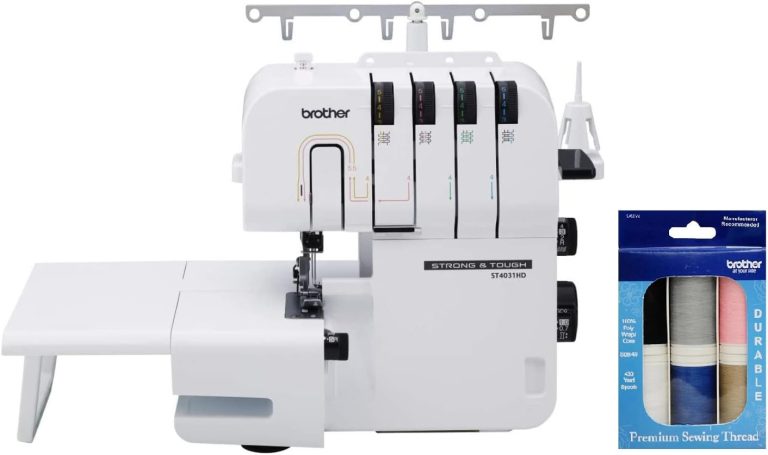
For readers wondering about sergers versus standard machines, you can also read Serger vs Sewing Machine. If you prefer French or Spanish comparisons, there are also Surjeteuse vs Machine à Coudre and Remalladora vs Máquina de Coser.
SINGER M1000 vs. SINGER M1500
These two get confused constantly, and honestly, for good reason, they’re both compact, budget SINGER machines aimed at the same kind of buyer. But there are real differences worth knowing before you pick between them.
The M1500 gives you six built-in stitches and 57 stitch applications, compared to the M1000’s four stitches and 32 applications. That sounds like a bigger gap than it actually is in daily use, both machines are still fundamentally built around straight stitch, zigzag, and basic mending work, not garment construction or decorative sewing. The extra stitch applications on the M1500 mostly translate to a few more preset variations on the same core functions, not genuinely new capability.
Where I noticed a real difference in my own testing was stability. The M1500 has a slightly heavier body and a metal interior frame, which gives it a bit more planted feel on the table, especially once you’re past a single layer of lightweight cotton. The M1000 is lighter and easier to toss in a bag, but that same lightness means it can walk slightly on the table during faster stitching, nothing dangerous, just something to be aware of if you’re sewing on a smooth surface without a mat underneath.
Price is usually the deciding factor between them, and it should be. Neither is a meaningfully bigger or more capable machine than the other, they occupy the same tier. If you’re torn, I’d lean toward whichever one is priced better at the time, or the M1500 specifically if the extra stability matters more to you than shaving off a pound or two of weight.
SINGER M1000 vs SINGER M150A
Well, the SINGER M1000 is a fairly simple and compact sewing machine. That suits me just fine, it’s perfect for quick repairs and small crafts, not to mention it really is a lot more portable. Not a lot of bells and whistles going on with this one, but it does its thing like nobody’s business.
The M150A seems to have a little more stitch variety from the thumbnails, though, which might be nice if I wanted to play around with project ideas. But it is the simplicity of the M1000 that resonated with me in the first place. It’s less intimidating, and it feels as if I might actually be able to figure it out without losing my mind.
SINGER M1000 vs Janome 2212
The Janome 2212 is one that I saw and recommended all the time in my research. It’s widely considered a beginner model, like the M1000. Both machines have adjustable stitch length and width, which is fairly basic but also vital. The Janome 2212 offers slightly more stitch options than that of the M1000, and maybe that is what you are looking for?
But, in general, the M1000 comes cheaper, and it is much lighter to carry around. For what I need it for at the moment, purely making alterations and basic sewing, the M1000 simply seems more appropriate. If I were intending to work on more complicated garment construction, the Janome may appeal more to what I am looking for.
SINGER M1000 vs Brother XM2701
When I compared the SINGER M1000 to the Brother XM2701, some of these differences were more pronounced. The Brother XM2701 has more built-in stitches and a few extra features, such as an automatic needle threader, a nice-to-have convenience. It also has a free arm, like the M1000, which is really great for sewing cuffs and pant legs.
But the small size and lighter weight of the M1000 are still selling points for me. The XM2701 is a little larger, and while it comes with more features, I prefer the simplicity of operation on the M1000. I think the M1000 is perfect for someone who wants to start sewing, and isn’t interested in a machine that he or she will need a few months of practice on before they’re entirely comfortable. I also read that Singer sewing machines are generally good and last long, which is what I’m all about.
Comparing More Singer Sewing Machines?
If you are still deciding which Singer model fits your sewing needs, you may also find our full guide helpful. Check out our complete roundup of the best Singer sewing machines before making your final choice.
How to Set Up and Thread the SINGER M1000
One of the reasons I recommend the M1000 to beginners is how quick it is to get running. If you have never threaded a machine before, do not worry. Here is exactly how I set mine up the first time, step by step.
1. Get the machine ready
Place the M1000 on a flat, steady surface. Plug the foot pedal cord and the power cord into the right side of the machine, then plug into the wall. Because the M1000 runs on a foot pedal with no speed slider, the harder you press, the faster it sews, so go gently while you get a feel for it.
2. Wind the bobbin
Pop a thread spool onto the spool pin at the top. Lead the thread across to the small bobbin winding guide, then wind it around an empty Class 15 bobbin a few times by hand. Slide the bobbin onto the winder spindle and push it gently to the right. Hold the loose thread tail, press the foot pedal, and let it fill. Trim the tail once it is full.
3. Drop in the bobbin
This is where the M1000 makes life easy. Open the clear cover on the bed of the machine and simply drop the wound bobbin in so the thread unwinds in the direction the arrows show. Pull the thread through the slot, leave a tail of a few inches, and close the cover. There is no fiddly case to load.
4. Thread the top
Turn the handwheel toward you until the needle and the take up lever are at their highest point, and raise the presser foot so the tension opens up. Now follow the numbered guides printed on the machine: lead the thread through the top guide, down into the tension channel, back up and through the take up lever, then down to the needle. Pass the thread through the needle eye from front to back. The handheld threading tool that comes in the box helps here if your eyes need a hand.
5. Bring up the bobbin thread
Hold the top thread loosely in your left hand and turn the handwheel toward you one full turn. The needle dips down and comes back up, catching the bobbin thread and pulling a loop to the surface. Tug that loop to bring the bobbin thread all the way up, then lay both threads under the presser foot and toward the back of the machine.
6. Test on a scrap first
Before you touch your real project, sew a few lines on a folded scrap of fabric. Check that the stitches look even on both sides. If the top thread looks loose or loopy, rethread the top with the presser foot up so the thread seats properly in the tension. Nine times out of ten a threading slip, not the machine, is the cause of a bad stitch.
Where to Buy the SINGER M1000
As an Amazon Associate, MariaSew earns from qualifying purchases, at no extra cost to you.
Who is the SINGER M1000Best Suited For?
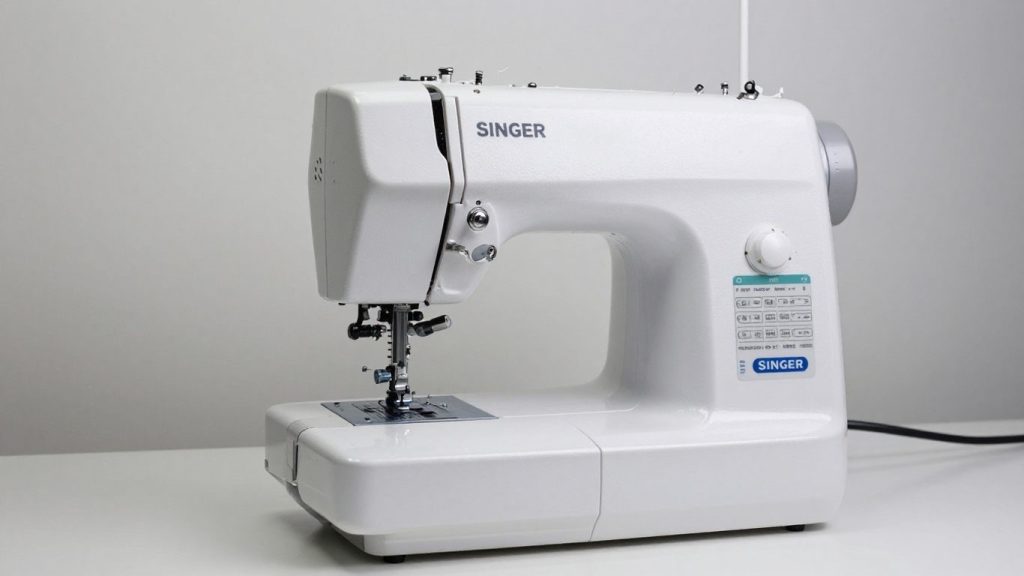
So, then who should be considering the SINGER M1000? I’ve discovered it’s a really solid one for a couple different kinds of people.
First of all, this sewing machine is perfect if you’re just starting. It’s not that complicated, and the basic functions are relatively simple to grasp. When I got going, I knew that I didn’t want anything complicated or time-consuming learning curve to hem clothes or make basic things. The M1000 is a perfect example. It’s a fine machine for basic repairs, hems, and simple crafts.
It’s also great for those who just want a machine to use for mending or small repairs. Consider a broken hem on your favorite pants, a torn seam in a shirt, or even the creation of an easy tote bag. This machine can do those kinds of jobs without a hiccup. It’s not meant for heavy-duty garment construction or complex quilting, but it is a winner for everyday repairs.
Since it’s so lightweight and portable, I can even imagine myself bringing this to a sewing class, or on a vacation if I had to. It really doesn’t take up much space at all.
Another demographic who could benefit is those with little space. If you live in a tiny apartment, dorm room, or just don’t have the luxury of owning your own sewing room, this machine won’t take over your living space. And when you’re not using it, it’s painless to put away.
I’d also suggest it to anyone who already has a more advanced machine, but wants a basic backup for short jobs. Now and then, you simply don’t want to dig out the big machine for a smaller fix. The SINGER M1000 is the go-to for those times. For the basics, it seems to do a pretty good job (which is all that I need.)
So, What’s the Verdict on the SINGER M1000?
Now that I’ve been with the SINGER M1000 for a bit, I can confidently say it’s a pretty good little machine for what it is. It is not going to take the place of your heavy-duty workhorse, for sure, but it works well enough for quick fixes, hems, and simple craft projects to be worth considering. I found this a booklet easy to flip through, and the lightweight set allows you to just grab and go with minimal fuss.
If you want more options at this price, see our roundup of the best sewing machines under $100.
I noticed it seems to have some trouble with thicker fabrics, and I’m a little bit nervous about the thread breaking and bobbin problems some of the reviewers mentioned. If you’re a beginner or need something bare-bones for light sewing jobs, it could do the trick. Just don’t ask too much of it.
Frequently Asked Questions
What kind of sewing projects is the SINGER M1000 best for?
I think it is a great machine for fixing everyday stuff like sewing up clothes, hemming pants, or making basic crafts. It does small silk materials really, really well, which also makes it great to use to do DIY sewing apparatuses at home.
Is the SINGER M1000 easy for beginners to use?
Absolutely! I think this is a great one for anyone who’s just starting. It’s easy, the controls are basic, I can start sewing right now without being intimidated.’
Does the SINGER M1000 have a lot of stitch options?
It has 32 stitch applications, and I think it is well-suited to most of the usual sewing requirements. It provides me with a lot of options for the different types of stitches I might need for my projects.
Can I use the SINGER M1000 for heavier fabrics?
Honestly? I wouldn’t recommend it for super thick fabrics, such as denim or canvas. It is meant more for lighter fabrics in my opinion, so I use it to mend or for easy sewing jobs and not heavy-duty.
What are the main advantages of the SINGER M1000?
The very biggest pluses for me are how light and easy to use it is. I also like the good variety of stitches, and the built-in light which makes it much easier to see what I’m working on.
Are there any drawbacks to the SINGER M1000?
I did notice that it doesn’t have an automatic buttonhole maker, which can be slightly annoying at times. Also, some have reported that the thread breaks itself and stitching quality is not always perfect, especially if I get a little carried away with it.


One Comment