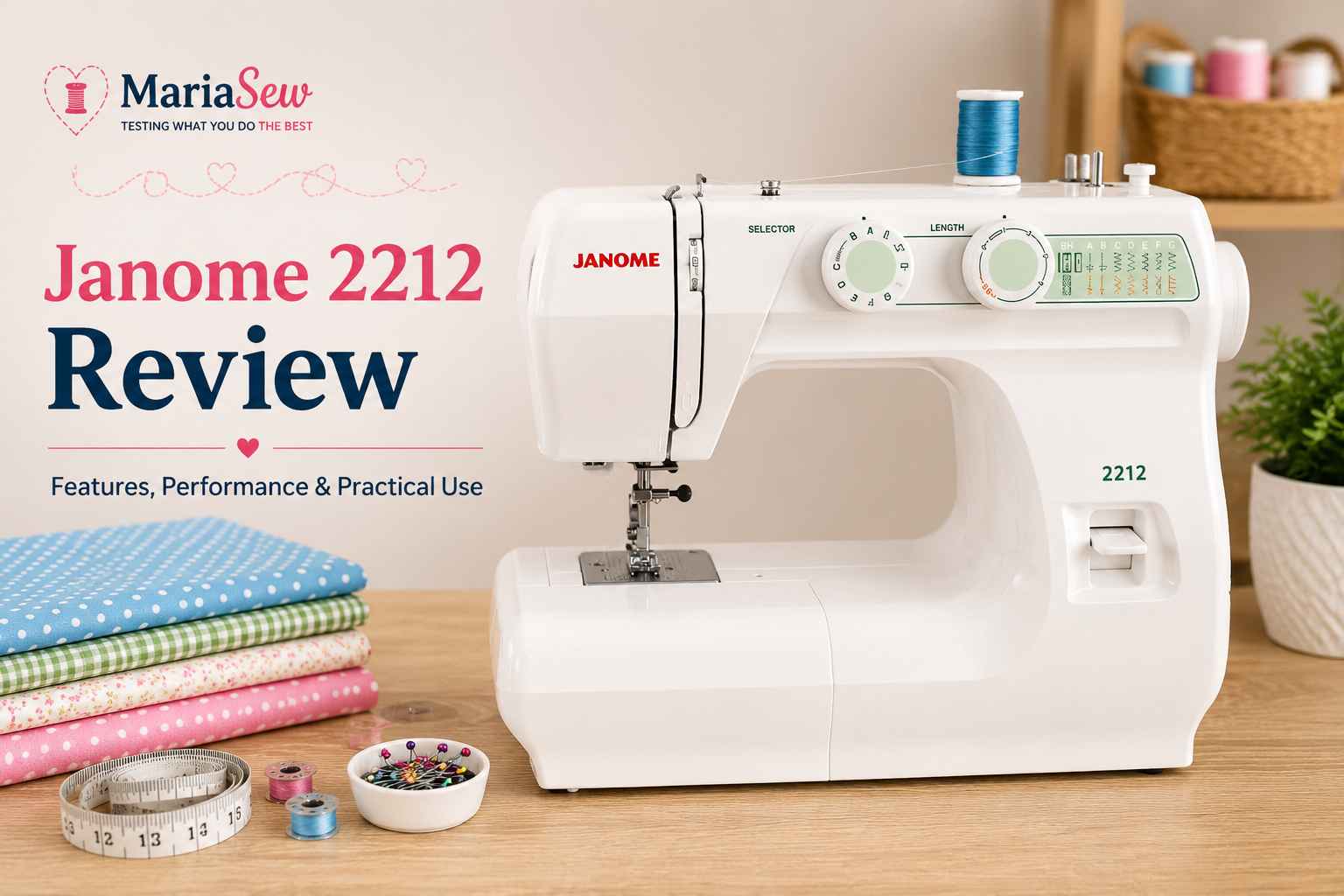
Janome 2212 Review 2026: I Tested It for 3 Weeks — Here Is the Honest Truth
After 12 years of sewing, I have tested machines at every price point from under $100 to professional models above $1,000. The Janome 2212 sits at the budget end of that range and I wanted to find out whether its reputation is earned or simply repeated.
I spent three weeks using the Janome 2212 daily across real projects before writing this review. Cotton garments, denim repairs, knit fabric, and basic quilting cotton. Here is what I actually found.
The Janome 2212 is a genuinely reliable mechanical machine for absolute beginners who want simplicity over features. It handled cotton, light denim, and basic quilting without any issues during testing. The limitations are real — 12 stitches, no automatic needle threader, weaker lighting, and a learning curve with tension on stretch fabrics — but for someone learning to sew for the first time, none of these are deal-breakers. At under $150 it represents honest value.
Overview of the Janome 2212 Sewing Machine

When I first tested the Janome 2212, I set it up on the same table where I test every machine — same lighting, same fabrics, same projects. Within the first hour, I had a clear picture of what this machine is and what it is not. It is a no-frills mechanical workhorse built for beginners who want to learn without fighting their equipment.
It’s a pretty simple mechanical machine, but honestly, for someone brand new to sewing or looking for a no-nonsense workhorse for everyday projects, it checks off most of the right boxes. It’s not loaded with hundreds of fancy stitches, but it has the basics you will actually use.
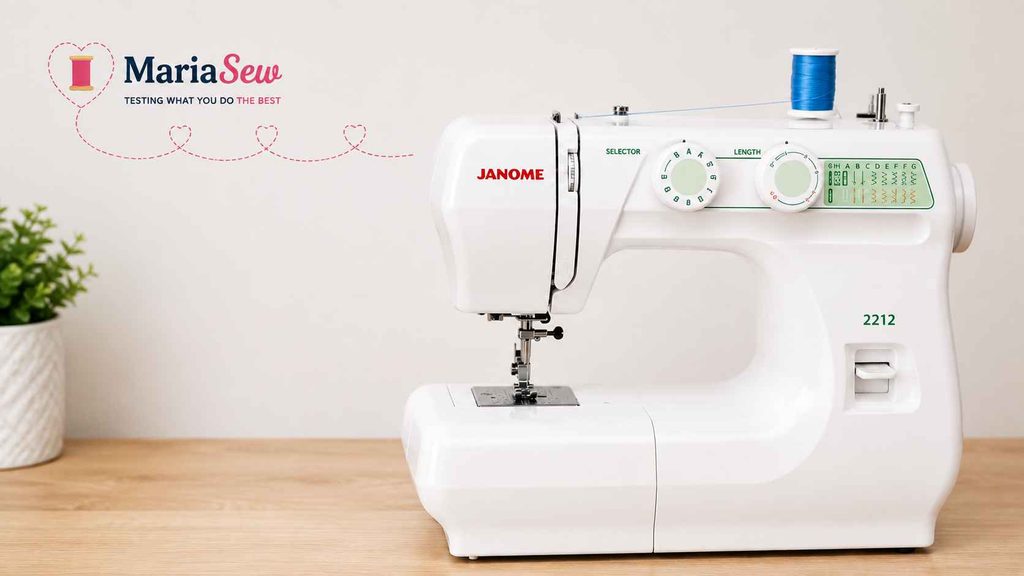
Ease of use is a big selling point for Janome sewing machines, especially when you just want to get your projects completed without the fuss. It has 12 built-in stitches, which sounds a bit limiting, but come on, how many times do you automatically need more than a straight stitch, a zigzag, and a buttonhole? It makes basic garment making, mending, and even a few lighter home decor projects without much fuss. Overall, I thought the Janome sewing machine features were perfect for new sewers. It’s a good, simple choice that does the job. If you want to sew thick materials or do detailed quilting, this may not be the machine for you, but for average sewing, it’s a good option.
It’s also pretty compact, which is helpful if you don’t have a lot of space. I’ve found it to be a fairly reliable machine for the price point, and it’s been around for several years, which often means something. It’s a solid intro before you know if sewing is something you want to devote more time (and potentially money) to, the Brother NQ1700E or something similar if you get serious about embroidery down the line.
If you’re still exploring beginner-friendly machines, you can also check out Brother CS7000X review or the Brother CS7205 review for comparison.
Here’s a quick look at what it offers:
- 12 built-in stitches
- 4-step buttonhole function
- Adjustable stitch length and width
- Manual tension control
- Free arm for smaller projects
This machine is designed to be user-friendly, focusing on the core functions most sewers need. It avoids overwhelming new users with too many options, making the learning curve much gentler.
Key Features and Specifications
When I took a closer look at the Janome 2212, I found a mix of features that make it really appealing for those just getting started. This sewing machine focuses on straightforward, reliable basics without overloading you with extras you won’t use.
Here’s a snapshot of what the Janome 2212 brings to the table:
- 12 built-in stitches, including a four-step buttonhole, covering basic needs for most sewing tasks
- Easy-to-adjust stitch length and width, great for experimenting as you learn
- Manual tension control, which gives you a bit more control over how your stitches turn out
- A powerful motor that can handle several layers of fabric with the right needle
- Built-in thread cutter for quicker workflow
- Workspace light that helps you see what you’re working on, even though it’s not super bright
- Folding carry handle, making it portable if you need to move it around the house
- Freearm capability, handy for sewing sleeves or pant legs (built-in thread cutter, workspace lamp, freearm)
If you’re just getting started with sewing, simplicity can save you hours of frustration. The Janome 2212 doesn’t overwhelm—it just tries to make learning a little less complicated.
If you’re unsure about machine components, understanding sewing machine parts can really help you use these features better.
Design and Build Quality
When I unboxed the Janome 2212, I was impressed with its straightforward appearance. It’s not trying to win any beauty contests, which is just fine by me. It’s encased in clean white plastic, which feels quite sturdy. When I handled it, there was no excessive flex or creaking, good news for any machine in this price range. It feels rugged and tough, even if there aren’t fancy metallic finishes like you would find on high-end models.
Internally, it features a metal skeleton for true ruggedness. I always look for this because it means the machine can take a little beating and still keep sewing. The overall feel is practical and rugged. It’s not fancy, but it feels like a workhorse.
If you plan to build a full sewing setup, pairing this machine with the best sewing box can help keep your tools organised.
Here’s a quick look at some of the physical aspects:
- Weight: Not super heavy, so you can move it around easily if you need to put it away after, but not so lightweight that it shakes itself across the table.
- Foot Pedal: The foot pedal that comes with it is responsive, and the cord is long enough for me to place it comfortably.
- Accessory Storage: There’s a small drawer built right into the machine to help keep your presser feet and bobbins close at hand. It’s not big, but convenient for the staples.
The Janome 2212 doesn’t have the sleek, modern look of many computerised machines, but it is all about function over form. This is a sewing machine, and its construction bears out that intent. I like that it doesn’t feel flimsy or cheap.
The design is fairly typical of that for a mechanical machine. Then it’s got your dials for stitch selection and length with a lever for reverse stitching. All in all, everything is labelled clearly, which is a definite plus for someone like me who doesn’t want to spend hours trying to interpret symbols. It also has a free-arm feature, which is excellent for sewing smaller, cylindrical objects such as pant legs or sleeves.
Ease of Use for Beginners
The very first time I dove into researching sewing machines personally, I admit the number of buttons and dials was a bit intimidating! I mean, I was trying to sew a basic tote bag, not perform surgery on a robot.
Fortunately, the Janome 2212 does a great job of making things as easy as possible for novices like myself who are just dipping their toes in the world of sewing.
Setup and Threading
Preparing the machine to sew is often the first challenge. For the Janome 2212, I found it to be quite a simple process. The manual helps, but a lot of it is pretty intuitive, to be honest. It is very simple to wind a bobbin, and the top-loading bobbin makes it much easier because you don’t have to play with a separate bobbin case.
The actual threading of the machine is also clearly numbered right on the machine, a nice touch. It helps you by showing the step-by-step path that the thread is required to take. We love that the quick-set bobbin helps save time, so you can just dive right in without having to pull up the bobbin thread. That means less fussing around and more real sewing, which is exactly what I wanted.
Still, beginners should always follow a proper guide like how to thread a sewing machine to avoid mistakes.
Stitch Options and Adjustability
This is not the most basic of beginner machines: it has a good variety of stitches for one at this level. There are your basic utility stitches, straight stitch, zigzag, and the like, a few decorative options and an automatic four-step buttonhole. Turning the dial to select stitches is simple, and since stitch patterns are printed directly on the machine body, you don’t have to keep flipping through the manual trying to remember what number corresponds to which setting.
Both stitch length and width adjustments are easy to make with clearly marked dials. I liked that I could easily edit those settings, and it didn’t leave me with a fear of breaking something. It’s not complicated enough to be frustrating, which is ideal for newcomers.
For someone just starting, having a machine that doesn’t wrestle every step of the way is essential. Janome 2212 has an appropriate balance between enough options to be versatile, but not so elaborate that it becomes stressful. It seems like it was made with someone who is still figuring things out in mind.
Performance and Stitch Quality
I was initially curious how the Janome 2212 would perform on various fabrics when I first sat down to use it. It’s a metal machine, so I wasn’t expecting miracles, but it was very nice, and I was pleasantly surprised. For basic tasks such as hemming pants or sewing simple tote bags, it gets the job done.
The “straight” stitch is clean and smooth on regular cottons and linens. The secret to a good result for me is being patient and mindful of the tension settings.
For quilting beginners, you may eventually want to explore machines from the best quilting sewing machine guide.
I tested it on a few different materials:
- Quilting Cotton: This was easy as pie. It fed through the machine smoothly, and the stitches were nice and even.
- Denim (lightweight): A few layers of regular denim passed through without a big fuss. I wouldn’t try to force it with multiple thick layers, but for routine repairs or basic denim-type projects, it’s up to the task.
- Knit Fabric: This part was a bit more complex. Not only can knits be stretchy, but they can also skip stitches. Although the 2212 does have a stretch stitch option, I had to play quite a bit with the tension and use a ballpoint needle in order to get any reasonable result. It can be done, but it definitely takes more focus than with a computerised machine.
The stitching quality is good enough for most beginner projects. It will never win precision awards for delicate silks or heavy-duty canvas, but it gets the job done well enough at its price point and with its target audience. Keep in mind that manual tension changes are your friend here.
The dials make adjusting stitch length and width easy, and the reverse stitch lever is conveniently located to lock seams. Flowing, for basic sewing needs, the Janome 2212 provides reliable performance, especially when you are sewing medium-weight fabrics. Something like the SINGER M1150 may offer a little more versatility in terms of stitch options if you’re looking for something that will handle many types of fabrics with ease.
Pros and Cons of the Janome 2212
When I first sat down with the Janome 2212, I had some quick wins and, honestly, a few surprises. There’s a mix of what I’d call real positives and a handful of things you kind of have to work around if you stick with this machine for a while.
Here’s how it breaks down for me:
Pros of the Janome 2212
- Simple mechanical controls – nothing fancy, everything is right there on a dial.
- Super durable build. This thing can take a few bumps and still work as new.
- Affordable price point; it’s almost always under $200 unless you catch a weird markup.
- Handles thicker materials way better than I expected for a beginner model. I’ve put it through some denim and home décor fabric without stalling out.
- 25-year warranty – enough said.
Cons of the Janome 2212
- Only 12 built-in stitches, which is fine for basics, but you’ll hit a ceiling fast if you want decorative options.
- The lighting is pretty weak. It’s there, but I usually have to set up an extra lamp.
- You have to manually thread the needle (no automatic system here), so there’s a learning curve for total beginners.
- A bit on the noisy side, especially compared to some newer models.
- The presser foot lacks pressure adjustment, which can make certain fabrics annoying to sew.
- Occasional jams if your needle or bobbin isn’t in just the right position, but it’s easy to learn workarounds.
For me, the Janome 2212 is one of those beginner machines that keeps it straightforward. Even with its quirks, I still reach for it over fancier models when I just want to get something done fast—no menus, no screen, just sewing.
Who Should Buy the Janome 2212?
Let’s be honest, if you’re a total sewing novice and feeling slightly daunted by all the options there are, the Janome 2212 is likely to suit you just fine. It is a basic machine, with nothing fancy to bog it down, but still enough features for you to experiment and grow. I have many friends who enjoy working with unusual fabrics, like denim, canvas, or thinner quilting material, and they’re often really pleased with this model because it handles layers better than you’d imagine for the cost.
If you’re just starting, pairing this with a good beginner kit like those in sewing kits for beginners will make your journey easier.
I think the Janome 2212 is a smart pick if you:
- Looking for a sewing machine without a digital display and complex buttons.
- Just learning to sew, or need something dependable for light projects, repairs, or basic skills.
- Would like a smaller and more portable setup, perhaps you don’t have a sewing room.
- Want to use for a budget that works well, too.
If you’re more into basic mending or home decor crafts, or smaller quilt tops, this machine can perform well. It doesn’t have some of the bells and whistles you might find, like a ton of built-in stitches (but for most beginners, 12 is plenty to get things rolling) or even a straightforward design.
For beginners who’ve never threaded a machine before, the 2212 makes it easy to gain confidence and avoid frustration in those initial stages.
Do not buy the Janome 2212 if you: Regularly sew knit or stretch fabrics, the lack of presser foot pressure adjustment makes this genuinely difficult. Want decorative stitches beyond the 12 basics? You will outgrow this machine quickly. Plan to do serious quilting, the workspace is limited, and the lighting is weak. Want an automatic needle threader? Threading manually is a learning curve that adds time every session. Are you shopping for a machine to grow into over several years? The ceiling is low.
Comparison: Janome 2212 vs. Other Beginner Sewing Machines
As a rule, I always want to see how it compares against other machines, especially for someone new searching for that first machine. I’ve heard plenty about the Janome 2212 (it gets mentioned a lot in sewing circles), and I can see why: it’s not a fancy machine, but it gets basic sewing done. It’s absolutely an inexpensive machine for beginners and relatively user-friendly, so it’s a solid choice for basic projects.
If you’re weighing the 2212 against Janome’s other models specifically, rather than a different brand, our full best Janome sewing machines guide covers the full lineup side by side.
Janome 2212 vs Singer 4423 Heavy Duty
When I was trying to decide on a sewing machine for myself, the Janome 2212 kept falling back and forth with the Singer 4423. These two machines are similar on the surface, but once you start sewing, you’ll see the small differences that can be important if you plan to use your machine regularly.
Here’s a quick comparison of the two:
The 2212 doesn’t stand a chance against the raw power and speed of the Singer 4423. If you plan to sew thick fabrics or large projects, the Singer almost always feels like a better pick. I’ve sewn denim on both, the 4423, said motor barely broke a sweat, and the Janome 2212, well, that needed to go at a slower pace.
But they all fall short in comparison to how simple, how unintimidating the Janome 2212 is for true beginners. It has fewer dials, less clutter, and it’s really hard to screw things up too badly. For the most part, Singer offers a few more features but is also a little overwhelming, what with its larger amount of screen space.
Some want all the options, others just want to start without getting lost in settings, such as the versatile Brother HC1850. Ultimately, it’s about whether you prefer simplicity and low cost to raw muscle and speed.
Compared to heavy-duty machines like the Singer HD4411 Prisma review, the Janome 2212 is simpler but easier to use.
Janome 2212 vs Brother CS7000X
Comparing the Janome 2212 and the Brother CS7000X side-by-side is like comparing a practical, reliable sedan to a feature-rich, flashier hatchback. Both will get you where you need to go, but they have very different experiences side by side.
When it comes to built-in stitches, the Brother CS7000X has a huge advantage, 70 options compared to just 12 on the Janome 2212. This means that you have much more room for decorative stitches, special buttonholes, and the like with the CS7000X. It also includes a really nice set of accessories, such as a walking foot and an extension table, that aren’t typically standard on beginner machines.
On the flip side, though, Janome 2212 is relatively basic. Its 12 stitches are the basics, including a simple 4-step buttonhole. It’s a machine that comes across as very direct and no-nonsense. I also found the build quality of the Janome felt a bit more substantial, as there were quite a few places on my Brother where it seemed like the plastic casing wasn’t as thorough. Even though the interior of the Brother is metal-framed, I noticed that especially around accessory storage.
To me, the choice between these two really boils down to what you want to do. If you want to try out a very wide range of stitches and decorative techniques straight away, and if you love accessories (because this machine includes a ton), then the Brother CS7000X is a great choice. But if you’d rather have a no-nonsense, reliable machine that can handle everyday sewing tasks and you don’t need all the extras, then the Janome 2212 is a solid workhorse that’s going to give you a lot of value for your money.
The Brother CS7000X review shows it offers more stitches and features, but it can feel overwhelming for beginners.
Janome 2212 vs Brother XM2701
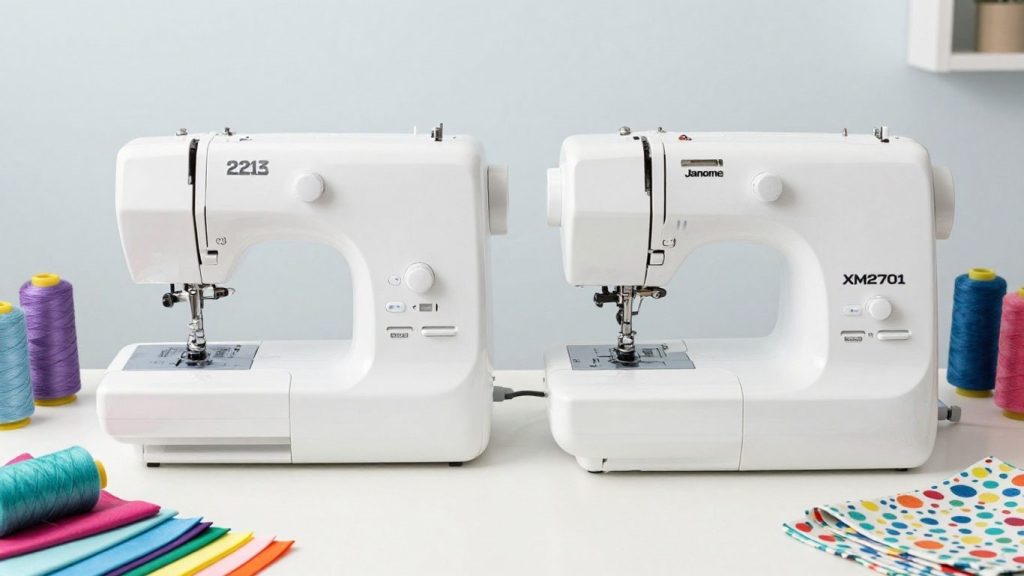
If you compare the Janome 2212 and Brother XM2701, they look quite similar—especially as a beginner. Both are generally regarded as solid entry-level machines, but I’ve noticed a few differences that could make one more suitable for you than the other.
Even though the Janome 2212 is a mechanical sewing machine, it feels much burlier overall. It offers 12 stitches (enough for most basic projects) and a four-step buttonhole. It’s easy to use, and I thought threading was fairly standard. It’s a machine that feels like it’s built for the long haul, with a glass front and a metal frame beneath that plastic casing.
Unlike the Brother XM2701, which features 27 built-in stitches — including decorative and a one-step buttonhole. This allows you a little more leeway if you want to try different stitch patterns in the future. It’s also generally lighter than the Janome, which is a big plus if you know you will be moving your machine around quite often.
Conclusion
So, after spending some quality time with the Janome 2212, I’m confident it’s a great choice for anyone who is getting started. It isn’t flashy, but it gets the job done. I had a couple of stumbling blocks with threading and an occasional jam, but once I figured things out, it went through pretty easily. The 12 built-in stitches should be plenty for any straight sewing project, and the machine feels solid for the price.
OK, it’s a bit loud and lacks all the bells and whistles on fancier models, but to tell you the truth, I didn’t miss them. If you want something reliable and cheap to learn on, I think the 2212 is worth considering. Just be prepared for a slight learning curve at first, but then again, that’s the case with most sewing machines.
All in all, I’d say it’s a decent deal for those getting into sewing and looking to minimise their initial costs. See how it stacks up against Janome’s full lineup in our best Janome sewing machines guide.
If you’re just starting your sewing journey, combining this machine with guides like how to learn sewing will help you progress faster.
Frequently Asked Questions
Is the Janome 2212 good for someone who has never sewn before?
Yes, I would say the Janome 2212 is a good option for a total beginner. It’s not too involved, and the instructions are reasonably straightforward. It makes the initial process for basic projects very easy. Also, it’s not too pricey, which is a nice way to dip your toes into sewing without breaking the bank.
What kinds of projects can I make with the Janome 2212?
From my experience, this machine is useful for most tasks of daily sewing. A seamstress is someone who can make clothes, home decor items like curtains or pillowcases, and do some basic quilting. It sews through different fabrics quite well, even thicker ones such as denim, which is useful for repairs or tough projects.
Does the Janome 2212 come with everything I need to start sewing?
When I received mine, it included a decent set of accessories. It also came with various presser feet for things like buttonholes and zippers, bobbins, needles, a seam ripper, and even a dust cover. And a screwdriver for maintenance. So, you can nearly sew straight out of the box.
Is it difficult to thread the Janome 2212?
I discovered that the Janome 2212 is very easy to thread. It doesn’t have one of those really fancy automatic needle threaders, so you do it manually. However, there’s a clear path for the thread, and I quickly got the hang of it. If you do encounter a thread jam, they are typically not too difficult to fix.
How many stitches does the Janome 2212 have, and are they useful?
This machine comes with 12 built-in stitches. Now that might not sound like much compared to some of those fancy machines, but I found that these 12 stitches are all I really need for most common sewing tasks. It even has an easy 4-step buttonhole maker, which is perfect for adding buttons to garments.
Is the Janome 2212 noisy when it’s running?
I won’t lie: It’s not the quietest machine I’ve ever used. It emits a slight humming sound. But I wouldn’t describe it as loud or disruptive. It’s more of a flat sewing machine thump than a noise that would disturb people in the next room.
Comparing Across Brands?
See how these stack up against other top brands:
Best Brother Sewing Machines · Best Singer Sewing Machines · Best Janome Sewing Machines · Brother vs. Singer · Best Sewing Machines for Beginners

4 Comments