SINGER HD500 vs Singer 4452 Comparison (2026) Features, Pros & Cons
I’ve been looking into sewing machines lately, and two models kept popping up: the SINGER HD500 and the Singer 4452. Both have ‘Heavy Duty’ in their names, which sounds promising, but after digging in, I’ve found they’re actually quite different. It’s not just about looks; their performance and what they’re best suited for really set them apart.
I wanted to break down the SINGER HD500 vs Singer 4452 comparison to help figure out which one might be the right fit for your sewing projects.
Key Takeaways
- The SINGER HD500 has a classic, retro look and is great for basic, everyday sewing tasks on lighter to medium fabrics. It’s straightforward to use, making it a good choice for beginners or those who like a simple, mechanical machine.
- The Singer 4452 is built for speed and power, handling heavier materials like denim and canvas with more ease thanks to its stronger motor. It’s more of a workhorse machine.
- While both are labeled ‘Heavy Duty,’ the HD500 focuses more on aesthetics and ease for simple projects, whereas the 4452 prioritizes getting through tougher jobs quickly.
- The HD500 might feel a bit light, and its instructions can be picture-heavy, which could be tricky for absolute beginners. It also lacks advanced features like automatic buttonholes.
- The Singer 4452, though less stylish, is known for its robust performance on thick fabrics and faster sewing speed, though some users find it can be a bit noisy.
Introduction: Understanding the SINGER HD500 and Singer 4452
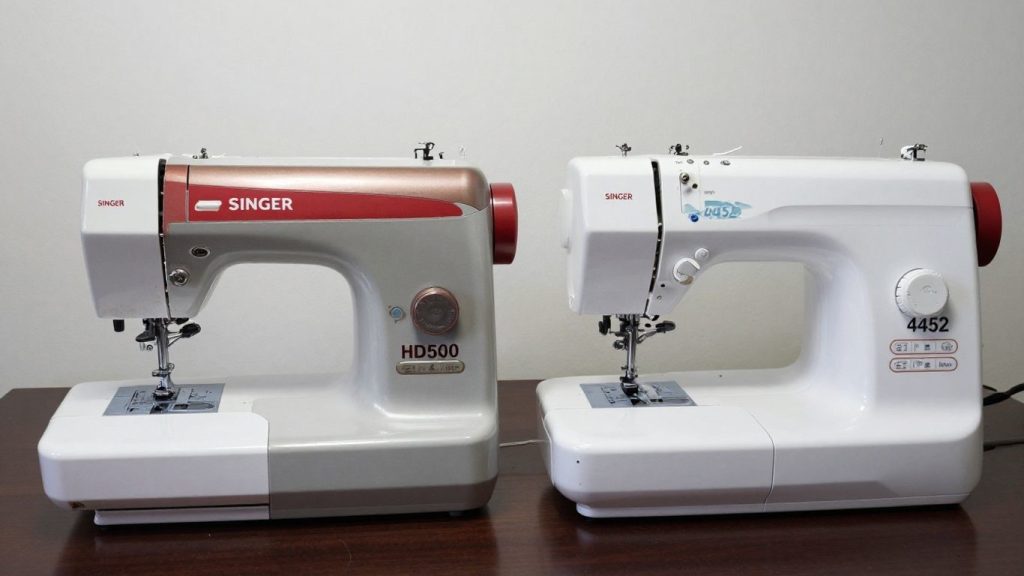
When I began researching sewing machines, two in particular continued to pop up: the Singer HD500 and the Singer 4452. Well, both of them have “Heavy Duty” in their name, which has to be good news, no? But after spending some time with them, I came to realize they are actually very different beasts from one another, despite both hailing from Singer. It’s kind of like comparing a classic car to a modern sports car — they’ll both get you places, but in very different styles.
I’ve been sewing up a storm and trying to know which of these two popular “heavy-duty” models might be the best match for different people. I love how this Singer HD500 has that cool retro look. It seems like a throwback, a simple, uncomplicated machine. It’s definitely got the charm, and for everyday sewing tasks, it seems capable enough. But when you’re talking about heavier fabrics or wanting them to go a little faster, that’s where it gets exciting.
The Singer 4452, on the other hand, seems made for speed and power. It’s what I hear is a machine that can chug through thicker materials like denim or canvas without much fuss, thanks to a beefier motor. It may lack the vintage appeal of the HD500, but if your priority is simply pumping out projects at a faster clip compared with others, particularly for more material-heavy builds, it sounds like it packs an advantage.
Having said this, it is clear that this Singer Heavy Duty vs Professional sewing machine comparison boils down to understanding those core differences. So let’s compare what both of these Singer sewing machines have to offer so you can determine which Singer HD500 vs 4452 sewing machine is for you.
When I began researching sewing machines, two in particular continued to pop up: the Singer HD500 and the Singer 4452. Both are often mentioned alongside beginner-friendly models like the Brother CS7000X review and Brother CS7205 review, but they serve a slightly different purpose.
Key Features at a Glance: Singer HD500 vs. Singer 4452
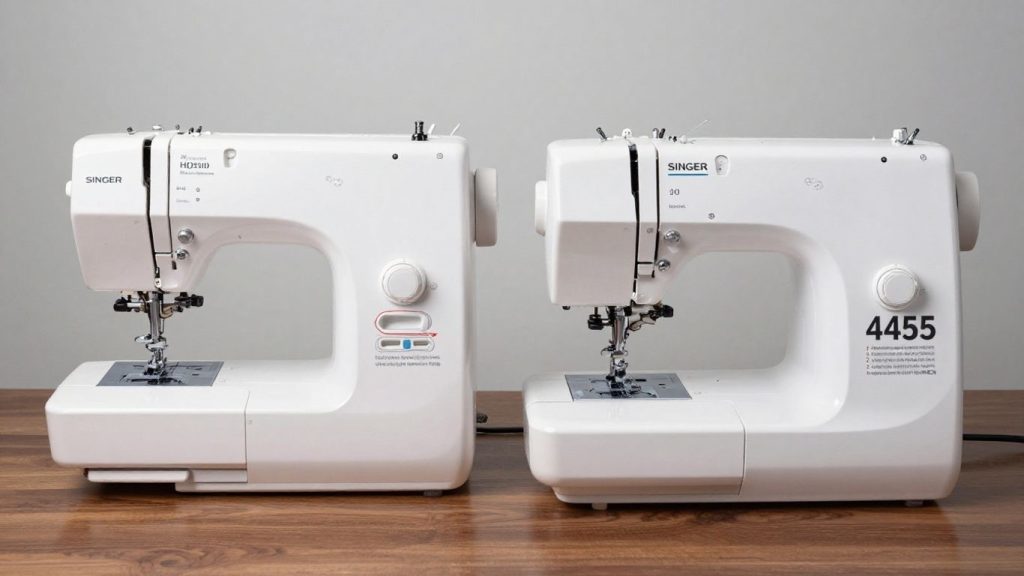
When I look at these two machines side-by-side, it’s clear that Singer designed them with different sewers in mind. It’s not just about looks, though that’s a big part of it. Let’s break down what really sets them apart.
Stitch Options and Capabilities
SINGER HD500 This one is quite simple. It offers you a good range of basic stitches, handy for weekly mending, simple garment construction, or home decor projects. Think straight stitches, zigzags, and perhaps a few decorative ones. It’s not attempting to be a computerized wonder with hundreds of stitch patterns.
The Singer 4452, however, has a bit more variety. It is not technically a super-advanced machine, but it does usually include more stitch options than the HD500 – often some utility stitches that can be very useful for certain tasks. It’s geared to run a wider variety of projects without requiring a specialized machine.
The HD500 is simple and works well for basic sewing. If you’re still learning stitches or machine setup, guides like how to thread a sewing machine and sewing machine parts explained can help.
Motor Power and Speed
This is where the “Heavy Duty” name begins to earn its keep. SINGER HD500, A motor sufficient for most home sewing. It functions well, but for lighter fabrics, it’s all good.
But the Singer 4452 has a more powerful motor. This added oomph enables it to power through heavier materials like denim, canvas, or even several layers of fabric with relative ease. I have found the 4452 to power through and keep up where the HD500 would sometimes struggle when working with tougher stuff. That also means faster sewing speed, which is a definite time-saver if you have a ton of sewing to finish.
The 4452 clearly dominates here. If you’re planning heavy-duty projects or even comparing machines deeply, check out Singer 4452 heavy duty sewing machine review for a full breakdown.
Build Quality and Durability
With retro looks, the HD500 has some charm about it too and feels reassuringly solid for what is really a fairly simple purpose. It has that classic style that some people absolutely love. But looking at its internals and what it is built with, it lacks that same muscle-down-the-field feel as the 4452.
The Singer 4452 is, as its “Heavy Duty” moniker implies, typically constructed with a metal frame and parts made to endure and hold up to greater use. It handles like a workhorse, made to withstand the rigors of many projects that would break an ordinary machine. If you’re looking for something that can take a beating and keep on sewing, the 4452 also has the upper hand here. It’s the sort of machine you’d find in a sewing class or small alteration shop.
The Singer 4452 is built more like machines you’d see in professional-level reviews such as Janome MC6650 review, which focus on durability and heavy use.
Ease of Use and User-Friendliness
The SINGER HD500 is often the best for beginners. Simpler stitch selection means less confusion, and getting started is often relatively(hardly) big. The manual is a little bit picture-heavy, but it does manage to walk you through the basics without too much fuss. It’s a sewing machine that allows you to get right into the actual sewing without having to get wrapped up in complicated settings.
The Singer 4452 is also user-friendly but may need just a tad more focus as it has slightly more varied stitch options and runs at a higher speed. Some users say it’s a little noisier than the HD500, which you may want to consider if you work in a shared space. But its direct operation allows you to often jump straight into sewing without a steep learning curve, at least for basic tasks. You’ll love how it works on tougher fabrics, too. For people who are working on projects like sewing leather, the power of the 4452 is a distinct benefit.
If you’re a beginner, you should also explore sewing kits for beginners to get started easily with either machine.
Here’s a quick rundown:
- Singer HD500: Simpler controls, fewer stitch options, good for beginners and basic tasks.
- Singer 4452: More stitch variety, powerful motor, faster speed, better for heavier fabrics, and more varied projects.
- Both: Reliable Singer brand, suitable for home use, though the 4452 leans more towards demanding tasks.
SINGER HD500: Pros and Cons
I was first attracted to the Singer HD500 for its classic, retro styling. It really does have a nice aesthetic; it looks good sitting on my sewing table. But once you past the looks, it was actually a pretty good little machine for basic sewing tasks. For simple projects such as creating a tote bag or hemming pants, it gets the job done with little fuss. Because it’s a mechanical machine, I never had to navigate complex computer menus, which I appreciated. It seems to me like a solid workhorse for someone new to sewing, or someone who primarily does basic sewing.
On stable woven fabrics, the stitch quality is generally neat and uniform. I didn’t run into too many thread nests or skipped stitches, which is always a good thing. It did a pretty good job on my cotton and linen tests, and the default tension settings were most often correct. From a regular sewing perspective, I believe that the quality of stitches is just perfectly fine.
For simple DIY projects like bags or home decor, the HD500 works great. You can explore creative ideas like macrame wall hanging patterns or small decor upgrades like window treatment ideas.
Here’s a quick rundown of what I found:
Pros:
- Attractive vintage design.
- Simple, mechanical operation – no complex menus.
- Good stitch quality on stable fabrics.
- Reliable for basic sewing tasks and straight stitching.
- Decent for beginners or casual sewers.
Cons:
- Lighter build materials compared to some heavy-duty models.
- The instruction manual could be more detailed.
- Limited decorative stitch options.
- May struggle with very thick or multiple layers of fabric.
- No automatic needle threader.
Now, the HD500 does its job well for what it’s designed to do; however, I found it relatively basic in a good way that some might consider as just not having features that more advanced machines cater towards seasoned sewers. While it’s a good starting point, don’t anticipate that every complex task thrown its way will be done automatically.
But if you love its old-school vibes, and you are looking for such a basic model to use for your daily projects, the Singer HD500 is definitely worth considering. For basic needs, it’s a machine that gets the job done, and ease of use is a clear bonus for beginners. But if your projects are more complicated or you just want better features, there are other options out there.
Singer 4452: Pros and Cons
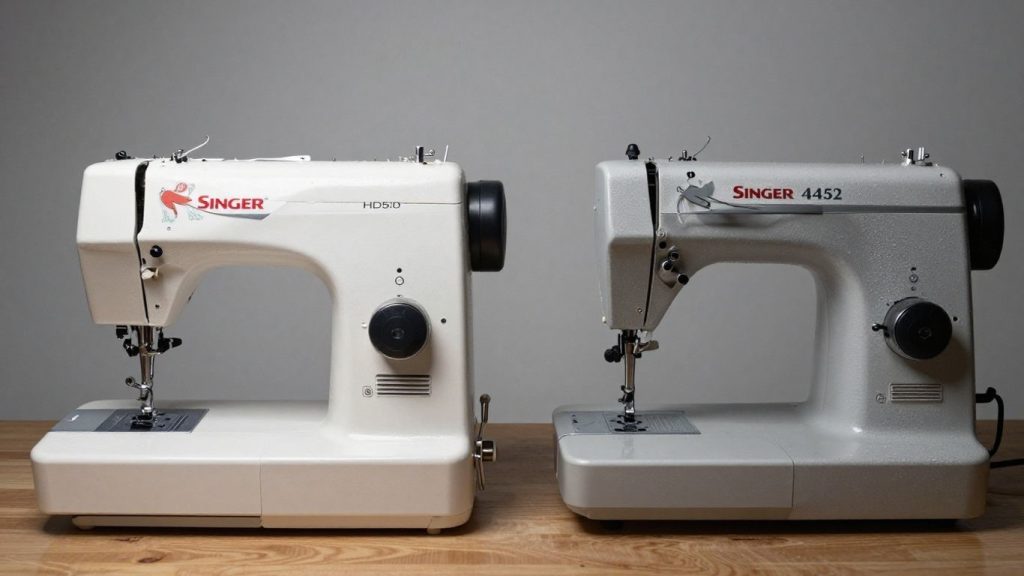
When I look at Singer 4452, I see a machine that’s quite sturdy for what it is. This is certainly an upgrade over most of those super-cost-cutting models, and I appreciate that. Because of this, it sits well on the table, combined with a heavy-duty metal frame that gives it a good heft, so it doesn’t feel like it’s about to shimmy across the table when I’m pushing hard. That’s a big plus for me.
The Singer 4452 shines when working on heavier materials. It’s a better fit for serious sewing projects, similar to machines reviewed in Brother SE2000 review or Janome JW8100 review.
Here’s a quick rundown of what I’ve found good and not-so-good:
Pros
- High Sewing Speed (1,100 stitches per minute)
Helps complete projects faster, especially useful for bulk sewing or heavy fabrics like denim and canvas. - Strong Motor for Thick Fabrics
Powerful motor allows smooth stitching through multiple layers, leather, upholstery, and other heavy materials. - Durable Metal Frame
Heavy-duty interior frame provides stability and reduces vibration during high-speed sewing. - 32 Built-in Stitches
Includes essential, decorative, and stretch stitches suitable for beginners and intermediate users. - Easy to Use for Beginners
Simple controls, an automatic needle threader, and adjustable stitch length make it beginner-friendly.
Cons
- Limited Advanced Features
Lacks computerized functions, LCD screen, and advanced customization options found in higher-end machines. - Can Be Noisy at High Speed
The powerful motor may produce noticeable noise when sewing at maximum speed. - Basic Lighting
Built-in light may not be bright enough for detailed or nighttime sewing projects.
I’ve come to realize that although the Singer 4452 is marketed as heavy-duty, using the appropriate needles and thread for bulkier fabrics makes a difference. But attempting to push it through something too thick without the proper configuration can cause skipped stitches or worse. It’s a workhorse, but it’s not invulnerable.
In the final analysis, my Singer 4452 review shows that this is a reliable machine for most home sewing jobs. It’s not the most glamorous machine around, but it does what you need without too much fuss. The pros and cons list for the Singer 4452 points to a pretty capable machine that is easy on the wallet, too. If you’re interested, here’s some more information about this Singer 4452 Heavy Duty Sewing Machine.
Who is Each Machine Best For?
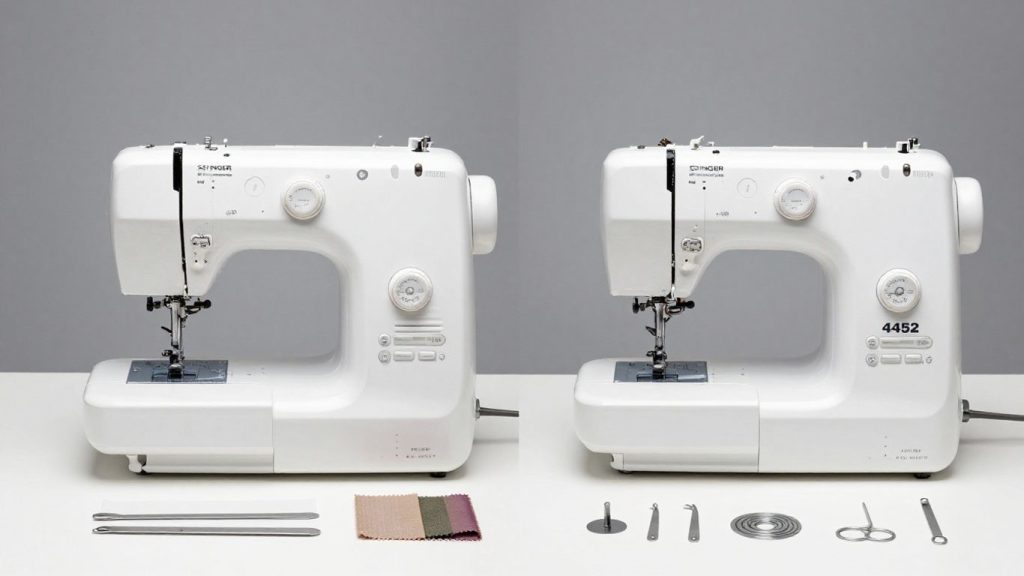
Deciding between the SINGER HD500 and the Singer 4452 really comes down to what kind of sewing you plan to do and how much you value extra features versus raw power and simplicity. I’ve spent a good amount of time with both, and they definitely cater to different needs.
Ideal User for the SINGER HD500
In all honesty, the SINGER HD500 is a workhorse. If you need a machine that sails through the toughest fabrics without complaint, and doesn’t get too bogged down with fancy stitch patterns, make this your machine. Think of it as a dependable workhorse; it can get it done, particularly if the job involves denim, canvas, or several layers of fabric. I thought it was so stable, weeping really nicely when you.
- Beginners who seek a durable, no-fuss machine: If you’re just starting and want something that won’t devastate your budget or break down easily, the HD500 is a solid choice. It’s easy to use, and its robust construction means it can take a hard knock or two.
- Home sewers taking on more serious projects: If you’re sewing curtains, reupholstering a chair, or sewing the kind of heavy garment fabrics that can make most home machines sputter, the HD500’s got the motor muscle for it. I was impressed by how it tackled multiple layers of denim.
- For those who like mechanical simplicity: If complex computerized settings make you break out in a sweat, the mechanical nature of the HD500 feels downright refreshing. It’s pure direct control and trustworthy performance.
The HD500 is a heavy-duty workhorse designed for easy sewing and reliability. It does less decorative stitching and more getting through tough jobs consistently.
If you’re into simple home projects or decorating spaces, you might also like ideas such as small apartment ideas or reading nook ideas where sewing projects can be useful.
Ideal User for the Singer 4452
The Singer 4452, however, has a little more pizzazz and adaptability. Although that heavy-duty sewing capability remains, this one adds more stitching options to the mix. This makes it a really good option if you want a serious sewing machine, but also one that gives you the opportunity to get more creative with decorative stitches or types of buttonholes. It’s like the truck that can, but with a few more creature comforts or options for different topographies.
- Intermediate sewers who want more choice: If you’ve outgrown a basic machine and plan to experiment with different fabrics or decorative effects, the 4452 is a solid step up. The additional stitches unlock a more creative range.
- Sewists who need a bit of power and variety: You get the heavy-duty motor and metal skeleton for durability, but you also get more stitch options, including all those super-handy stretch stitches for knit fabrics. This, in turn, allows for the adaptability of a larger scope of projects.”
- For anyone who would appreciate a helpful accessory: The addition of an even-feed walking foot is really nice for sewing multiple layers or difficult fabrics, like knits. It really assists with even feeding of the fabric, which I found very helpful when working on a quilt project. You can read about accessories for heavy-duty machines here.
If I’m doing basic repairs or working with thicker stuff, the HD500 is my go-to in the end. But for adding a little decorative flair or making other kinds of fabrics with more stitch options, the Singer 4452 would be my go-to. It’s a sturdy unit that delivers the essential and then some without getting too complicated.
If you’re moving into more advanced or heavy-duty sewing, it’s worth understanding machine differences like serger vs sewing machine or even surjeteuse vs machine à coudre for broader knowledge.
So, Which One Should You Pick?
Having spent a little time with both the Singer HD500 and the Singer 4452, I see where folks get confused. They both say ‘Heavy Duty’ in their name, but they serve very different purposes. With a cool retro style, the HD500 is a looker and does quite well for day-to-day sewing tasks and lighter fabrics.
When you want to get started, it’s nice that it’s easy to use. In contrast, the 4452 is a proper workhorse. It’s designed for speed and tackles heavier fabrics like denim or canvas without batting an eye. If I’m working on a more difficult project or need to sew up a ton of stuff in short order, I would probably turn to the 4452. For me, it very much has to do with the garment you are sewing. If the vintage aesthetic appeals to you and you mainly make basic projects, the HD500 is a good option. But if you want power and speed on heavier fabrics, the 4452 is your machine.
Also, if you’re building a full sewing setup at home, don’t forget essentials like the best sewing box to organize your tools.
Frequently Asked Questions
Is the Singer HD500 good for beginners?
Yes, the Singer HD500 is very user-friendly for me. It has an easy way to select stitches and doesn’t throw a bunch of complicated features at you. For a beginner, I think it was nice to learn several basics without being very frustrated. It doesn’t take very long to get started with sewing!
Can the Singer HD500 handle thicker fabrics?
I have used HD500 on other substrates, and it generally performs very well. It’s classified as a ‘Heavy Duty’ machine, so it can certainly sew heavier fabrics like denim or canvas. It also does well with lighter materials, though I have to tweak the tension a few times for an optimal stitch.
What makes the Singer 4452 stand out?
The Singer 4452 excels at speed and power. I’ve read it recommended for sewing through thicker materials like denim or canvas gracefully, because of its stronger motor. It feels designed for speedy project making, particularly if you’re sewing through heavier fabrics.
Are the Singer HD500 and 4452 very different?
They’re both Singer “Heavy Duty” machines, but they have a different philosophy when it comes to sewing. The HD500 is a cool, retro-looking machine that is excellent for basic, everyday sewing. That said, the 4452 is built for raw speed and power, so the machine will be more suited for thicker materials that you want to get done quickly.
What are the main pros and cons of the Singer HD500?
The HD500 has that heady feeling of durability to it, and its clean operation; it does what it’s supposed to do without issue. And that old-school aesthetic is a sweet bonus! On the minus side, the instruction manual could be clearer; it lacks advanced computerized features. It could also have difficulty with very thick material.
What accessories come with the Singer 4452?
The Singer 4452 is generally equipped with a decent range of accessories. As I recall, it contained stuff such as an all-purpose foot, zipper foot, buttonhole foot, button sewing foot, even feed (walking) foot, and nonstick foot. It also usually includes needles, bobbins, and other useful tools.